
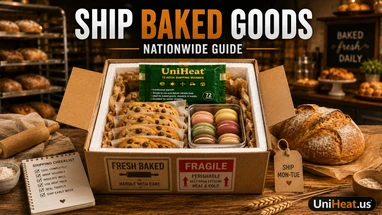
Posted by UniHeatPacks on 3rd Aug 2026
How to Ship Baked Goods, Cakes & Cookies Nationwide (2026)
Shipping baked goods successfully has three competing demands: preserving freshness (which fights time and moisture loss), preventing structural damage (which fights carrier handling), and managing temperature (which fights both winter freeze damage and summer heat softening). Home bakers, small bakery businesses, and specialty food brands ship baked goods nationwide every day — from wedding cakes to cookie subscription boxes to artisan bread. Getting it right requires understanding which product categories tolerate shipping well, which don't, and how packaging design and shipping strategy interact. This guide walks through the complete framework: product-by-product shipping suitability, packaging design, freshness preservation, freeze prevention, and carrier selection — building on the broader food shipping framework we've developed across our cold-weather shipping resource center.
The Short Answer: Match Product to Shipping Suitability
The first question isn't how to ship baked goods — it's whether your specific baked good should be shipped at all. Some products travel remarkably well; others simply don't tolerate the parcel network. Understanding your product's suitability drives everything else.
Ship easily: Cookies (unfrosted), brownies, bar cookies, sturdy quick breads, biscotti, granola, dry mixes, chocolate-covered items in winter, artisan breads with 2-3 day shelf life.
Ship with care: Frosted cookies, cupcakes with buttercream, cake pops, macarons (with correct packaging), cinnamon rolls, delicate pastries, some breads.
Ship only with expert setup: Full decorated cakes, wedding cakes, cream-filled pastries, extremely delicate items like sugar decorations, custom items with intricate work.
Don't ship: Items requiring true refrigeration (fresh cream fillings without additional cold chain), items with less than 24-hour freshness window (fresh-glazed donuts), or products where transit time exceeds shelf life.
For products that fall in the middle categories, the packaging and shipping strategy matters enormously. The rest of this guide walks through what actually works — building on the food shipping framework in our foundational piece on heat packs for food shipping.
Product-by-Product Shipping Guide
Cookies (Drop, Bar, Cutout)
Cookies are the easiest baked good to ship. Unfrosted cookies handle 5-7 day transit windows without significant quality loss. Structural integrity is the main concern — cookies break if boxes are dropped or crushed. Layered packaging with parchment or wax paper between rows prevents breakage. Standard corrugated boxes with adequate padding on all sides work for most cookies.
Sturdy cookies (chocolate chip, oatmeal, sugar cookies) travel best. Delicate cookies (thin lace cookies, tuiles, springerle) require additional cushioning. Bar cookies and brownies actually travel better than drop cookies due to their solid structure.
Frosted & Decorated Cookies
Frosted cookies require more careful handling. Buttercream frosting softens above 75°F and melts above 90°F. Royal icing dries harder but can crack under impact. Sugar-based decorations chip easily. Winter frosted cookie shipping needs heat pack protection to prevent freeze damage; summer shipping needs gel pack cooling in extreme heat to prevent softening.
Package frosted cookies with the decorated side up, in individual cavities that prevent movement, with adequate top clearance to prevent decoration contact with box top. Wax paper barriers between rows if stacked.
Brownies & Bar Cookies
Among the best baked goods for shipping. Solid structure resists breakage. Modest moisture content (drier than cake) prevents mold. Shelf life of 5-10 days for most recipes. Simple packaging works: parchment-lined box with brownies in single layer, or layered with parchment between rows.
Fudgy brownies with high moisture content need slightly more attention to airflow (to prevent condensation) and slightly warmer temperature protection (they can freeze more solid).
Cakes (Non-Decorated)
Plain loaf cakes, bundt cakes, and undecorated layer cakes ship reasonably well. Structural integrity is good if the cake is fully baked and cooled. Wrap in parchment or plastic wrap, then in a rigid inner box, then in an outer box with cushioning. Winter shipping needs heat pack protection to prevent freeze damage; sponge cakes particularly sensitive to freeze/thaw texture change.
Frosted & Decorated Cakes
The hardest baked good to ship. Decorated cakes require custom cavity packaging (cake board on bottom, tall corrugated collar around cake, dome or lid above with clearance). Every millimeter of movement risks decoration damage. Fondant is more shipping-durable than buttercream but has its own challenges (temperature sensitivity, humidity issues, cracking at low temperatures).
For decorated cake shipping, per-shipment costs run $50-150 for materials plus premium overnight shipping. Many decorated cake bakeries limit shipping to regional destinations (drivable within 24-48 hours) to reduce risk. Wedding cake shipping specifically often uses partial-transport-plus-assembly models where the components ship separately and assembly happens at destination.
Cupcakes
Cupcakes ship poorly. The combination of frosting on top (motion sensitive) and delicate cake structure (crush sensitive) makes cupcake shipping high-risk. Successful cupcake shipping requires custom cupcake cavity boxes (each cupcake in an individual well), airspace above each frosting swirl, and adequate outer padding. Even with all this, 5-10% breakage rate is common.
Many home bakeries offer cupcakes as local delivery or pickup only, avoiding the shipping risk. Businesses that do ship cupcakes typically charge premium prices to offset breakage and replacement.
Muffins
Similar to cupcakes but slightly easier due to typically un-frosted tops. Package in individual cavity boxes or with sufficient parchment between muffins. Prone to moisture loss during shipping if not wrapped adequately.
Artisan & Sourdough Bread
Fresh artisan breads have 3-5 day peak freshness windows. Shipping timing matters — bread baked Sunday for Monday shipping delivers Tuesday-Wednesday, giving the customer 2-3 days of freshness. Bread baked Wednesday for shipping doesn't work — by delivery Friday, the bread has passed peak freshness.
Package artisan breads in paper (not plastic, which traps moisture and causes soggy crusts) inside a corrugated box with adequate airflow. Winter shipping needs heat pack protection (bread freezes rapidly and thaws with texture damage).
Quick Breads (Banana, Pumpkin, Zucchini)
Quick breads travel better than yeast breads due to firmer structure and higher moisture retention. Shelf life of 5-7 days at room temperature makes them well-suited to shipping. Wrap in plastic or foil, place in corrugated box with padding. Simple and reliable shipping category.
Bagels
Bagels ship well due to dense structure. Traditional New York bagels have shipped nationwide for decades as a specialty category. Bagels benefit from same-day baking and shipping for best quality. Simple corrugated packaging works. Best consumed within 3-4 days of baking.
Cinnamon Rolls & Sweet Rolls
Ship well when packaged correctly. Rolls should be individually separated (parchment or waxed liners) to prevent frosting-to-frosting contact. Winter shipping needs heat pack protection for iced products. Best consumed within 3-5 days.
Pies
Fruit pies with firm fillings (apple, cherry, blueberry) ship reasonably well when properly boxed. Custard-based pies (pumpkin, pecan, key lime) are more challenging — the filling is soft and prone to shifting during transit. Cream pies are essentially not shippable without cold chain infrastructure. Winter shipping needs heat pack protection for pies with delicate crusts.
Cheesecakes
Cheesecakes ship if they're transported frozen (using the framework in our piece on how to ship frozen meat & food overnight) or refrigerated with proper cold chain. Traditional cheesecake shipping treats them as frozen products, arriving frozen and thawing at customer destination.
Macarons
Macarons are delicate but ship successfully with correct packaging. Individual cavity boxes (like cupcake boxes but sized for macarons) prevent contact between shells and preserve the delicate structure. Winter shipping needs heat pack protection; humidity can also affect macaron texture. Best consumed within 5-7 days of shipping.
Cake Pops
Cake pops ship in individual cavity trays with adequate top clearance. The stick position needs consideration (sticks should not touch box top). Coating (chocolate or candy melt) is temperature-sensitive and needs winter freeze protection or summer heat protection.
The Fresh-Baked Timeline
Understanding baked goods freshness is critical to shipping strategy. Different products have different freshness windows:
| Product | Peak Freshness | Acceptable Shelf | Ship-By Guideline |
|---|---|---|---|
| Fresh donuts | Same day | 1-2 days | Not shippable |
| Cream pastries | 1 day | 2-3 days | Overnight only |
| Artisan bread | 1-2 days | 3-5 days | Overnight preferred |
| Bagels | 1-2 days | 3-4 days | Overnight or 2-day |
| Cinnamon rolls | 1-2 days | 3-5 days | Overnight or 2-day |
| Frosted cakes | 2-3 days | 5-7 days | 2-day acceptable |
| Cupcakes | 1-2 days | 3-5 days | Overnight strongly preferred |
| Cookies (soft) | 2-4 days | 7-10 days | 2-day or 3-day fine |
| Cookies (crisp) | 3-5 days | 10-14 days | Standard ground service fine |
| Brownies & bars | 3-5 days | 7-14 days | Standard ground service fine |
| Quick breads | 3-5 days | 7-10 days | Standard ground service fine |
| Biscotti & dry items | Weeks | 1-3 months | Any service |
The freshness timeline drives carrier service selection. Products with 1-2 day peak freshness need overnight service. Products with 5-14 day shelf life can use standard ground service. Matching carrier speed to freshness window controls shipping cost.
Winter Baked Goods Shipping
Winter shipping adds freeze protection concerns to the standard freshness/structural challenges. Different products have different freeze sensitivities:
Products Highly Sensitive to Freeze Damage
- Frosted cakes and cookies — buttercream cracks and separates on freeze/thaw; royal icing may crack; fondant is more freeze-tolerant but still susceptible
- Decorated cakes — sugar decorations, gum paste flowers, and fondant work can all crack
- Cream-filled products — cream fillings separate on thaw
- Cupcakes — combination of frosting and cake sensitivity
Products Moderately Sensitive
- Artisan breads — freeze/thaw affects texture, particularly crumb structure
- Frosted brownies — frosting damage possible
- Cinnamon rolls — icing damage possible
- Cheesecakes (if shipped as fresh, not frozen)
Products Well-Tolerant of Cold
- Plain cookies — texture may soften slightly but generally acceptable
- Brownies and bar cookies — solid structure resists freeze damage
- Biscotti and dry items — effectively immune to freeze damage
- Quick breads (unfrosted) — typically fine after gentle warming
Winter Configuration
For sensitive products, use standard SMB cold-weather shipping configuration: 1.5″ EPS foam insulation liner inside the corrugated box, 72-hour heat pack, buffer materials between pack and product, ship Monday-Wednesday only. For premium decorated products or cold-zone destinations, upgrade to 96-hour heat packs. The framework parallels our piece on specialty food and chocolate shipping in cold weather. Bulk pack purchasing available for 40-hour, 72-hour, and 96-hour options. For a complete cross-reference of freeze thresholds by baked good, see our cold-weather shipping protection reference table.
The Frost/Bloom Issue for Chocolate-Containing Items
Chocolate-covered cookies, chocolate frosting, and chocolate decorations are all subject to fat bloom at 50°F and below. This is cosmetic damage rather than food safety, but for premium products it ruins customer experience. The freeze point data for chocolate is in our recent piece on complete freezing points reference for shipped products.
Summer Baked Goods Shipping
Summer shipping has different challenges. Heat softens frosting, melts chocolate, and accelerates moisture loss. Products particularly vulnerable to summer conditions:
- Buttercream-frosted items — buttercream softens above 75°F, melts above 90°F
- Chocolate-covered items — chocolate melts above 85°F
- Cream-filled items — cream fillings destabilize in heat
- Anything with visible decorative work — decorative elements can slip, sag, or melt
Summer Configuration
For heat-sensitive products, use insulation plus gel packs for shipments through hot hubs (temperatures above 85°F) or to hot destinations. Standard configuration: 1.5″ EPS foam liner + 2-3 pre-conditioned gel packs + FedEx Priority Overnight. Ship Monday-Tuesday only. The framework parallels our piece on gel packs vs heat packs, applied to bakery-specific requirements.
Packaging Design for Baked Goods
The Layered Approach
Successful baked goods packaging uses a layered approach with each layer serving a specific function:
- Product contact layer — parchment paper, wax paper, or food-safe cellophane in direct contact with the baked good
- Freshness liner — often a food-safe cellophane bag or specialized freshness bag that retains moisture without trapping condensation
- Inner container — sturdy inner box, cavity insert, or fitted container that prevents movement
- Buffer material — kraft paper, tissue paper, or bubble wrap around the inner container
- Insulation (winter/summer extremes) — 1.5″ EPS foam liner
- Heat pack or gel pack — placed on top of insulation, not in direct contact with product
- Outer corrugated box — adequately sized with clearance on all sides
For box selection and buffer material framework, see our pieces on choosing the right box size and insulation for heat packs and top 3 packing materials to pair with heat packs. For determining how many packs a larger box needs, see how many heat packs you really need per box. Container selection framework in our recent piece on insulated shipping containers: types, sizes & selection guide.
Cavity Inserts and Custom Fittings
For cupcakes, macarons, cake pops, and other products with vulnerable decoration, cavity inserts prevent product-to-product contact and product-to-box contact. Cavity inserts can be:
- Molded pulp inserts (biodegradable, custom-sized)
- Corrugated cavity dividers
- Foam cavity inserts (for premium applications)
- Custom die-cut plastic inserts
Freshness Preservation Techniques
Beyond structural packaging, several techniques preserve freshness during transit:
- Oxygen absorbers — small packets that prevent staling and oxidation
- Silica gel — controls humidity for products where moisture control matters
- Vacuum sealing — for products where oxygen exposure accelerates staling
- Freshness bags — specialized packaging that regulates moisture and gas exchange
Labeling and Presentation
Baked goods shipping benefits from professional labeling for freshness handling:
- "Perishable" designation on outer box
- "Fresh Baked Goods" or "Handle With Care" labels
- "Best By" date if applicable
- Storage instructions for customer
Carrier Selection for Baked Goods
USPS Priority Mail
USPS Priority Mail works for baked goods with 5-14 day shelf life. Two-to-three-day delivery for most US destinations. Standard rates apply. USPS handles baked goods reliably though handling is rougher than premium carriers.
USPS Priority Mail Express
Overnight service for time-sensitive items. Higher cost but preserves freshness for products with tight windows. Best for fresh breads, delicate pastries, or high-value decorated items.
FedEx
FedEx offers Ground (2-5 days), 2-Day, and Priority Overnight service. Better handling reliability than USPS in general. Priority Overnight strongly recommended for winter shipping of sensitive baked goods.
UPS
Similar service tiers to FedEx. Comparable pricing and reliability. Some regional preferences based on your origin location.
Regional Considerations
For destinations within 1-2 day ground distance from origin, ground service works well for shelf-stable items. For cross-country shipments, overnight service is typically necessary to maintain freshness. Framework in our piece on route package protection.
Cost Analysis for Baked Goods Shipping
| Component | Cost per Shipment |
|---|---|
| Product contact paper (parchment/wax) | $0.25-0.75 |
| Freshness liner/bag | $0.50-1.50 |
| Inner container or cavity insert | $1-3 |
| Buffer materials | $0.50-2 |
| EPS foam liner (winter/summer) | $4-8 |
| Heat pack or gel pack (seasonal) | $3-8 |
| Outer corrugated box | $2-4 |
| Labels and marketing materials | $0.50-2 |
| Carrier service (varies by speed) | $8-45 |
| Total per shipment | $20-75 |
Simple products with ground service run $18-30 all-in. Premium products with overnight service and full cold-weather protection run $50-75 all-in. Decorated cakes with premium packaging and overnight service can exceed $100 per shipment.
The economic implication: baked goods DTC brands typically price shipping into product cost or use flat-rate shipping fees. Free-shipping thresholds around $50-75 order value are common. The cost-vs-protection framework is in our piece on cost vs protection in heat pack usage.
Ship-Day Discipline for Baked Goods
Ship-day timing is critical for freshness-sensitive baked goods:
Monday-Tuesday Ship Days
For products with 3-5 day peak freshness, ship Monday or Tuesday. This ensures delivery Wednesday-Thursday with the product still in prime condition. Customers have the weekend to consume before staleness sets in.
Wednesday Acceptable for Longer-Shelf Items
Cookies, brownies, and quick breads with 5-10 day shelf life can ship Wednesday. Delivery Thursday-Friday still gives adequate consumption window.
Never Thursday or Friday for Freshness-Sensitive Items
Thursday or Friday shipping means potential weekend delays and Monday delivery at earliest. For freshness-sensitive items, this is problematic. Only ship Thursday-Friday if the item has extended shelf life (2+ weeks).
Weekend Shipping
Saturday delivery through USPS Priority Mail Express and FedEx Overnight is available. Costs more but preserves quality for tight-window items. Sunday and Monday delivery is standard for weekend-shipped items.
Ship-day discipline connects to the broader framework in our piece on how to reduce winter shipping losses.
Real Bakery Shipping Scenarios
Scenario 1: Home-Based Cookie Business (30 shipments/week)
Origin: Ohio. Product: assorted cookie boxes ($30 for 24 cookies). Route: nationwide. Configuration: 8″×8″×3″ corrugated box, parchment layers between cookies, freshness bag over stack, kraft paper buffer, 1.5″ EPS foam liner (winter only), 72-hour heat pack (winter), USPS Priority Mail. Ship Monday-Wednesday. Per-shipment cost: $12-18 (summer), $20-28 (winter). Breakage rate under 3%.
Scenario 2: Artisan Bread Bakery Subscription
Origin: California. Product: 2-loaf artisan bread subscription ($40). Route: nationwide. Configuration: 12″×10″×6″ box, breathable paper wrap around each loaf (not plastic), kraft paper filler, 1.5″ EPS foam liner (winter), 72-hour heat pack (winter), FedEx 2-Day. Ship Monday only. Per-shipment cost: $25-35. Loss rate under 5% (primarily freshness issues, not damage).
Scenario 3: Decorated Cake Delivery Service (Regional)
Origin: New York. Product: fully decorated custom cakes ($150-500). Route: East Coast only. Configuration: cake board bottom, tall corrugated collar, dome lid with clearance, cavity fillers, sturdy outer box, ice packs (summer) or heat packs (winter), FedEx Priority Overnight. Ship Monday-Tuesday only. Per-shipment cost: $50-90. Damage rate 3-8% (industry high but managed through insurance/replacement guarantee).
Scenario 4: Cinnamon Roll DTC Brand (150 shipments/week)
Origin: Kansas. Product: 6-pack of frosted cinnamon rolls ($35). Route: nationwide. Configuration: 10″×10″×4″ box, individual cavity inserts to separate rolls, freshness liner, 1.5″ EPS foam liner (winter), 72-hour heat pack (winter), FedEx 2-Day. Ship Monday-Tuesday. Per-shipment cost: $18-28. Loss rate under 4%.
Scenario 5: Cookie Subscription Box (500 shipments/week)
Origin: Illinois. Product: 24-cookie variety pack ($40). Route: nationwide. Configuration: 10″×10″×3″ box, layered cookies with parchment between rows, custom insert, EPS foam liner (winter), 72-hour heat pack (winter), USPS Priority Mail Express (winter Monday-Tuesday shipments), USPS Priority Mail (summer). Ship Monday-Wednesday. Per-shipment cost: $15-22 (summer), $22-30 (winter). Volume economics allow bulk purchasing of packs, boxes, and inserts.
Scenario 6: Macaron Specialty Shop (100 shipments/week)
Origin: San Francisco. Product: 12-piece macaron box ($35). Route: nationwide. Configuration: 6″×6″×3″ box, individual cavity insert (each macaron in its own well), freshness liner, 1.5″ EPS foam liner (winter), 72-hour heat pack (winter), FedEx Priority Overnight. Ship Monday-Tuesday. Per-shipment cost: $22-35. Breakage rate under 3% with proper cavity packaging. For pack duration matching to route length, see our resource on how long heat packs really last in transit. Choosing the right pack for macaron shipping specifically follows the framework in how to choose the right heat pack for your shipment. The interaction between insulation and pack performance is covered in heat pack vs insulation in cold shipping.
Common Baked Goods Shipping Mistakes
Six patterns that account for most baked goods shipping failures:
Mistake 1: Wrong ship day. Thursday or Friday shipping of freshness-sensitive items creates weekend delay risk. Monday-Tuesday shipping is the standard for time-sensitive baked goods. Similar principle to our piece on 5 common mistakes when using heat packs.
Mistake 2: Inadequate structural support. Baked goods without proper cavity inserts or buffer materials shift during transit and break. Loose products in oversized boxes cause the most damage.
Mistake 3: Wrong wrapping material. Plastic wrap traps moisture on artisan bread and causes soggy crust. Paper wrap that allows moisture escape works better. Match wrapping to product needs.
Mistake 4: Skipping winter heat pack protection. Frosted items, chocolate-covered items, and delicate baked goods all suffer freeze damage in winter transit without heat pack protection. The "food ships fine" assumption fails for decorated products.
Mistake 5: Overpackaging that suffocates. Sealing baked goods in airtight containers can accelerate mold growth on high-moisture products (breads, cakes). Airflow matters for some products.
Mistake 6: Ignoring seasonal transitions. Summer buttercream sag and winter frosting crack are opposite problems requiring opposite solutions. Framework in our piece on the complete fall-to-winter shipping transition guide.
Building a Baked Goods Shipping SOP
Pre-Ship SOP
- Verify ship day is Monday-Wednesday for freshness-sensitive products
- Weather check origin, hub, destination
- Confirm production timing (baked no more than 24 hours before shipping)
- Prepare correct packaging materials for product type
- Print labels including "Perishable" and freshness date
Pack-Out SOP
- Cool baked goods to room temperature before packing (prevents condensation)
- Wrap in product-appropriate contact material (parchment/wax paper/cellophane)
- Insert into freshness liner or bag
- Place in inner container or cavity insert
- Add buffer materials around inner container
- Add EPS foam liner in outer box (winter/summer extremes)
- Activate heat pack (winter) 20-30 minutes before pickup
- Place pack on top of insulation, not touching product
- Seal outer box
- Photo document pack-out for records
Post-Ship SOP
- Log tracking number and route metadata
- Send customer notification of shipment with expected delivery window
- Include unboxing/serving suggestions
- Track any customer-reported damage within 48 hours
- Documentation of successful deliveries for continuous improvement
For the broader operational framework, see our capstone piece on cold chain solutions for small businesses. For daily discipline, our resource on the winter shipping checklist for small businesses applies with baked goods-specific additions.
Regulatory Considerations for Baked Goods Shipping
Home bakery shipping has some regulatory considerations beyond standard food shipping:
Cottage Food Laws
Many US states have cottage food laws that allow home baking businesses to operate with limited regulation for certain product categories. Shelf-stable baked goods (cookies, breads, bar cookies) typically fall within cottage food allowances. Products requiring refrigeration (cream pies, cheesecakes, custard-filled items) typically require commercial licensing.
Interstate Shipping
Interstate shipping of home-baked goods has additional considerations. Some states restrict interstate sale of cottage food products. Verify destination state regulations for cottage food operators.
Labeling Requirements
Most jurisdictions require baked goods labels to include:
- Product name and description
- Producer name and contact information
- Ingredients list with allergen callouts
- Net weight
- Best-by or use-by date
Building a Baked Goods Shipping Business
Product Category Selection
For new bakery shipping operations, start with the most shippable product categories:
- Cookies (drop, cut-out, or bar cookies)
- Brownies and blondies
- Quick breads (banana, zucchini, pumpkin)
- Biscotti and dry items
- Granola and granola bars
Add more challenging categories (frosted products, decorated items, delicate pastries) as operational maturity grows.
Volume Scaling
Small operations (under 50 shipments/week) can execute with minimal specialized equipment. Larger operations benefit from:
- Bulk purchasing of boxes, cavity inserts, and packaging supplies
- Bulk purchasing of heat packs through our UniHeat shop
- Dedicated packing station with organized inventory
- Batch pack-out during production periods
- Carrier account relationships for volume discounts
Volume scaling framework in our piece on how to scale heat pack usage for higher volumes.
Customer Experience Considerations
Baked goods shipping is a premium DTC experience. Unboxing matters:
- Attractive outer packaging
- Branded inner box or wrapper
- Serving suggestions or care card
- Ingredient list and allergen info
- Follow-up feedback request
How Baked Goods Shipping Connects to Broader Food Shipping
Baked goods shipping fits within the broader SMB food cold chain framework. The same operational patterns — heat packs in winter, gel packs in summer, insulated containers, ship-day discipline — apply here with baked goods-specific adjustments for freshness and structural handling.
For the broader system view:
- Heat packs for food shipping — foundational food framework
- Insulated food delivery bags vs boxes — container selection for food
- Specialty food and chocolate shipping — premium food framework
- How to ship frozen meat & food overnight — frozen framework (for cheesecakes and frozen bakery items)
- Cold chain solutions for small business — complete SMB framework
For adjacent categories, our vertical guides on wine shipping (how to ship wine, beer & spirits in winter) and pharmaceutical shipping (pharmaceutical cold chain packaging for small businesses) show how the same SMB framework serves multiple verticals. For technology comparison across cooling options, see dry ice vs heat packs vs gel packs.
Highlights — The Baked Goods Shipping Reference Card
Frequently Asked Questions
How do you ship baked goods without them getting damaged?
The core framework: cushion products with parchment or wax paper for direct contact, use freshness liners or bags for moisture control, place products in cavity inserts or fitted inner containers to prevent motion, add kraft paper or bubble wrap buffer around the inner container, insulate with 1.5-inch EPS foam liner in winter or summer heat extremes, add a 72-hour heat pack in winter or gel packs in summer heat, and ship Monday-Tuesday only for freshness-sensitive items. Delicate items like cupcakes and macarons require individual cavity inserts to prevent decoration damage. Sturdy items like cookies and brownies need less specialized packaging but still benefit from parchment layers to prevent breakage.
How do you ship cookies without them breaking?
Package cookies in stacked rows with parchment paper between each row inside a fitted inner container. The container should have minimal empty space to prevent movement. Add kraft paper buffer around the container inside a snugly-sized outer box (8x8x3 inches for a standard dozen). Winter shipments should include a 72-hour heat pack. USPS Priority Mail works for cookies with 5-10 day shelf life; overnight service isn't typically needed. Breakage rates under 3% are achievable with this approach. Sturdy cookies (chocolate chip, oatmeal, sugar) travel better than delicate cookies (thin lace, tuiles, springerle) which need additional cushioning.
Can you ship a cake in the mail?
Yes, but the difficulty varies dramatically by cake type. Plain loaf cakes, bundt cakes, and undecorated layer cakes ship reasonably well with parchment wrap plus rigid inner box plus outer box with cushioning. Frosted cakes require more careful handling with cavity packaging that prevents any frosting-to-box contact. Fully decorated cakes are the hardest baked good to ship successfully; per-shipment costs run $50-150 for materials plus premium overnight shipping, and damage rates of 3-8% are common industry-wide. Wedding cakes are usually shipped as components with assembly at destination rather than as complete cakes. Winter shipping requires heat pack protection to prevent decoration cracking; summer shipping requires cooling to prevent frosting melt.
How long can baked goods be in transit before going stale?
Different baked goods have different peak freshness windows. Fresh donuts should not be shipped (1-2 day shelf life). Cream pastries need overnight service only. Artisan bread peaks at 1-2 days but is acceptable through 3-5 days. Bagels peak at 1-2 days and are acceptable through 3-4 days. Cinnamon rolls peak at 1-2 days and are acceptable through 3-5 days. Cookies (soft) peak at 2-4 days and are acceptable through 7-10 days. Cookies (crisp) peak at 3-5 days and are acceptable through 10-14 days. Brownies and bar cookies peak at 3-5 days and are acceptable through 7-14 days. Biscotti and dry items maintain quality for weeks. Match your shipping speed to your product's freshness window.
What packaging supplies do I need to ship baked goods?
Essential supplies include: corrugated outer boxes in appropriate sizes for your products (typically 6x6x3 to 12x10x6 for most items), parchment paper or wax paper for product contact, freshness liners or food-safe cellophane bags, cavity inserts for decorated or delicate items (available in molded pulp, corrugated, or plastic), kraft paper or bubble wrap for buffer material, EPS foam liners for winter/summer extreme conditions, 72-hour heat packs for winter shipping (available through our UniHeat shop), gel packs for extreme summer conditions, and labels for perishability marking. Home bakery operations can start with a small inventory and add specialized supplies as product mix expands.
Do baked goods need refrigeration during shipping?
Most baked goods do not require refrigeration during shipping. Cookies, brownies, quick breads, standard cakes, and most cinnamon rolls are shelf-stable at room temperature. Products that DO require refrigeration during shipping include cream-filled pastries, cheesecakes, some custard pies, and cakes with dairy-based fillings. For these products, the shipping framework becomes cold chain shipping using gel packs and insulated containers, similar to other refrigerated food shipping. Some bakers freeze cheesecakes and ship them frozen using dry ice or sub-zero gel packs; the cheesecake thaws during transit and arrives ready to serve.
What's the best shipping carrier for baked goods?
Choose based on freshness window and destination. USPS Priority Mail (2-3 day delivery) works well for products with 5-14 day shelf life at reasonable cost. USPS Priority Mail Express (overnight) or FedEx Priority Overnight are best for time-sensitive items like fresh bread, delicate pastries, or decorated cakes. FedEx Ground works for 5-day delivery of longer-shelf-life items. UPS offers comparable services. USPS handling is rougher than premium carriers but adequate for most sturdy baked goods. Winter shipping benefits from FedEx over USPS due to better handling and more reliable overnight delivery.
Can I sell baked goods online and ship them from home?
Yes, many home-based bakers ship baked goods successfully. Most US states have cottage food laws that allow home baking businesses to operate with limited regulation for shelf-stable products (cookies, breads, bar cookies). Products requiring refrigeration (cream pies, cheesecakes) typically require commercial licensing. Cottage food laws vary by state; some allow interstate shipping while others restrict to in-state sales. Verify your state's cottage food regulations and any restrictions on interstate shipping. Labeling requirements typically include product name, producer contact info, ingredients with allergen callouts, net weight, and best-by date. Starting with shipping-friendly product categories (cookies, brownies, biscotti) simplifies the operational learning curve.
Summary
Shipping baked goods successfully requires understanding the three competing demands of freshness, structural integrity, and temperature control. Different baked goods have very different shipping profiles: cookies and brownies ship easily, frosted and decorated products require careful packaging, and full decorated cakes are the most challenging category.
The standard framework for most baked goods: corrugated outer box, parchment or wax paper product contact, freshness liner, cavity inserts or fitted containers for delicate items, kraft paper buffer, EPS foam insulation liner in winter or summer heat extremes, 72-hour heat pack (winter) or gel packs (summer heat), and Monday-Tuesday ship days for freshness-sensitive items. Total per-shipment costs typically run $15-35 for standard items, higher for decorated cakes.
Freshness timeline matters as much as damage prevention. Products with 1-2 day peak freshness need overnight service. Products with 5-14 day shelf life can use standard ground service. Matching carrier speed to freshness window controls shipping cost and ensures product quality at delivery.
For the broader system view that connects baked goods shipping to other food categories and SMB cold chain operations, see our shipping solutions resource center and comprehensive coverage across perishables shipping, heat pack topics, cold shipping, and temperature control shipping. For pack tier selection specifics, see our resource on how to select the perfect heat pack duration, and for the underlying chemistry that drives pack performance, see understanding heat pack activation and performance. For customer expectation-setting and realistic performance framing, see managing expectations around heat pack performance. Historical patterns from prior peak seasons in lessons learned from peak season shipping.