
Posted by UniHeatPacks on 20th Jun 2026
Route Package Protection: A Cold-Weather Shipper's Playbook
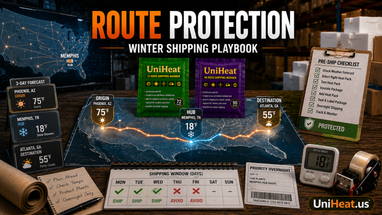
Most winter shipping failures aren't about the destination — they're about the route. A package shipped from Florida to Texas can fail in winter because it goes through Memphis at 18°F. A "mild weather" shipment can sit on a porch in 25°F afternoon air because residential delivery was attempted at the wrong time. The protection equation isn't just pack + insulation. It's pack + insulation + route awareness. This guide walks through every routing decision that affects whether your package arrives intact, drawing on the systems thinking from our broader cold-weather shipping resource center.
The Short Answer: Pack for the Coldest Point on the Route
The single most important principle in route-based package protection is to assess the entire transit path, not just the endpoints. A Florida-to-Texas shipment isn't a Florida-to-Texas thermal challenge — it's a Florida-to-Memphis-to-Texas thermal challenge. The Memphis hub is the coldest point on that route in December, and it's where your 72-hour heat pack does its hardest work.
This is why two shippers using identical packs and identical insulation can have completely different loss rates: one ships during forecast windows that avoid hub cold snaps, the other doesn't. The pack and the insulation are the tools; route awareness is the strategy. Both are required, as we covered in our analysis of heat pack vs insulation in cold shipping.
Why Route Matters More Than Destination
A surprising number of cold-shipping failures happen on routes where origin and destination are both relatively warm. The reason is the carrier hub network. Almost every package shipped through FedEx, UPS, or USPS routes through one or more central sorting facilities, and those facilities are usually located in the geographic middle of the country — which means colder winter conditions than coastal origins or destinations.
The hub effect creates situations that don't show up in a simple origin-to-destination weather check:
- Florida (60°F origin) to Texas (55°F destination) through Memphis (18°F hub) — 42-degree temperature gap from the destination forecast
- California (65°F origin) to North Carolina (50°F destination) through Memphis (20°F hub) — similar pattern
- Arizona (70°F origin) to Georgia (55°F destination) through Memphis (15°F hub) — warm-to-warm route with severe hub exposure
Shippers who only check destination weather are blind to half their risk. For a deeper breakdown of how this drives losses, see our piece on how to reduce winter shipping losses.
The Three-Point Weather Check
The cleanest fix for the route-vs-destination problem is a three-point weather check before every winter shipment. Here's how it works:
Point 1: Origin City Forecast
Check the overnight low at your origin city for the day of pickup and the day after. Cold conditions at origin affect the heat pack's ramp-up phase — the chemistry runs slower at sub-freezing temperatures. The fundamentals of this are covered in our guide to heat pack activation and performance.
Point 2: Hub Forecast
Identify the FedEx or carrier hub your package will route through and check its forecast for the 48 hours following pickup. For most US shipments, the FedEx hub is Memphis or Indianapolis. UPS uses Louisville and Worldport. USPS routes through regional Network Distribution Centers.
The hub forecast is often the most important data point in the whole check. Hub facilities are large, partially unheated buildings where packages can sit for 4-12 hours during sorting. A 0°F hub overnight is far more dangerous than a 20°F destination day.
Point 3: Destination City Forecast
Check both the overnight low and the delivery-window high at the destination. The delivery-window forecast matters because a package may sit on a porch or in a delivery truck during the day. If you can't guarantee immediate receipt, the daytime ambient temperature affects the final hours of protection.
The decision rule that emerges from this check: if any of the three points is forecast below 25°F in the 48 hours after pickup, and you have flexibility on ship timing, delay the shipment by a day or two. The cost of one day's delay is almost always less than the cost of a cold-weather loss, a point we've made clearly in our analysis of cost vs protection in heat pack usage.
Major US Carrier Hubs and Their Winter Temperatures
A practical reference for the FedEx hubs that handle most cold-weather shipments:
| Hub | Carrier | Typical Winter Lows | Coverage |
|---|---|---|---|
| Memphis, TN | FedEx Express | 15-30°F | Most US east coast, central |
| Indianapolis, IN | FedEx Express Secondary | 10-25°F | Midwest, east coast secondary |
| Louisville, KY | UPS Worldport | 20-32°F | Global UPS hub |
| Oakland, CA | FedEx West Coast | 40-50°F | West coast routing |
| Anchorage, AK | FedEx International | -10-20°F | Asia-Pacific routing |
| Newark, NJ | FedEx Northeast | 25-35°F | Northeast corridor |
For most cold-weather shipments in the continental US, your package will route through Memphis or Indianapolis. Both regularly drop into the teens during peak winter months, which is why a 72-hour heat pack as the winter default makes sense even for warm-origin-to-warm-destination routes.
USDA Hardiness Zones for Shipping Planning
USDA plant hardiness zones aren't designed for shipping decisions, but they're a useful proxy for "how cold does it get here in winter." For broader application of zones to specific verticals, see our piece on heat mat vs heat pack for plant shipping, which includes a detailed zone-to-pack mapping for live plant shippers.
The general zone framework for cold-weather route planning:
| Zone | Winter Lows | Recommended Pack | Service Tier |
|---|---|---|---|
| 9-10 | 25-40°F | 40hr-72hr | Priority Overnight or 2-Day |
| 7-8 | 10-25°F | 72hr standard | Priority Overnight |
| 5-6 | -10 to 10°F | 72hr floor / 96hr standard | Priority Overnight + Hold for Pickup |
| 3-4 | -30 to -10°F | 96hr standard | Priority Overnight + Hold for Pickup |
| 1-2 | Below -30°F | 96hr + consider delay | Priority Overnight + Hold for Pickup |
A common mistake is mapping pack tier only to destination zone. The route through the hub matters as much — for in-depth product selection logic, see our framework in how to select the perfect heat pack duration and our broader resource on choosing the right heat pack for your shipment.
Carrier Service Tier Selection
The service tier you choose affects route protection as much as the pack you ship. Three primary options:
FedEx Priority Overnight (The Standard)
This is the default for any cold-sensitive shipment in winter. Priority Overnight typically delivers within 18-26 hours door-to-door, with most of the transit happening overnight when ambient temperatures are stable. The package goes through one hub (usually Memphis or Indianapolis) and gets sorted during off-hours. For live animal shippers, Priority Overnight is effectively the only option, as we cover in our live reptile shipping best practices and ball python winter shipping guide.
FedEx Standard Overnight
Delivers by 4:30 PM next business day instead of by 10:30 AM. Cheaper than Priority, but the longer delivery window means the package may sit in delivery rotation longer at the destination. For live animal shipments, Priority is worth the upgrade.
FedEx 2-Day Air
Delivers in 2 business days. The risk in winter is the additional hub time — a 2-Day package may sit at the hub for 12-24 hours during sorting, which doubles the exposure window vs Priority Overnight. For 2-Day shipments, always upgrade to a 96-hour pack and consider whether the cost savings justify the additional risk.
FedEx Ground
Not recommended for any cold-sensitive shipment in active winter weather. Ground transit can take 3-5 business days and routes through multiple regional facilities. The cumulative cold exposure exceeds the practical duration of even a 96-hour pack on most routes.
Delay Buffer Math: Why 24-Hour Transit Needs 72-Hour Protection
A core principle of route protection: build buffer for the gap between expected transit and actual transit. The math is straightforward but often ignored.
Expected transit on Priority Overnight: 18-26 hours. Realistic delays:
- Weather delays: +6 to +24 hours (storms, hub closures)
- Mechanical or operational delays: +6 to +12 hours
- Missed delivery attempt: +24 hours (next-day retry)
- Weekend rollover (Thursday/Friday ship): +48 to +72 hours
A 24-hour expected transit can realistically become 36, 48, or even 72 hours under any of these conditions. This is exactly why a "2× rule" works: pack duration should be at least twice the expected transit time. For an overnight shipment, that's a 72-hour pack minimum — or a 96-hour pack if you're shipping to a cold zone or near a weekend.
We covered this math in detail in our analysis of how long heat packs really last in transit, including the gap between rated and real-world performance under different conditions.
Weekend & Holiday Risk Windows
The single highest-leverage routing decision in winter is ship day. The rule is simple: ship Monday through Wednesday only.
Here's why. A package shipped Thursday for Friday delivery has a chance of running into Friday weather delays, which then push delivery to Saturday or Monday. A package shipped Friday has an even higher chance of weekend-long delays. Once a package is sitting in a hub or on a truck for 60-72 hours past the activation point, even a 96-hour pack is running out of margin.
The pattern shows up clearly in loss data. Businesses that ship seven days a week often find that 70-80% of their winter losses come from Thursday-Friday shipments, even though those days represent only 30-40% of total volume. Restricting peak-season shipping to Monday-Wednesday can drop overall loss rates by 40-60% with no other changes. The same pattern applies to holiday windows — the Wednesday before Thanksgiving and the week before Christmas are particularly risky.
For seasonal preparation, our resource on the complete fall-to-winter shipping transition covers when to switch your ship-day discipline on, and our winter shipping checklist for small businesses includes the specific operational items.
Hold for Pickup vs Residential Delivery
The last-mile delivery method is one of the most overlooked routing decisions. Two options:
Hold for Pickup at FedEx Station
The package is held at the destination FedEx Office, Ship Center, or station for the recipient to collect. This eliminates the worst failure mode in winter shipping — a package sitting on a porch at 20°F because no one was home. For cold-zone destinations or high-value shipments, Hold for Pickup is almost always worth the small customer friction.
Hold for Pickup is the gold standard for:
- Live animal shipments (reptiles, fish, invertebrates)
- Live plant shipments to cold zones, as covered in our piece on shipping tropical houseplants
- High-value pharmaceutical or supplement shipments
- Any shipment where the customer can't guarantee immediate doorstep receipt
Residential Delivery
The carrier attempts delivery at the recipient's home address. Convenient for the customer but introduces last-mile risk: the package may sit in a delivery truck for hours waiting for the route to reach the address, or sit on a porch if delivery is unattended. For shipments under $50 in value and warm-zone destinations, residential delivery is usually acceptable. For everything else, evaluate the trade-off.
The trade-off matters most for shipping tropical fish in winter, where even brief exposure to freezing temperatures can be fatal, and for specialty food and chocolate shipping, where freeze-thaw cycles can ruin the product.
Documentation for Claims Protection
Winter shipping inevitably produces some claims. Documentation determines whether you get paid for losses or absorb them. The standard documentation for every cold-weather shipment:
- Photo of the assembled box before sealing — shows heat pack placement, insulation, and product positioning
- Photo of the carrier receipt with timestamp visible — establishes pickup time
- Tracking number entered into a shipment log — with route, pack SKU, packaging configuration, and weather forecast at ship time
- Photo of damage or loss on arrival — requested from the customer immediately on receipt
This documentation also feeds your loss tracking and continuous improvement process. After one full winter of disciplined logging, patterns emerge: certain routes are over-represented in losses, certain packaging configurations underperform, certain heat pack lots run weaker than others. The framework for building this feedback loop is covered in our piece on building a reliable cold shipping system.
Real Route Examples: Pack Selection by Scenario
Five practical scenarios with the recommended pack selection logic:
Scenario 1: Florida to Texas, December, Live Reptile
Origin: 65°F. Hub (Memphis): 18°F. Destination: 55°F. Despite warm endpoints, the Memphis hub passage is severe. Use a 72-hour pack at minimum, ideally a 96-hour pack with Hold for Pickup. Ship Monday through Wednesday only.
Scenario 2: California to North Carolina, January, Live Plants
Origin: 60°F. Hub (Memphis): 15°F. Destination: 35°F. Cold hub plus cold destination means a 96-hour pack is the right call. Hold for Pickup recommended for sensitive tropical plants.
Scenario 3: Florida to Florida, November, Premium Chocolate
Origin: 75°F. Hub or direct: warm conditions throughout. A 40-hour pack with standard insulation is sufficient. Standard Overnight or 2-Day service acceptable. The framework in our specialty food and chocolate shipping guide applies directly.
Scenario 4: Texas to Minnesota, January, Live Fish
Origin: 40°F. Hub (Memphis): 20°F. Destination: -5°F. The destination is the limiting factor here. A 96-hour pack with maximum insulation and Hold for Pickup is mandatory. Consider delaying the shipment if a severe cold snap is forecast. The full live fish protocol is covered in our tropical fish winter shipping guide.
Scenario 5: New York to California, December, Meal Kit
Origin: 25°F. Hub (Memphis): 25°F. Destination: 60°F. The challenge is the origin and hub portions. A 72-hour pack with 1.5″ insulation handles this routing well. Residential delivery is acceptable since the destination side is mild. Operational considerations are covered in our piece on meal prep companies and cold-weather logistics.
Sudden Cold Snaps: When to Adjust or Delay
Forecasts change. A route that looked safe at 9 AM Monday can look risky by 9 AM Tuesday if a cold front arrives faster than expected. Two questions to ask when conditions shift:
- Can I upgrade the pack? If you have higher-duration packs in stock, switching from 72-hour to 96-hour absorbs most cold-snap risk for an additional $2-3 per shipment.
- Can I delay the shipment? If the cold snap is short (24-48 hours), waiting until conditions normalize is often the right call. The cost of a 1-2 day delay is almost always less than the cost of a failed shipment.
For the operational playbook on this, see our piece on shipping safely during sudden cold snaps and our broader piece on when delaying shipping is the smartest decision.
Multi-Pack Strategies for High-Risk Routes
For extreme routes — cross-country shipments to USDA zones 1-3, premium live animals, irreplaceable plants — some shippers use multiple packs for redundancy. The decision logic is covered in our piece on how many heat packs you really need per box.
The short version: two 72-hour packs do not equal one 144-hour pack. They burn through chemistry on the same timeline. The right approach is usually to step up to a longer-duration single pack rather than stack shorter-duration packs. Two 40-hour packs deliver more total heat over the same 40-hour window but don't extend duration.
The exception is extreme cold zones where the temperature differential is so large that two packs working together can maintain box temperature where one would lose ground. For those scenarios, the additional cost of redundancy is genuinely worth it. The full pack performance framework is in our piece on whether heat packs actually work in extreme cold.
The Pre-Ship Checklist for Route Protection
Before any winter shipment, run through this sequence:
- Three-point weather check. Origin, hub, destination forecasts for the next 48 hours.
- Day of week verification. Monday, Tuesday, or Wednesday only in active winter.
- Pack tier selection. Match to the coldest point on the route, with 2× transit time buffer.
- Insulation verification. 1.5″ foam minimum on all six sides.
- Hold for Pickup decision. Recommended for cold zones, live animals, or high-value shipments.
- Activation timing. Heat pack opened 20-30 minutes before carrier handoff.
- Documentation capture. Photo of assembled box, photo of carrier receipt with timestamp.
- Customer communication. Tracking number, expected delivery window, and any Hold for Pickup instructions communicated before the package leaves your facility.
This sequence sits at the heart of every reliable cold-weather shipping operation. For the broader operational SOP, see our resource on the winter shipping checklist for small businesses.
How Route Protection Connects to the Full Shipping System
Route awareness is one component of a complete cold-weather shipping system. The full system also requires:
- The right heat pack selection — covered in our gel packs vs heat packs guide and heat mat vs heat pack guide
- The right insulation — covered in our shipping container insulation guide
- The right packaging materials — covered in our top 3 packing materials guide
- The right pack-to-container fit — covered in our box size and insulation selection guide
- The right cost-to-protection balance — covered in our cost vs protection analysis
Each piece matters. A perfect route plan with under-spec packaging still fails. Perfect packaging with poor route planning still fails. The systems thinking required to integrate all of these is what we cover in building a reliable cold shipping system for your business.
Highlights — The Route Protection Playbook
Frequently Asked Questions
What is route package protection in cold-weather shipping?
Route package protection refers to the practice of evaluating and protecting against thermal risks across the entire shipping route, not just the destination. This includes checking weather conditions at the origin, hub, and destination; matching pack duration and insulation to the coldest point on the route; selecting the right carrier service tier; and timing the shipment to avoid weekend delay windows. The goal is to ensure the package interior stays in a safe temperature range throughout transit, regardless of the route's coldest exposure point.
Why does the FedEx hub matter for cold shipping?
Almost every FedEx Priority Overnight shipment in the continental US routes through Memphis or Indianapolis. These hubs are partially-heated facilities where packages can sit for 4-12 hours during sorting. In active winter, hub temperatures often drop into the 15-25 degrees Fahrenheit range even when the package's origin and destination are warmer. The Memphis hub is often the coldest point on the entire route, which is why hub forecasts matter as much as destination forecasts for pack selection.
What is the safest day to ship in winter?
Monday is the safest, followed by Tuesday and Wednesday. Thursday and Friday should be avoided whenever possible during active winter. A package shipped Thursday for Friday delivery has a chance of running into Friday weather delays, which then push delivery to Saturday or Monday. A package shipped Friday has an even higher chance of weekend-long delays. Restricting winter shipping to Monday-Wednesday is one of the highest-leverage changes any operation can make for loss reduction.
Should I use FedEx Priority Overnight or 2-Day Air in winter?
Priority Overnight is strongly preferred for cold-sensitive shipments in winter. The longer transit window of 2-Day Air means the package sits in hub facilities longer, doubling the cold exposure window. For Priority Overnight, most transit happens during off-hours when sorting is fast. For 2-Day Air, packages may sit at the hub for 12-24 hours waiting for daytime delivery routing. If you must use 2-Day, upgrade to a 96-hour heat pack to absorb the additional risk.
What is Hold for Pickup and when should I use it?
Hold for Pickup means the package is held at the destination FedEx Office, Ship Center, or station for the recipient to collect, rather than being delivered to a residential address. This eliminates the risk of a package sitting on an unattended porch in cold weather. Hold for Pickup is recommended for live animal shipments, live plant shipments to cold zones, high-value pharmaceuticals, and any package where the customer cannot guarantee immediate doorstep receipt at the time of delivery.
How does USDA hardiness zone affect shipping decisions?
USDA hardiness zones provide a useful proxy for winter temperature severity at the destination. Zones 9-10 (mild winter) typically need 40-72 hour heat packs. Zones 5-6 need 72-96 hour packs as standard. Zones 3-4 require 96-hour packs and Hold for Pickup. Zones 1-2 may require considering whether to ship at all during peak winter. The route also matters: packages traveling from zone 9 to zone 4 still need to be packed for the destination zone.
How do I calculate the right heat pack duration for my route?
Use the 2x rule: pack duration should be at least twice the expected transit time. Priority Overnight has 18-26 hour expected transit, so use a 72-hour pack minimum. 2-Day Air has 36-48 hour expected transit, so use a 96-hour pack. Add another tier of buffer for cold zones, weekend risk, or extreme cold snaps. This buffer absorbs typical weather delays, missed deliveries, and the gap between rated and real-world pack performance.
What documentation do I need for shipping claims?
For winter cold-weather shipping claims, you typically need: a photo of the assembled box before sealing (showing heat pack placement and insulation), a photo of the carrier receipt with timestamp visible (establishing pickup time), the tracking number with shipment metadata (pack SKU, packaging configuration, weather forecast at ship time), and a photo of the damage or loss on arrival from the customer. This documentation establishes that the shipment was properly prepared and helps determine where the failure occurred in the route.
Summary
Route package protection is the often-overlooked third leg of the cold-weather shipping system. Heat packs provide the heat. Insulation retains it. Route awareness ensures the system runs in conditions where the first two can actually do their jobs.
For most cold-weather shipping operations, the route protection framework is straightforward: pack for the coldest point on the route (usually the hub), ship Monday through Wednesday only, build 2× duration buffer for delays, use FedEx Priority Overnight, and add Hold for Pickup for high-risk shipments. This combination protects against the vast majority of failure modes that cause winter losses.
The data is clear: businesses that build this discipline into their operations run 1-2% winter loss rates. Businesses that don't run 8-15% loss rates with similar products. The gap is almost entirely systems and routing discipline, not luck or weather. For more on building this discipline into a complete operational system, see our shipping solutions resource center and our piece on building a reliable cold shipping system for your business.