
Posted by UniHeatPacks on 30th Jul 2026
Complete Freezing Points Reference for Shipped Products (60+)
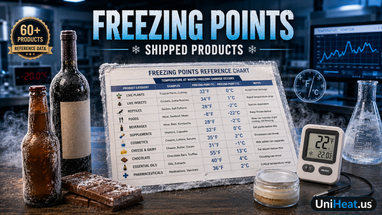
This is the definitive freezing-point reference for products commonly shipped through parcel networks. For each product category, we've documented the exact freezing temperature, the damage-onset temperature (which is often warmer than the true freezing point due to chilling injury or texture change), and the damage type that occurs. The data is organized by product category and cross-referenced with our operational shipping recommendations for cold-weather protection. This resource complements our cold-weather shipping protection reference table and consolidates the temperature science that drives cold-chain decisions across our cold-weather shipping resource center.
Understanding the Science of Freezing Damage
Before the reference tables, it's useful to understand why products fail at different temperatures. There are five distinct failure modes for cold-damaged shipped products, and each occurs at a different temperature:
Failure Mode 1: True Freezing (Structural Damage)
When a product's water content freezes, ice crystals form and expand. This can rupture cell walls in fresh produce, break emulsions in cosmetics, crack glass bottles containing liquids, and permanently alter product structure. True freezing is the most severe failure mode. Products high in water content (fresh produce, live organisms, water-based liquids) freeze around 32°F. Products with dissolved solids (sugars, salts, alcohol) freeze at lower temperatures — the more dissolved matter, the lower the freezing point.
Failure Mode 2: Chilling Injury (Pre-Freeze Damage)
Tropical products can suffer damage at temperatures well above true freezing. Bananas, tomatoes, tropical houseplants, and reptiles from tropical climates all experience "chilling injury" at 45-56°F. The damage is cellular and cumulative. A tomato exposed to 40°F for 24 hours will show damage even though the tomato hasn't frozen. This failure mode is often overlooked because the product looks fine at the moment of exposure — damage appears hours or days later.
Failure Mode 3: Texture/Cosmetic Change
Some products remain safe to consume but suffer texture changes at cold temperatures. Chocolate develops "fat bloom" (white surface deposits) at 50°F and below. Bread becomes stale faster when refrigerated. Honey crystallizes below 32°F. Peanut butter separates. These aren't safety issues but ruin customer experience and generate complaints.
Failure Mode 4: Emulsion Break (Personal Care/Cosmetics)
Emulsion-based products (creams, lotions, sunscreens, some sauces) contain both water and oil phases held together by emulsifiers. Freezing disrupts the emulsifier structure, and the water and oil separate permanently on thaw. The product is unusable even though no bottle broke and no visible damage occurred at the freezing moment.
Failure Mode 5: Pressure Burst (Carbonated/Sealed Containers)
Water expands 9% when it freezes. In a sealed container, this expansion creates enormous pressure. Carbonated beverages (beer, kombucha, sparkling wine) have added CO2 pressure that compounds the freeze expansion. Glass bottles crack, aluminum cans rupture, and plastic bottles distort. This can happen even when the product technically hasn't reached freezing temperature — if the outer film freezes while the interior expands, the container fails.
How to Read the Reference Tables
Each table below documents:
- True Freezing Point: The exact temperature at which the product would freeze solid
- Damage-Onset Temperature: The temperature at which product damage begins (often warmer than true freezing)
- Failure Mode: What actually happens to the product at damage-onset
- Reversibility: Whether the damage is reversible on warming
- Ship-Cold Safety Margin: The minimum shipping temperature to guarantee no damage
For operational shipping recommendations that map to these temperatures, cross-reference with our cold-weather shipping protection reference table.
Beverages
| Product | Freezing Point | Damage-Onset | Failure Mode | Reversible? | Ship-Safe Above |
|---|---|---|---|---|---|
| Wine (11-13% ABV, table) | 22°F | 22-25°F | Bottle burst, cork push | No | 30°F |
| Wine (14-16% ABV) | 18-20°F | 20-24°F | Bottle burst, cork push | No | 28°F |
| Fortified wine (port, sherry) | 10-15°F | 15-20°F | Bottle burst | No | 20°F |
| Champagne / sparkling wine | 23°F | 25-28°F | Bottle burst (CO2 pressure) | No | 32°F |
| Beer (4-6% ABV, standard) | 28°F | 28-30°F | Can/bottle burst | No | 32°F |
| Craft beer (7-10% ABV) | 25-27°F | 26-28°F | Can/bottle burst | No | 30°F |
| Vodka (40% ABV) | -16°F | 20°F (cloudiness) | Cosmetic cloudiness | Yes | 25°F |
| Whiskey (40-50% ABV) | -20°F | 20°F (cloudiness) | Cosmetic cloudiness | Yes | 25°F |
| Gin (37-47% ABV) | -15°F | 15°F | Cosmetic cloudiness | Yes | 25°F |
| Liqueurs (15-30% ABV) | 0-15°F | 15-20°F | Sugar crystallization | Partial | 25°F |
| Kombucha | 28°F | 28-30°F | Bottle burst (CO2) | No | 32°F |
| Hard cider | 26°F | 27-29°F | Bottle burst | No | 31°F |
| Mead (12-14% ABV) | 22°F | 24-26°F | Bottle burst | No | 30°F |
| Cold-brew coffee | 30°F | 30-32°F | Bottle burst | No | 34°F |
| Fresh juice (unpasteurized) | 28-30°F | 30-32°F | Bottle burst | No | 34°F |
For beverage shipping operations, see our piece on how to ship wine, beer & spirits in winter.
Beverage Freezing Point Science
Alcohol has a much lower freezing point than water (-173°F for pure ethanol vs 32°F for water). A beverage's freezing point depends on the water-to-alcohol ratio. Pure wine at 12% ABV freezes around 22°F because most of the liquid is still water. Vodka at 40% ABV freezes around -16°F because ethanol dominates. Beer at 5% ABV freezes just below water (around 28°F). Sugar content also lowers freezing points — sweet dessert wines freeze slightly lower than dry table wines at the same ABV.
Container failure mode is critical to understand. Even when the beverage itself hasn't fully frozen, the water portion can freeze first and expand. In a sealed container, this 9% volume expansion creates enormous internal pressure. Cork is pushed out of wine bottles. Bottle glass cracks. Cans deform or split. This is why the damage-onset temperature is often slightly warmer than the true freezing point for bottled beverages — the container fails before the liquid fully solidifies.
Fresh Food & Produce
| Product | Freezing Point | Damage-Onset | Failure Mode | Reversible? | Ship-Safe Above |
|---|---|---|---|---|---|
| Bananas | 31°F | 56°F (chilling injury) | Black spotting, texture | No | 58°F |
| Tomatoes | 31°F | 55°F (chilling) | Mealiness, off-flavor | No | 55°F |
| Citrus (oranges, lemons) | 29°F | 40-45°F | Pitting, off-flavor | Partial | 45°F |
| Leafy greens | 31°F | 32-33°F | Wilting, cell rupture | No | 34°F |
| Root vegetables | 28-30°F | 30-32°F | Cell rupture, softening | No | 33°F |
| Apples | 28°F | 30-32°F | Mealiness | No | 33°F |
| Berries (fresh) | 30°F | 31-33°F | Cell rupture, mush | No | 34°F |
| Mangoes, papayas | 30°F | 55°F (chilling) | Pitting, off-flavor | No | 58°F |
| Fresh meat (raw) | 28°F | 28-30°F | Ice crystal damage | Partial | 32°F |
| Fresh seafood | 28°F | 28-30°F | Cell rupture, texture | No | 32°F |
Fresh food shipping frameworks in our pieces on heat packs for food shipping and insulated food delivery bags vs boxes.
Chilling Injury vs True Freezing
The most misunderstood concept in produce shipping is chilling injury. Products like bananas, tomatoes, and mangoes suffer damage at temperatures well above freezing. A tomato exposed to 40°F for 24 hours will show damage on the shelf 2-3 days later — even though it never came close to freezing. This is why tropical produce needs warmth in the 55-65°F range during winter transit, not just protection from freezing. Understanding chilling injury is critical for tropical produce shippers.
Baked Goods, Sweets & Specialty Foods
| Product | Freezing Point | Damage-Onset | Failure Mode | Reversible? | Ship-Safe Above |
|---|---|---|---|---|---|
| Milk chocolate | 14°F | 50°F (fat bloom) | Cosmetic white bloom | No (irreversible) | 55°F |
| Dark chocolate | 12°F | 55°F (fat bloom) | Cosmetic white bloom | No | 55°F |
| Bread (artisan loaf) | 32°F | 36°F (retrograde staling) | Texture, stale mouthfeel | Partial | 40°F |
| Cakes (frosted) | 28-30°F | 32-35°F | Frosting damage, decoration | No | 40°F |
| Cookies | 30°F | 32-35°F | Texture change, breakage | Yes | 35°F |
| Honey | -5 to 15°F | 50°F (crystallization) | Crystallization (cosmetic) | Yes (gentle warming) | 55°F |
| Maple syrup | 15°F | 20-25°F | Bottle burst | No | 30°F |
| Olive oil | 30-45°F (depends on grade) | 45-50°F (waxy) | Solidification (cosmetic) | Yes | 55°F |
| Coconut oil | 76°F | 76°F (solid at room temp) | Solid form (not damage) | Yes | Any temp |
| Peanut butter | 28°F | 40°F (separation) | Oil separation, texture | Yes (stir) | 45°F |
Specialty food shipping frameworks in our piece on specialty food and chocolate shipping in cold weather.
Chocolate Fat Bloom Explained
Chocolate deserves its own explanation. The true freezing point of chocolate is 12-14°F, but damage begins at 50°F through a process called "fat bloom." Cocoa butter crystals in tempered chocolate can transition to a different crystalline form when cooled below 50°F, then migrate to the surface as a white or gray dusty coating on warming. The chocolate is still safe to eat but visually damaged. Premium chocolate brands consider this a total loss for customer experience. Fat bloom is why premium chocolate shipping requires 96-hour heat packs and 2″ insulation even in mild winter conditions.
Personal Care & Cosmetics
| Product | Freezing Point | Damage-Onset | Failure Mode | Reversible? | Ship-Safe Above |
|---|---|---|---|---|---|
| Water-based lotions | 30°F | 32°F (emulsion) | Emulsion break | No | 35°F |
| Facial creams | 28-30°F | 32°F (emulsion) | Emulsion break, separation | No | 35°F |
| Sunscreens (SPF) | 28°F | 32°F | Emulsion break, SPF reduction | No | 35°F |
| Serums (water-based) | 30°F | 32°F | Active ingredient degradation | Partial | 35°F |
| Body oils (single ingredient) | Varies (35-76°F) | Same as freezing | Solidification | Yes (warming) | Varies |
| Lipsticks & balms | Varies (50-90°F melt/freeze) | 32°F (cracking) | Cosmetic cracking | No | 40°F |
| Perfumes (alcohol-based) | -15 to 15°F | 10°F (cloudiness) | Cosmetic cloudiness | Yes | 20°F |
| Shampoos, conditioners | 28-32°F | 32°F | Emulsion break, separation | Partial | 35°F |
Why Emulsion Cosmetics Are So Vulnerable
Emulsion cosmetics contain water phase and oil phase held together by emulsifying agents. Freezing disrupts these emulsifiers, and even brief exposure below 32°F can permanently break the emulsion. Once broken, the product separates into water and oil phases that cannot be reunited by shaking or warming. The product is unusable. This is why cosmetic DTC brands treat any winter shipment as high-stakes — a $60 cream that gets 15 minutes below freezing is a total loss.
Pharmaceuticals, Supplements & Nutraceuticals
| Product | Freezing Point | Damage-Onset | Failure Mode | Reversible? | Ship-Safe Above |
|---|---|---|---|---|---|
| Solid tablets/capsules | Not applicable | 32°F (bottle burst if liquid) | Rare | N/A | Room temp |
| Liquid supplements (water-based) | 32°F | 32°F | Bottle burst | No | 35°F |
| Herbal tinctures (alcohol-based) | -10 to 15°F | 15°F | Cosmetic sediment | Partial | 25°F |
| Probiotics | Requires refrigeration (2-8°C) | Warm damage above 40°F | Bacterial die-off | No | 36-46°F |
| Gummies | 28°F | 30°F | Texture change | Partial | 35°F |
| Protein powders | Not applicable | Not affected by cold | Moisture-sensitive | N/A | Room temp |
| Homeopathic remedies | -10 to 32°F | Varies | Depends on formulation | Varies | 32°F |
Supplement and pharma shipping frameworks in our piece on pharmaceutical cold chain packaging for small businesses.
Live Organisms
Live organisms have unique freezing considerations. Unlike inert products, live plants and animals suffer physiological stress at temperatures well above true freezing, and mortality occurs before true freezing in most cases.
| Product | Physiological Freeze | Stress-Onset | Mortality Below | Reversible? | Ship-Safe Above |
|---|---|---|---|---|---|
| Tropical houseplants | 32°F | 45°F (chilling) | Cumulative below 40°F | Sometimes partial | 50°F |
| Succulents | 32°F | 40°F | Below 32°F | Partial | 40°F |
| Orchids | 32°F | 50°F (highly sensitive) | Cumulative below 50°F | No | 55°F |
| Ball pythons | Below 32°F | 65°F | Extended below 55°F | No | 65°F |
| Bearded dragons | Below 32°F | 70°F | Below 60°F | No | 70°F |
| Tropical fish (bagged) | Water freezes 32°F | 65°F | Below 55°F | No | 65°F |
| Crickets | Below 32°F | 55°F | Below 45°F | No | 55°F |
| Mealworms | Below 32°F | 40°F | Below 32°F | No | 40°F |
Live organism shipping in our pieces on heat mat vs heat pack for plant shipping, shipping live feeder insects, and shipping tropical fish safely in winter. Pack selection for live organisms: use our 72-hour heat pack as standard, upgrade to 96-hour packs for tropical animals or cold-zone destinations.
The Six-Category Freeze Point Summary
Looking across all categories, six patterns emerge:
Category 1: Pure Water-Based Products (Freeze at 32°F)
Fresh produce, water-based cosmetics, water-based liquid supplements, and non-carbonated soft drinks all freeze at close to 32°F because water dominates their composition. Ship-safe temperature: 35°F or higher.
Category 2: Alcoholic Beverages (Freeze at 15-28°F)
Wine, beer, spirits, and other alcohol-containing beverages freeze at lower temperatures depending on alcohol content. Higher ABV = lower freezing point. But glass bottle containers may fail before the liquid fully freezes.
Category 3: Sugar-Concentrated Products (Freeze at -10 to 32°F)
Honey, maple syrup, dessert wines, and liqueurs freeze at lower temperatures due to high dissolved sugar content. Honey may not freeze until -5°F but crystallizes at 50°F.
Category 4: Chilling-Injury Products (Damage Above Freezing)
Tropical produce, tropical houseplants, and tropical animals suffer damage at 45-65°F — well above true freezing. These products need warmth, not just freeze protection.
Category 5: Cosmetic-Damage Products (Damage at Various Temperatures)
Chocolate (fat bloom at 50°F), honey (crystallization at 50°F), olive oil (waxy at 45°F), coconut oil (solid at 76°F) — these products change form without true freezing. The damage may be cosmetic (visual) or functional (usability).
Category 6: Emulsion-Break Products (Failure Just Below 32°F)
Emulsion-based cosmetics, some pharmaceuticals, and certain sauces break irreversibly just below freezing. The product may look fine until warming, when separation reveals the damage.
Cross-Reference to Shipping Configuration
The freezing points documented above directly drive shipping configuration. Products that freeze at 22°F need less protection than products damaged at 55°F. The relationship:
- Products damaged at 55-60°F (tropical produce, tropical animals, orchids, chocolate premium): 96-hour heat pack, 2″ EPS foam, ship Monday only
- Products damaged at 40-50°F (cosmetic emulsions, cold-sensitive supplements, some produce): 72-96 hour heat pack, 1.5-2″ EPS foam
- Products damaged at 32-40°F (most fresh food, water-based products, live animals): 72-hour heat pack, 1.5″ EPS foam
- Products damaged at 22-32°F (wine, beer, non-alcoholic beverages): 72-hour heat pack, 1.5″ EPS foam
- Products damaged below 22°F (spirits, fortified wine, honey): 40-72 hour heat pack, 1.5″ EPS foam
Full configuration details in our cold-weather shipping protection reference table and our capstone piece on cold chain solutions for small businesses.
How Ambient Conditions Compound Freezing Risk
FedEx hub cities matter for shipping decisions. Memphis (SuperHub) can drop to teens in January. This affects transit-time exposure:
- Origin: Time from pickup to first sort. Usually 2-4 hours.
- Hub: Time at central sorting facility. Can be 8-12 hours in a cold hub.
- Destination hub: Time at destination sort facility. 4-8 hours.
- Delivery vehicle: Final mile in a delivery truck. 2-6 hours.
- Doorstep: Time from delivery to customer bringing package in. Variable, sometimes hours.
The most vulnerable exposure is often at the hub or doorstep. A wine shipment through Memphis at 15°F for 10 hours in the hub can freeze even inside insulated packaging with an aging heat pack.
Route strategy in our piece on route package protection. Loss reduction patterns in how to reduce winter shipping losses. Understanding pack duration and how it interacts with hub exposure time is covered in how long heat packs last in transit. For the underlying chemistry of pack heat output, see understanding heat pack activation and performance. Insulation performance during hub exposure is covered in shipping container insulation guide.
How to Cite This Reference
Citation Format
"Complete Freezing Points Reference for Shipped Products (60+)," UniHeat.us Shipping Solutions Resource Center, https://uniheat.us/complete-freezing-points-reference-shipped-products/, accessed [date].
Data License
This reference is available under Creative Commons BY 4.0 for use in industry publications, educational resources, and business blogs. Attribution to UniHeat.us appreciated.
Data Sources
Freezing points reflect the physical chemistry of each product category. Damage-onset temperatures reflect operational experience across cold-weather shipping. Ship-safe temperatures include a small buffer to account for hub temperature variability and package micro-climate. Data current as of 2026.
Common Questions About Freezing Points
Beer Freezing Point vs Wine Freezing Point
Beer freezes around 28°F because it has 4-6% alcohol content (higher water ratio than wine). Wine freezes around 22°F because it has 11-14% alcohol content. Both have similar container-burst risk, but wine has more cushion — 6°F below beer's failure point.
Why Doesn't Honey Freeze?
Honey has extremely high dissolved sugar content (80%+ dry matter). Sugar molecules disrupt water crystal formation, dramatically lowering the freezing point. Pure honey doesn't freeze until -5 to 15°F depending on composition. But honey crystallizes at 50°F (a form change, not true freezing) and this crystallization is often confused with freezing.
Does Alcohol Content Matter for Wine Freezing?
Yes. Table wines at 11-13% ABV freeze around 22°F. Fortified wines at 18-20% ABV freeze around 15-18°F. Dessert wines with high sugar content also freeze at lower temperatures.
Can Frozen Emulsions Be Rescued?
No. Once an emulsion (lotion, sunscreen, most creams) freezes and thaws, the water and oil phases separate permanently. No amount of shaking, warming, or stirring rejoins them. This is why cosmetic DTC brands treat any winter shipment as high-stakes.
The Reference in Practice
For Wine Shippers
Wine freezes at 22°F. Ship-safe above 30°F. Use 72-hour heat packs, 1.5″ EPS foam, molded pulp bottle inserts. Framework in our piece on how to ship wine, beer & spirits in winter.
For Chocolate Shippers
Chocolate fat blooms at 50°F. Ship-safe above 55°F. Use 96-hour heat packs, 2″ EPS foam. This is aggressive protection compared to true freezing points because cosmetic damage matters as much as physical damage.
For Live Plant Shippers
Tropical houseplants suffer chilling injury above 40°F. Ship-safe above 50°F. Use 72-96 hour heat packs, 1.5-2″ EPS foam. Framework in our piece on heat mat vs heat pack for plant shipping.
For Cosmetics Shippers
Emulsions break at 32°F. Ship-safe above 35°F. Use 72-hour heat packs, 1.5″ EPS foam. Emulsion damage is irreversible and often invisible until customer receives the product.
For Live Animal Shippers
Tropical reptiles need 65°F+ during transit. Ball pythons, bearded dragons, and other tropical species require 96-hour heat packs and 2″ EPS foam. Framework in our piece on ball python winter shipping.
Highlights — Freeze Point Reference Card
Frequently Asked Questions
At what temperature does wine freeze?
Wine freezes at 22 degrees Fahrenheit for standard table wines with 11-13% alcohol content. Fortified wines like port and sherry freeze at 15-18 degrees Fahrenheit due to higher alcohol content. Sparkling wines and champagne freeze at 23 degrees Fahrenheit and have added bottle burst risk from CO2 pressure. Damage typically occurs at temperatures just above true freezing, as expansion of the water content pushes corks out or cracks bottles even before the wine fully solidifies. Ship-safe temperature for wine is 30 degrees Fahrenheit or higher.
At what temperature does beer freeze?
Beer freezes at 28 degrees Fahrenheit for standard 4-6% ABV brews. Craft beers with 7-10% ABV freeze slightly lower, around 25-27 degrees Fahrenheit. The damage-onset temperature is close to true freezing (28-30 degrees Fahrenheit) because carbonation pressure combined with water expansion causes can and bottle burst even before the beer fully solidifies. Ship-safe temperature for beer is 32 degrees Fahrenheit or higher. Craft beers have slightly more cushion but pressure burst risk applies to all carbonated beverages.
At what temperature does vodka freeze?
Vodka at 40% ABV freezes at -16 degrees Fahrenheit. Higher-proof spirits freeze even lower (whiskey at -20 degrees Fahrenheit, gin at -15 degrees Fahrenheit). Spirits rarely truly freeze during shipping because ambient conditions rarely drop that low. However, cosmetic cloudiness can appear at 15-20 degrees Fahrenheit as some compounds precipitate out. This cloudiness is reversible on warming. Ship-safe temperature for spirits is 25 degrees Fahrenheit to prevent cosmetic issues; true freezing damage is essentially never a concern.
At what temperature does chocolate get damaged?
Chocolate suffers damage at 50 degrees Fahrenheit through a process called "fat bloom," well above its true freezing point of 12-14 degrees Fahrenheit. Fat bloom appears as white or gray surface deposits when cocoa butter crystals transition to a different crystalline form. The chocolate is still safe to eat but visually damaged. Premium chocolate brands consider this a total customer experience loss. Ship-safe temperature for chocolate is 55 degrees Fahrenheit or higher, requiring 96-hour heat packs and 2-inch EPS foam even in mild winter conditions.
Does honey freeze?
Honey has an extremely low true freezing point of -5 to 15 degrees Fahrenheit depending on composition. This is due to its very high dissolved sugar content, which disrupts water crystal formation. In practice, honey is rarely damaged by true freezing during shipping. However, honey crystallizes at temperatures around 50 degrees Fahrenheit and below, which is often confused with freezing. Crystallization is a natural process that doesn't damage the honey but affects appearance and pourability. Gentle warming reverses crystallization.
Why do bottles burst before the liquid fully freezes?
Water expands 9% in volume when it transitions from liquid to solid. In a sealed container, this expansion creates enormous internal pressure. Even if the liquid hasn't fully solidified, the water portion that has frozen creates enough pressure to crack glass, deform cans, or push out corks. Carbonated beverages have added CO2 pressure that compounds the freeze expansion. This is why beer cans, wine bottles, and kombucha bottles can all fail at temperatures slightly warmer than the true freezing point of the beverage itself.
Why do cosmetic emulsions break so easily?
Emulsion cosmetics (lotions, creams, sunscreens, some serums) contain both water and oil phases held together by emulsifiers. Freezing disrupts the emulsifier molecules and forces water and oil into separate phases. When the product thaws, the phases don't rejoin because the emulsifier structure has been permanently damaged. The product separates into visible water and oil layers that cannot be recombined by shaking, warming, or stirring. This is why cosmetic brands treat any winter shipment as high-risk requiring premium protection.
What's chilling injury and how is it different from freezing?
Chilling injury is damage that occurs at temperatures above freezing (typically 40-56 degrees Fahrenheit) to tropical products including bananas, tomatoes, tropical houseplants, and tropical reptiles. Unlike true freezing, the damage is not immediate. It's cellular and cumulative, appearing hours or days after exposure. A tomato at 40 degrees Fahrenheit for 24 hours looks fine at the moment of exposure but shows damage 2-3 days later on the shelf. This is why tropical products need warmth in the 55-65 degrees Fahrenheit range during winter transit, not just freeze protection.
Summary
This reference documents the freezing points, damage-onset temperatures, failure modes, and ship-safe temperatures for 60+ product categories commonly shipped through parcel networks. The data covers beverages, fresh food and produce, baked goods and sweets, personal care and cosmetics, pharmaceuticals and supplements, and live organisms.
The critical understanding is that damage-onset temperature is often warmer than true freezing point. Chocolate fat blooms at 50°F despite freezing at 12-14°F. Chilling injury damages tropical products at 45-55°F. Bottles burst before liquids fully solidify due to water expansion. Emulsion cosmetics break irreversibly at just below 32°F.
These science-based understandings drive the operational shipping recommendations documented in our companion piece on the cold-weather shipping protection reference table. Together, these two references provide the complete decision framework for cold-weather shipping across the SMB cold chain.
For the broader operational system, see our shipping solutions resource center, and our comprehensive coverage across heat pack topics, cold shipping, perishables, and temperature control shipping. Bulk pack purchasing is available through our UniHeat shop (40-hour, 72-hour, and 96-hour options), and pack tier selection framework in how to select the perfect heat pack duration. For the binary comparison between heat packs and gel packs, see gel packs vs heat packs. For common mistakes across all categories, see 5 common mistakes when using heat packs. Daily operational discipline is covered in the winter shipping checklist for small businesses.