
Posted by UniHeatPacks on 31st May 2026
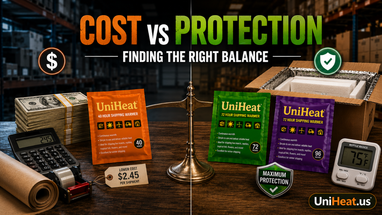
Cost vs Protection: Finding the Right Balance in Heat Pack Usage
The cheapest heat pack on your shelf is not the cheapest heat pack in your operation. Every winter, businesses make the same mistake: they optimize for the per-unit cost of a heat pack and end up paying for it in losses, refunds, and angry customers. The honest framework is different — you're not buying a heat pack, you're buying a probability of safe arrival. This article is about how to think clearly about that trade-off and stop leaving money on the table in either direction.
The Real Cost of a Heat Pack Is Not the Price on the Invoice
Most businesses calculate heat pack cost wrong. They look at the per-unit price on the supplier invoice, multiply by volume, and that's the budget line. This is the most expensive way to think about it.
The real cost of a heat pack is the sticker price plus the expected cost of the losses it doesn't prevent. A $4 heat pack that prevents a $300 loss 99% of the time has a different real cost than a $2 heat pack that prevents the same loss 92% of the time. Math out a hundred shipments and the cheaper pack is suddenly much more expensive.
Here's the simple version of that math, using rough numbers. Say you ship 100 packages in a winter month, each carrying $200 in product value:
- Cheaper pack at $2, 92% safe arrival: $200 in pack cost + 8 losses × $200 = $1,800 total cost.
- Better pack at $4, 99% safe arrival: $400 in pack cost + 1 loss × $200 = $600 total cost.
The "more expensive" pack saved you $1,200 across 100 shipments. The "cheaper" pack didn't save money; it just hid the cost on a different line of the P&L.
This is the framework. Cost per safe arrival, not cost per pack. Once you start thinking this way, most heat pack decisions get a lot easier.
What Drives the Probability of Safe Arrival
The "safe arrival rate" of any heat pack depends on the gap between the pack's protection capacity and the transit conditions. A pack that's well-matched to the route delivers near-100% protection. A pack that's under-matched starts losing shipments. A pack that's over-matched delivers full protection but you're paying for capacity you didn't use.
The variables that close or widen that gap:
- Pack duration — the rated hours of heat output.
- Transit duration — how long the package is actually in motion, including realistic delays.
- Ambient temperature along the route.
- Insulation quality of the box.
- Activation timing — whether the pack reaches working temperature at handoff.
- Pack freshness — whether the chemistry is at full strength.
The first three of these you set when you place the order. The last three are operational. Both layers matter, but the pack-selection layer is the one this article focuses on, because it's where the cost-vs-protection decision actually gets made.
The Three Cost Mistakes Businesses Make
After working with hundreds of businesses across winter shipping cycles, three patterns show up over and over.
Mistake 1: Buying the Cheapest Pack to Save on Per-Unit Cost
This is the classic under-protection mistake. Someone in finance looks at the line item and pushes for a cheaper SKU. The savings are real but small — maybe $1-3 per pack. The losses are also real and large — a single failed shipment can wipe out the savings of dozens of cheaper packs.
The mistake usually shows up most clearly in cold zone shipments. A business stocks 40-hour packs to save margin, uses them on routes that really need 72-hour or 96-hour protection, and absorbs the losses as "winter risk." In reality, those losses are an avoidable cost dressed up as a fixed one.
Mistake 2: Over-Protecting Every Shipment "Just In Case"
The opposite mistake. After a bad winter, a business swings hard the other way and starts using 96-hour packs on every shipment regardless of route. Losses drop to near-zero, but the heat pack budget doubles or triples. The cost of protection is now real, but most of it is buying capacity that's never used.
A 96-hour pack on a 24-hour summer shipment is paying for 72 hours of protection you don't need. Over a year of shipments, that's a meaningful margin leak.
Mistake 3: Using the Same Pack for All Routes
The most common pattern is somewhere between the two extremes: a business picks one duration as the default and uses it for everything. Sometimes that pack is under-matched (cold zones get under-protected). Sometimes it's over-matched (warm zones pay for capacity they don't need). Average performance looks acceptable, but the business is over-paying on one end and under-protecting on the other.
The fix is the SKU rationalization framework: two or three pack durations matched to clear routing rules. Not one default, not five SKUs, but a small set with explicit decision rules.
The Cost-per-Safe-Arrival Framework
Here's the explicit framework. For every pack you stock, calculate:
Cost per Safe Arrival = (Pack Cost + Expected Loss per Shipment) / Probability of Safe Arrival
This sounds abstract. Let's work through it with realistic numbers for a business shipping live reptiles in active winter weather.
Scenario: Shipping a $300 Ball Python in January, Zone 5 Destination
Three pack options:
- 40-hour pack: Lower per-unit cost. In zone 5 winter conditions, realistic safe arrival rate ~85%.
- 72-hour pack: Mid-tier cost. Realistic safe arrival rate ~96%.
- 96-hour pack: Highest per-unit cost. Realistic safe arrival rate ~99%.
For a $300 animal, the math (using illustrative pack costs):
- 40hr: $3 pack + 15% × $300 loss = $48 total expected cost per shipment.
- 72hr: $5 pack + 4% × $300 loss = $17 total expected cost per shipment.
- 96hr: $7 pack + 1% × $300 loss = $10 total expected cost per shipment.
The "expensive" 96-hour pack is actually the cheapest option per safe arrival. The "cheap" 40-hour pack is the most expensive. The decision is not close once you do the math.
Scenario: Shipping a $40 Beverage Subscription Box, Zone 8 Destination
Same three options, very different math. For a $40 product in milder winter conditions:
- 40hr: $3 pack + 3% × $40 loss = $4.20 per shipment.
- 72hr: $5 pack + 1% × $40 loss = $5.40 per shipment.
- 96hr: $7 pack + 0.5% × $40 loss = $7.20 per shipment.
Now the 40-hour pack is the right answer. The product value isn't high enough to justify the upgrade cost. The 72-hour pack barely loses money compared to the 40-hour pack and could be a defensible "always use the same thing for simplicity" choice. The 96-hour pack is clearly over-spending.
The point isn't the specific numbers — your actual costs and loss rates will be different. The point is the framework. Pack cost plus probability-weighted loss equals total cost, and the right pack is the one that minimizes that number for the shipment in question.
The $50 Threshold Rule
After running this math across hundreds of shipment scenarios, a useful rule of thumb emerges:
For shipments with product value above $50, upgrading one duration tier almost always pays for itself.
This is because the marginal cost of upgrading from a 40-hour pack to a 72-hour pack — or from a 72-hour to a 96-hour — is typically just a couple of dollars. The marginal protection gain (5-15% better safe arrival rate in winter conditions) applied to a $50+ product is worth far more than those couple of dollars.
For shipments below $50 in product value, the math gets closer and the right answer depends more on your operation's tolerance for variability. Above $50, the upgrade is almost always the right call in winter.
When to Optimize for Cost, When to Optimize for Protection
The cost-vs-protection trade-off looks different at different scales and seasons. Here's a practical breakdown.
Optimize for Cost When:
- Product value per shipment is under $30-50.
- Conditions are mild (shoulder season, warm zones, predictable transit).
- You have data showing your operation runs near 100% safe arrival with the current pack tier.
- You're shipping consumables (food, supplements, beverages) where slight temperature excursions don't ruin the product.
- Your customer expectations and refund policies make occasional cold arrivals manageable.
Optimize for Protection When:
- Product value per shipment is above $100.
- You're shipping live animals or live plants — loss is permanent.
- Conditions are unpredictable (peak winter, cold zones, weekend risk).
- Your brand depends on consistent delivery quality (one viral bad review is worth a year of pack savings).
- You're in a regulated category (pharmaceuticals, biological samples) where temperature compliance is non-negotiable.
- You've had losses recently and don't yet have data on what fixed them.
Optimize for Balance When:
- You ship a mix of product values and route types — which describes most businesses.
- Use the routing rule framework: tier your pack selection by route and conditions, not by product alone.
How to Reduce Pack Costs Without Reducing Protection
The smartest cost optimization isn't buying cheaper packs. It's buying smarter, in three ways.
Buy in Volume Before Peak Season
Most quality heat pack manufacturers offer meaningful discounts on bulk orders, especially when placed in summer or early fall before peak demand. A business buying 5,000 packs in August often pays 15-25% less per unit than the same business buying 500 packs at a time in December.
This requires forecasting your winter volume reasonably well and having storage space. Both are worth the trade-off for most businesses above ~50 shipments per week in peak season.
Standardize SKUs to Increase Volume per SKU
A business stocking 5 pack durations and ordering small quantities of each pays more than a business stocking 2 durations and ordering larger quantities of each. SKU rationalization isn't just an operations win — it's a procurement win.
The 2-SKU rule (72-hour standard plus 96-hour upgrade) usually consolidates 80%+ of a business's volume into two SKUs, which is exactly where bulk pricing kicks in hardest.
Reduce Operational Waste
Pack costs that come from operational mistakes are pure margin loss:
- Expired stock — packs that ran past their shelf life and have to be discarded.
- Over-stocking — ordering more than you'll use in a season, then carrying it across the next year with reduced performance.
- Wrong-SKU usage — using a 96-hour pack on a shipment that only needed a 72-hour, because the right one wasn't at the bench.
- Damaged outer wrappers — packs whose protective foil got punctured in storage, pre-oxidizing and losing capacity before activation.
Tightening up storage, inventory rotation, and bench organization usually saves more money than negotiating a lower per-unit price.
The Hidden Costs of Under-Protection
The direct cost of a failed shipment is obvious: the refund, the replacement product, the return shipping. The hidden costs are often larger.
Customer acquisition cost wasted. If you spent $30 in marketing to acquire a customer and they receive a cold or dead arrival, you've not only lost the product — you've lost the customer and the marketing spend that brought them in.
Negative reviews. One bad review on Google, Trustpilot, or a community forum can deter dozens of future customers. The "cost" of that lost revenue is rarely captured in shipping math, but it's real.
Customer service time. Each loss generates emails, claims, follow-ups. At any reasonable hourly rate for a CS rep or business owner, this adds $10-30 per incident.
Wholesale account risk. If you sell B2B, repeated quality issues can lose you a major account. A single account loss can dwarf a year of heat pack savings.
Regulatory risk. In categories like supplements, pharmaceuticals, or live animals, temperature failures can have compliance implications that go beyond the individual shipment.
When you sum these hidden costs into the "expected loss" side of the equation, the case for adequate protection gets stronger, not weaker.
A Practical Decision Tree
For each shipment, work through this in order:
- What's the product value? Under $30, optimize for cost. Above $100, optimize for protection. In between, use the routing rule.
- What's the route condition? Mild (zones 7+, above 30°F, short route) leans toward shorter-duration pack. Cold (zones 3-6, below 30°F, long route) leans toward longer-duration pack.
- What's the consequence of failure? Recoverable (food, beverages) tolerates more risk. Non-recoverable (live animals, live plants, biologicals) needs higher protection.
- What's the customer relationship? A first order from a new customer or a major B2B account tolerates less risk than a repeat consumer order.
- What's the season and weather window? Active winter, storm windows, weekend risk — all push toward longer duration.
The decision tree usually points clearly to one of your 2-3 stock SKUs. If two come back equally good, choose the longer-duration one for live animals and the shorter-duration one for everything else. When in doubt, the cost of one tier up is usually less than the cost of being wrong.
The Annual Math: Run It Once a Year
Once a year — ideally in summer when you have last winter's data fresh — run the actual cost-per-safe-arrival math for your operation:
- Pull last winter's shipment volume by pack SKU.
- Pull last winter's loss count by pack SKU.
- Calculate actual safe arrival rates by SKU.
- Multiply through to get cost per safe arrival by SKU.
- Compare against the route mix you actually shipped.
Almost every business finds at least one place where they're either under-protecting (high loss rate on a specific SKU/route combination) or over-protecting (paying for capacity that wasn't needed). The fix usually saves real money in the next season.
For more on data-driven cold shipping operations, our cold shipping resource center includes guidance on tracking shipment performance and building feedback loops across product categories.
Highlights — The Cost-vs-Protection Framework
Frequently Asked Questions
How much should I budget for heat packs as a percentage of shipping cost?
For most cold-weather shippers, heat packs run about 5-15% of total shipping cost per package, depending on the duration tier and the product value. Live animal and high-value perishable shippers tend toward the higher end; food and beverage subscriptions toward the lower end. If your heat pack spend is dramatically below 5% of shipping cost, you may be under-protecting. If it's above 20%, you may be over-protecting or have an opportunity for bulk procurement savings.
Is it ever worth using a 40-hour pack in winter?
Yes, in specific conditions: shoulder-season shipments (October, early November, late March), short routes within mild USDA zones (7+), and low-value products where the marginal cost of a 72-hour upgrade isn't justified. For active winter shipments of any meaningful product value, the 72-hour pack is usually the better economic choice even though its per-unit cost is higher.
How do I know what my actual safe arrival rate is?
Track it. Every shipment that arrives cold, dead, or damaged due to temperature should be logged with the pack SKU, route, and date. After one full winter, you have enough data to calculate safe arrival rates by SKU. Most businesses overestimate their safe arrival rate before they track it and are surprised by the actual numbers. The data usually justifies upgrades that seemed unnecessary.
Are cheaper off-brand heat packs ever worth it?
Sometimes for non-critical applications like keeping a beverage warm or a casual hand warmer. For shipping live animals, plants, or temperature-sensitive products with meaningful value, the chemistry consistency and quality control of established manufacturers is part of what you're paying for. A pack that fails at 60 hours of its rated 72 because of inconsistent manufacturing costs you the same as a complete protection failure.
Should I pass heat pack costs to the customer or absorb them?
Both approaches work. Passing them through as a winter shipping surcharge or a temperature-protection add-on lets you upgrade protection without margin pressure. Absorbing them into product pricing or shipping cost is simpler for customers but reduces your flexibility on protection tier. Most subscription businesses absorb; most live-animal and high-value-product businesses pass through. The right answer depends on customer expectations in your category.
How much can I save by buying heat packs in bulk?
Most quality manufacturers offer 15-25% off per-unit pricing on bulk orders compared to small-quantity buying. The exact threshold for bulk pricing varies by supplier, but it typically kicks in around 500-1000 units per order. Combining bulk orders with summer or early-fall purchasing (before peak season demand) can stack savings further. For most operations above 50 shipments per week, bulk procurement is worth the cash flow trade-off.
If I upgrade pack duration, do I still need to upgrade insulation?
Yes. A longer-duration pack in inadequate insulation still underperforms because the pack is forced to burn through chemistry faster to maintain box temperature. The pack and the insulation are one system. Upgrading the pack without upgrading the insulation gives you a fraction of the protection you're paying for. Maintain at least 1.5 inches of foam insulation regardless of pack tier.
When does it make sense to use multiple heat packs in one box?
Rarely, and only for specific cases: extremely high-value shipments where redundancy is worth the cost, or shipments to extreme cold zones where a single pack of any duration may not be sufficient. In most cases, upgrading to a longer-duration single pack is more cost-effective and gives better temperature control than stacking shorter-duration packs. Two 40-hour packs do not equal an 80-hour pack — they both burn out on the same timeline.
Summary
The cost of a heat pack is not what's on the invoice. It's the invoice price plus the expected cost of every shipment the pack doesn't protect. Once you do the math this way, most heat pack decisions stop feeling like cost decisions and start feeling like risk-management decisions — which is what they actually are.
For most businesses, the right answer is a 2 or 3-SKU pack inventory matched to clear routing rules, with the 72-hour pack as the winter standard and the 96-hour pack as the upgrade for cold zones, long routes, and high-value shipments. The 40-hour pack has a role for shoulder season and short-route, low-value shipments, but it's rarely the right winter default.
The biggest savings in cold shipping don't come from buying cheaper packs. They come from buying the right packs in the right quantities at the right times, paired with proper insulation and operational discipline. Once those fundamentals are in place, the cost-vs-protection trade-off mostly takes care of itself.