
Posted by UniHeatPacks on 18th May 2026
How Long Do Heat Packs Really Last in Transit? A Cold-Weather Shipper's Guide
The label says 72 hours. The package arrives in 26 hours. So why did the live animal arrive cold? This is one of the most common — and most expensive — questions in winter shipping. The honest answer is that "rated hours" and "real-world hours" are not the same number, and once you understand the gap between them, your shipping decisions get a lot more reliable.
Under proper insulation in moderate winter conditions, a quality chemical heat pack delivers very close to its rated duration — usually within 10–15% of the label number. Under poor conditions (thin insulation, very cold ambient, oversized box, late-stage stock), the same pack can deliver as little as half its rated duration.
So a 72-hour pack might deliver anywhere from 36 hours to 72 hours of usable heat in transit, depending on how the box is built and what the weather does. The whole point of this article is to explain which side of that range you're on, and how to push toward the better end.
What "Rated Hours" Actually Mean
Every heat pack on the market is rated under a set of standardized lab conditions. Those conditions vary slightly between manufacturers, but the testing setup is roughly the same:
- The pack is activated and placed inside a standard insulated container, usually a polystyrene cooler with about 1.5 inches of foam wall thickness.
- The container is held at a controlled ambient temperature, often around 32°F or 40°F.
- The pack is given a defined oxygen supply through controlled venting.
- Internal temperature is logged at intervals.
- "Duration" is the number of hours the pack maintains a defined output threshold — typically the time the pack stays above a working surface temperature (around 100°F on the active side) or maintains the box interior above a target temperature.
This is good engineering practice. It gives buyers a consistent number to compare across products. But it's a lab number. The real shipment your box goes through is not a controlled test environment.
This is why we always tell new customers: think of rated hours as the manufacturer's best-case promise, not the field average. The real-world number is downstream of choices you make in packaging and timing.
The Chemistry, Briefly
The reason all of this matters is in how chemical heat packs actually work. Most reptile and live-animal heat packs use the same chemistry as a hand warmer: powdered iron, salt, activated carbon, and a moisture source, sealed in a permeable pouch. When you open the outer wrapper, oxygen reaches the iron and triggers a slow exothermic oxidation reaction (rust, basically), releasing heat.
The reaction rate depends on how much oxygen reaches the iron and how much heat the reaction has to do to keep the local environment warm. Cold air outside the pack draws heat out faster, which speeds the reaction inside. More oxygen means a hotter, shorter burn. Less oxygen means a cooler, longer burn. A quality pack is engineered with a specific permeability profile so the reaction stays in a usable temperature range for the rated duration.
This is why every variable in the next section matters: each one changes the rate of the reaction, the rate of heat loss, or both.
The Seven Variables That Determine Real-World Duration
Here is what actually moves the number, ranked roughly by impact.
1. Insulation Quality (Biggest Single Factor)
Insulation is the single largest variable in heat pack performance. The rated duration assumes a properly insulated container. Take that away or thin it out, and the numbers fall apart fast.
A quality 72-hour pack inside a 1.5-inch foam shipping cooler delivers something close to its rated duration. The same pack inside a thin corrugated cardboard box with no foam liner might give you 12 to 18 hours of usable heat before the chemistry burns through. The pack is working harder, the cold outside air is winning, and the reaction speeds up to compensate — which means it ends sooner.
Practical takeaway: don't think of the heat pack and the insulation as separate purchases. They're one system. If you're buying a 72-hour pack and pairing it with thin packaging, you're not actually shipping with 72 hours of protection.
2. Outside (Ambient) Temperature
The colder the outside air, the more work the pack has to do to keep the box interior warm. A pack designed for performance at 32°F ambient will burn through faster at 10°F or 0°F.
A rough planning estimate: every 20°F drop in ambient temperature below the test condition can shorten real-world duration by 15–25%. So a 72-hour pack tested at 32°F might deliver only 55–60 hours when shipped through a hub experiencing 0°F weather.
This is why the route matters more than the destination. A Florida-to-Texas shipment is technically a warm-to-warm route, but the package goes through Memphis. In a December cold snap, your pack is doing its hardest work during those Memphis hub hours.
3. Box Air Volume
A heat pack has a fixed amount of chemistry. It can warm a small enclosed air volume to a target temperature for X hours, or warm a larger air volume to the same target for fewer hours. There's no free lunch.
A 72-hour pack in a small 8″×8″×8″ insulated cooler will outlast the same pack in a large 16″×16″×16″ cooler, simply because there's less air to keep warm. Oversized boxes are one of the most common mistakes in winter shipping — people use whatever's on hand without thinking about how the air volume affects the protection profile.
Practical guidance: match the box size to the contents. Extra empty space inside the box is a heat sink, not a buffer.
4. Pack Placement Inside the Box
Heat rises. A pack on the bottom of the box has cold air rising past it constantly — the pack is fighting gravity. A pack on the top (taped to the inside of the lid or upper wall) lets warm air settle down through the box naturally.
This affects duration measurably. A pack on the top can extend useful duration by 10–20% compared to the same pack on the bottom, because the warm air pocket reduces the temperature gradient the pack is working against.
A second placement consideration: don't put the pack flush against the cold outer wall of the box. The thin outer surface of an insulated cooler is much colder than the interior air, and a pack pressed against it loses heat directly to that cold surface. A small buffer of crumpled paper between the pack and the wall improves duration noticeably.
5. Activation Timing
Most air-activated heat packs reach working temperature within 20 to 40 minutes of exposure to oxygen. Open the wrapper too early and you've burned through usable duration before the box even gets to the carrier.
A common mistake: a breeder activates the pack at 9am while packing the box, drives to the FedEx station, drops the package at 11am. That's two hours of duration spent on a workbench and in a car. Multiply that by every shipment in a winter season and the numbers add up.
The right window for activation is roughly 30 minutes before the box leaves your hands. Open the pack, place it in the box, seal the box, hand it to the carrier. You get the benefit of a fully-warmed box at handoff without sacrificing duration.
6. Pack Freshness
Chemical heat packs do have a shelf life, even sealed. Over time, the iron in the pack can oxidize slowly through the packaging, the salt catalyst can migrate, and the moisture content can shift. A pack stored properly for six months is essentially identical to a fresh one. A pack stored on a shelf for two years — especially in a humid or temperature-variable environment — will not perform like the label says.
Industry standard shelf life for quality packs is roughly 18 to 24 months from manufacture, when stored in a cool, dry environment. Outside that window, expect real-world duration to drop by 10–20% per additional year. Old stock is the silent killer of winter shipping performance.
Practical guidance: rotate inventory FIFO (first in, first out). Check manufacturing or expiration dates before each winter season. Don't try to stretch two-winter-old packs through a third season.
7. Oxygen Access
This one is less commonly discussed but worth understanding. The chemistry needs oxygen to run. Most packs have a controlled-permeability outer membrane that allows just enough oxygen to keep the reaction in its target temperature window.
Two ways shippers accidentally affect this:
- Sealing the pack inside a plastic bag (to "keep moisture off the animal") starves the reaction of oxygen. The pack runs cold and short-duration.
- Folding or compressing the pack against a hard surface can block large portions of the membrane, with the same effect.
The pack should sit flat or lightly cushioned in the box, with both major faces exposed to interior air. Don't bag it, don't wrap it, don't compress it.
Real-World Duration Ranges, By Conditions
Pulling all of the above together, here is roughly what to expect across the three core duration ratings. These are realistic field ranges, not lab numbers.
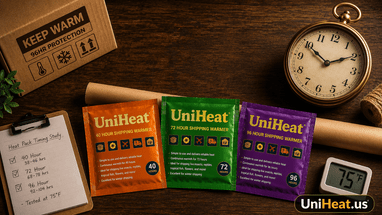
40-Hour Pack
Rated for 40 hours under standard conditions. Real-world ranges:
- Favorable conditions (proper foam insulation, ambient above 32°F, small box, fresh stock, top placement, 30-min activation window): 34–40 hours.
- Moderate conditions (foam insulation, ambient 20–32°F, normal box, fresh stock): 26–34 hours.
- Rough conditions (thin or no insulation, ambient below 20°F, oversized box, older stock): 15–26 hours.
This is why the 40-hour pack is not a winter default. In rough conditions you can lose more than half the rated duration, and a 24-hour overnight FedEx transit with a half-day delay is already in trouble.
72-Hour Pack
Rated for 72 hours under standard conditions. Real-world ranges:
- Favorable conditions: 62–72 hours.
- Moderate conditions: 48–62 hours.
- Rough conditions: 30–48 hours.
The 72-hour pack is the winter workhorse precisely because even in rough conditions it usually still beats the duration of overnight transit with a 24-hour delay. The lower-bound estimate of 30 hours still buys you a meaningful buffer over most expected ship times.
96-Hour Pack
Rated for 96 hours under standard conditions. Real-world ranges:
- Favorable conditions: 82–96 hours.
- Moderate conditions: 62–82 hours.
- Rough conditions: 42–62 hours.
The 96-hour pack is what you want for long routes, hard cold zones, and weekend-delay risk. Even in rough conditions you still have enough duration to absorb most realistic transit problems.
How to Tell If Your Heat Pack Is Still Working
A common assumption is that if the pack feels warm at delivery, it must have been warm the whole time. Not necessarily. A pack near the end of its reaction can give off some residual warmth even after dropping below useful working temperature. What feels lukewarm to your hand is not necessarily warm enough to protect a tropical animal.
A few practical checks:
- Look at the pack's color (some products only). Some heat packs are designed with iron-based content that visibly oxidizes from grey to brown as the chemistry completes. A pack that's still mostly grey has reaction capacity left.
- Check the box interior temperature on arrival. If you have a min/max thermometer (worth keeping a few for spot checks), a box that arrived at 70°F+ was protected. A box at 50°F was not.
- Check the receipt timing. A pack activated at 9am Monday, package picked up at 11am, delivered at noon Tuesday: that's 27 hours of duration spent. Anything beyond rated minus 27 was still available at delivery.
Common Misconceptions About Heat Pack Duration
A few myths worth correcting.
Myth 1: A bigger pack lasts longer. Not necessarily. Heat pack size and duration are independent specs. A larger 40-hour pack is still a 40-hour pack — it may deliver more total heat over those 40 hours (useful for a larger box), but it won't last longer than a smaller 40-hour pack.
Myth 2: Refrigerating heat packs makes them last longer. Storing unopened heat packs in cool, dry conditions extends shelf life. But you cannot pre-cool an activated pack to "save" it. Once the reaction starts, it runs. Refrigerating an active pack just makes the chemistry run cooler and the box colder — it doesn't pause it.
Myth 3: Two packs together last twice as long. Two packs in the same box deliver more heat output, not more duration. They both run on the same chemistry clock. They start together, they end together. Two 40-hour packs give you 40 hours of doubled output, not 80 hours.
Myth 4: A warm delivery means the pack worked the whole time. A pack can drop below useful protection temperature six or eight hours before delivery and still feel slightly warm. The animal's exposure to cold during those final hours is the actual risk, and you can't reconstruct it from the pack's hand-feel at the doorstep.
Myth 5: Adding more insulation always extends duration. Up to a point, yes. Past about 2 inches of foam, you're getting diminishing returns and adding box weight and shipping cost. The 1.5-inch standard exists because it's the practical sweet spot.
How to Plan Duration: The 2x Rule and Real-World Buffer
Most experienced shippers use a simple planning heuristic: choose a pack rated for roughly twice your expected transit time.
- Overnight (24 hours expected): 40-hour pack in favorable conditions, 72-hour in moderate or rough.
- Two-day (48 hours expected): 72-hour pack minimum, 96-hour in cold conditions.
- Three-day or anything with weekend risk: 96-hour pack as standard.
The 2x rule isn't magic. It's a buffer that absorbs the gap between rated and real-world performance, plus typical winter delays, plus the activation-window time before the box reaches the carrier. In favorable conditions you have surplus protection. In rough conditions you have just-enough protection. Either way, you're rarely caught short.
We've written a broader framework on this in our cold-weather shipping resource center, where the principles in this article apply across reptiles, plants, supplements, and live-animal shipping.
Highlights — Save This For Your Winter Shipping Workflow
Frequently Asked Questions
Does a 72-hour heat pack actually last 72 hours?
Under standard test conditions (proper foam insulation, ambient around 32°F, fresh stock, correct placement), yes — or very close to it. In rougher real-world conditions (thin insulation, ambient near 0°F, oversized box, older stock), the same pack might deliver 30 to 48 hours. The rated duration is achievable but conditional. Plan with real-world ranges in mind, not the label.
Why does my heat pack feel cold halfway through transit?
A few likely causes. The pack may have been activated too early, burning hours before the box reached the carrier. The box may be undersized on insulation, forcing the pack to work harder against the cold and shortening its life. The ambient route temperature may be significantly colder than the pack's test condition. Or the pack may be older stock with degraded chemistry. Audit each variable when troubleshooting.
Can I extend a heat pack's duration by sealing the box more tightly?
Counterintuitively, no. The reaction needs oxygen. A box sealed too tightly — especially the inner pack environment — will starve the chemistry of air, causing the pack to run cool and underperform. Use normal box sealing (tape on the outer seams) and let the pack breathe inside the insulated cavity.
How much insulation is enough?
Industry standard is 1.5 inches of expanded polystyrene foam (or equivalent R-value in another material) on all six sides of the inner cavity. Less than this and the pack works harder and dies sooner. More than 2 inches gives diminishing returns and adds shipping weight cost. 1.5″ is the practical sweet spot.
How long can I store unopened heat packs before they go bad?
Roughly 18 to 24 months from manufacture, when stored in cool, dry conditions. Beyond that window, expect real-world duration to drop measurably. Rotate inventory first-in-first-out. Check manufacture or expiration dates before each winter season. Don't try to stretch old stock through a winter cycle on high-value shipments.
Can I activate a heat pack in advance and then store it for later?
No. Once exposed to oxygen, the reaction starts and cannot be paused. Refrigerating an active pack slows the reaction slightly but doesn't stop it — and the cold storage means the box interior is colder, not warmer, when you actually use it. Activate within 30 minutes of sealing the box for transit.
Does the heat pack lose duration if it gets shaken or jostled in transit?
Not meaningfully. The chemistry isn't sensitive to motion. What can matter is if jostling causes the pack to shift inside the box — for example, sliding from the top into direct contact with the animal's container, or pressing against the cold outer wall. Tape the pack securely in place before sealing the box.
How do I know if my heat pack is fresh enough to use?
Check the manufacture or expiration date printed on the pack or the outer carton. Quality packs from established manufacturers are clearly dated. If you can't find a date, contact your supplier — for high-value or live-animal shipments it's worth knowing. As a rule of thumb, packs older than 24 months should be treated as reduced-performance and used only on low-stakes shipments, if at all.
Summary
Heat pack duration is a real specification, but it's a conditional one. The rated number on the label assumes a clean lab setup with controlled insulation, ambient temperature, oxygen access, and packaging. Every variation from that setup costs hours.
In favorable real-world conditions — proper foam insulation, moderate winter ambient, right-sized box, fresh stock, top placement, on-time activation — a quality heat pack will deliver close to its rated duration. In rough conditions, the same pack might deliver as little as 40 to 60% of rated. The difference is not the pack's fault. It's the system the pack is operating in.
The practical answer is to choose duration for the system, not just the route. A 72-hour pack with thin insulation in 0°F weather is not a 72-hour solution. A 40-hour pack in a tight foam cooler in 30°F weather often is. Choose for the conditions, build in 2× buffer over expected transit, and treat the pack and the insulation as a single system. Done that way, the gap between rated and real-world closes — and your winter shipping gets a lot more predictable.