
Posted by UniHeatPacks on 6th Jul 2026
Cold Chain Solutions for Small & Medium Businesses (2026)
Cold chain used to mean refrigerated trucks, industrial freezer warehouses, and enterprise-scale logistics operations. Small businesses had two choices: pay for enterprise-grade infrastructure they couldn't afford, or don't ship temperature-sensitive products at all. That's no longer true. Modern heat pack and insulation technology, combined with disciplined operational systems, lets small and medium businesses run reliable cold chain operations at costs that make sense for their volumes. This guide walks through what SMB cold chain actually looks like in 2026 — the technology, the operational systems, the vertical-specific applications, and the scaling path from 10 shipments per week to 10,000 — drawing on the framework we've built across our cold-weather shipping resource center.
The Short Answer: SMBs Don't Need Refrigerated Logistics
The mental model most small business owners have of "cold chain" is wrong for their situation. They picture refrigerated Sysco trucks, temperature-monitored warehouse cold storage, and enterprise-scale infrastructure operations serving grocery chains. That's one form of cold chain, but it's not the one their business needs.
Modern SMB cold chain uses passive systems: chemical heat packs (or gel packs, depending on season and product) inside insulated shipping containers, moved through standard carrier networks (FedEx, UPS). The system delivers reliable temperature control for 24-96 hour transit windows at a fraction of the cost of refrigerated logistics. The complete framework for choosing this approach is covered in our recent piece on insulated food delivery bags vs boxes, which distinguishes between local delivery bags and multi-day shipping boxes.
The savings are substantial. A refrigerated LTL shipment across state lines runs $200-600 depending on distance and volume. A parcel-sized heat pack shipment covering the same route runs $25-50 all-in, including the pack, insulation, outer box, and carrier service. For SMBs shipping between 10 and 1,000 boxes per week, the parcel-based cold chain is usually the right economic and operational fit.
What "Cold Chain" Actually Means for SMBs
For enterprise operations, cold chain means end-to-end refrigerated storage and transport from source to shelf. For SMBs, cold chain means something different: reliable temperature control during the specific window when the product is out of your hands and in the carrier's network.
The SMB cold chain has three phases:
Phase 1: Origin Storage
Your products live in your normal storage (climate-controlled if needed, but often just room-temperature warehouse or dedicated cold storage for genuinely refrigerated products). This phase is under your control and doesn't require special cold-chain infrastructure beyond what you already have.
Phase 2: Transit (The Critical Window)
This is where cold chain technology matters. The product goes from your fulfillment area into an insulated shipping box with the right heat pack (winter) or gel pack (summer). It rides FedEx or UPS through carrier sorting facilities and delivery routes for 24-96 hours. This is the window where temperature failures happen if the system isn't right. The full route strategy is covered in our piece on route package protection.
Phase 3: Delivery
The customer receives the package. Ideally they receive it in-person (Adult Signature for alcohol, or standard signature for other categories). Sometimes it sits on a porch (residential delivery) or waits at a carrier facility (Hold for Pickup). This phase is where the difference between "package arrives" and "package arrives in good condition" gets tested.
Why Refrigerated Shipping Isn't Always the Answer
Even for products that "need" refrigeration, refrigerated parcel service isn't automatically the right choice for SMBs. Several factors push toward passive heat pack systems instead:
Cost
Refrigerated parcel service costs 3-10x standard shipping rates. For an SMB shipping 100 boxes per week at $30 per box refrigerated vs $15 per box with heat packs and insulation, the difference is $6,000/month or $72,000/year. That's real money that has to come out of margin.
Reliability
Passive systems (heat packs + insulation) have surprisingly high reliability once configured correctly. Testing data on whether heat packs actually work in extreme cold shows consistent performance across challenging conditions. The failure modes are known and manageable through operational discipline.
Availability
Refrigerated parcel service isn't universally available. Coverage gaps exist in rural areas, and some SMB fulfillment locations don't have refrigerated LTL pickup at all. Passive systems work through the standard FedEx/UPS network that reaches virtually every US ZIP code.
Simplicity
Managing refrigerated shipping adds operational complexity: cold-chain-certified staff, temperature loggers, compliance documentation, refrigerated LTL scheduling. Passive systems fit inside standard fulfillment workflows. Our piece on building a reliable cold shipping system covers the operational simplicity angle in detail.
For most SMBs, the answer is a passive heat pack system for the vast majority of shipments, with the option to use refrigerated shipping only for the small percentage of products where it's genuinely required (regulated pharmaceuticals, specific temperature-critical biologicals).
The Heat Pack + Insulation System Approach
Here's what a working SMB cold chain looks like in practice:
Component 1: Heat Pack (Winter) or Gel Pack (Summer)
For winter shipping, the choice is between 40-hour, 72-hour, and 96-hour heat packs. Our guide on how to select the perfect heat pack duration covers the framework. Summary:
- 40-hour pack for short routes and mild winter conditions
- 72-hour pack for standard winter shipping (most common choice)
- 96-hour pack for cold zones and weekend-delay risk
For summer shipping, gel packs replace heat packs. The framework for choosing between them is in our piece on gel packs vs heat packs. For overlap scenarios where both are needed, see combining heat packs with cold packs.
Component 2: Insulation
The standard is 1.5-inch expanded polystyrene (EPS) foam on all six sides of the interior cavity. Alternative materials (polyurethane foam, vacuum insulated panels, reflective bubble wrap, eco-friendly wool liners) exist for specific use cases. Our comprehensive shipping container insulation guide compares them across R-value, cost, and use case.
Component 3: Outer Container
Corrugated cardboard outer box, single or double-walled depending on weight and structural needs. For box size selection, see our resource on choosing the right box size and insulation.
Component 4: Buffer Materials
Kraft paper, food-safe wraps, molded pulp inserts for glass bottles. These prevent direct contact between the heat pack and the product (which can cause burn damage or product quality issues) and secure the product against shifting during transit. Full material analysis is in our piece on the top 3 packing materials to pair with heat packs.
Component 5: Documentation
Photo of assembled box, tracking data, weather forecast at ship time. This documentation supports claims and drives continuous improvement.
Verticals Where SMB Cold Chain Works
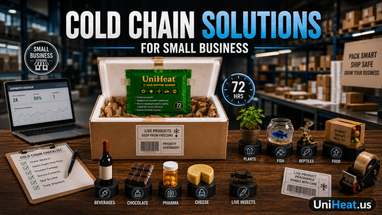
Nine main product verticals use SMB passive cold chain reliably. Each has slightly different pack and insulation requirements, but the underlying system is consistent.
1. Live Plants
Tropical houseplants, succulents, orchids, and specialty plants shipped by online nurseries. The full protocol is in our piece on heat mat vs heat pack for plant shipping, which walks through USDA zone selection and packaging.
2. Live Animals (Reptiles, Amphibians, Invertebrates)
Reptile breeders and exotic pet retailers shipping directly to hobbyist customers. This is the most demanding SMB cold chain use case — the failure mode is animal mortality. Detailed guidance in our piece on ball python winter shipping and broader coverage in our live animal shipping content.
3. Live Tropical Fish
Aquarium fish shipped from breeders and specialty retailers. Similar principles to reptile shipping. Our resource on shipping tropical fish safely in winter covers species-specific requirements.
4. Food (Meal Kits, Baked Goods, Fresh)
DTC food companies, meal kit subscriptions, artisan bakeries, specialty food producers. The recent food vertical opens in our piece on heat packs for food shipping, with FDA compliance considerations and category-by-category recommendations.
5. Beverages (Wine, Beer, Spirits)
Wineries, breweries, distilleries, and specialty beverage retailers. Legal complexity plus freeze sensitivity make this vertical uniquely demanding. Full guide in our piece on how to ship wine, beer & spirits in winter.
6. Premium Chocolate and Confections
Artisan chocolatiers and specialty confection makers. Cosmetic sensitivity means small temperature swings can ruin premium products. Detailed guidance in our specialty food and chocolate shipping guide.
7. Pharmaceuticals and Supplements
Supplement retailers, specialty pharmacy operations, some biologic supplements. Regulatory considerations layer on top of the temperature challenge. Some products fit within SMB passive systems; others require validated refrigerated cold chain.
8. Cheese and Dairy
Artisan cheesemakers, dairy subscription services, specialty dairy retailers. Similar principles to other food categories, with attention to species-specific storage requirements for aged cheeses.
9. Live Insects (Feeder Insects, Beneficial Insects)
Reptile hobby industry feeders, pollinator services, biological pest control. The particular challenge is that live insects are sensitive to both cold and overheating in transit. Guidance in our piece on shipping live insects and feeders.
Verticals Where You Need Full Refrigerated Logistics
Not everything belongs in an SMB passive cold chain. Some products genuinely require enterprise refrigerated logistics:
- Regulated pharmaceutical cold chain (vaccines, insulin, temperature-critical biologics with strict compliance requirements)
- Fresh, un-frozen seafood for restaurant and grocery supply (temperature stability requirements exceed passive system capability)
- Fresh, un-frozen meat for restaurant and grocery supply
- Time-sensitive biological samples (tissue samples, certain diagnostic materials)
- Large-scale food distribution (LTL loads to restaurants, distributors, food service)
For SMBs whose product mix includes some of these categories, the operational answer is usually a hybrid model: passive cold chain for the parcel-sized DTC shipments, refrigerated logistics for the LTL loads to institutional customers. The two systems can coexist within one business without adding excessive operational complexity.
Cost Comparison: Heat Pack System vs Refrigerated Carrier
The math almost always favors passive cold chain for SMB parcel shipments. Here's the comparison for a typical 8″×8″×12″ box shipped 1,200 miles overnight:
| Cost Component | Heat Pack System | Refrigerated Carrier |
|---|---|---|
| Heat pack / gel pack | $4-6 | Included in service |
| Insulation liner | $5-8 | Not required |
| Outer box | $2-4 | $2-4 |
| Buffer materials | $1-2 | $1-2 |
| Carrier service (Priority Overnight) | $25-45 | $75-150 |
| Insurance / compliance | $1-2 | $5-15 |
| Total per shipment | $38-67 | $83-171 |
For an SMB shipping 100 boxes per week, the annual difference between passive and refrigerated is approximately $234,000-540,000. That's a substantial fraction of most SMB total operational budgets. The framework for making this trade-off analytically is in our piece on cost vs protection in heat pack usage.
Operational Setup for an SMB Cold Chain
Building the operational side of an SMB cold chain requires answering these questions:
Physical Setup
- Dedicated packing station with heat pack storage nearby
- Foam liner and outer box inventory in accessible locations
- Buffer material dispensers (kraft paper, molded pulp inserts)
- Tape, labels, and outer marking supplies
- Pack activation timing area (opens 20-30 min before pickup)
- Carrier pickup coordination point
SOPs and Training
- Standard pack-out procedure by product category
- Three-point weather check procedure (origin, hub, destination)
- Ship-day discipline (Monday-Wednesday in active winter)
- Documentation procedure (photo, tracking log)
- Customer communication template (tracking, expected window, handling instructions)
- Claims documentation procedure for the small percentage of failures
Inventory Management
- Pack inventory by tier (40hr, 72hr, 96hr) matched to seasonal demand
- Foam liner inventory by box size
- Outer box inventory
- Buffer material inventory (kraft paper, molded pulp)
- Seasonal ramp planning (heat packs order 60-90 days before peak winter)
The full operational framework is in our piece on building a reliable cold shipping system and our practical resource on the winter shipping checklist for small businesses.
Inventory and Procurement Strategy
For SMBs building cold chain inventory, the procurement rhythm matters. Heat packs have an 18-24 month shelf life, which allows moderate stockpiling for peak seasons. Foam liners and boxes have effectively unlimited shelf life. Buffer materials (kraft paper) also unlimited.
A typical annual procurement rhythm:
- August-September: Order winter-season pack inventory (60-90 day buffer for the coming Oct-Mar season)
- October: Ramp up storage of foam liners and outer boxes
- December-February: Peak use, reorder as needed based on run rate
- March-April: Transition to gel packs for summer season
- May-August: Summer season, gel pack use dominant
This seasonal rhythm is covered in more depth in our piece on the complete fall-to-winter shipping transition guide and our resource on preparing your shipping strategy for next year.
Building SOPs and Team Training
The single biggest driver of SMB cold chain success is operational discipline, not technology choice. Two identical operations with the same packs and boxes can have vastly different loss rates based on how consistently they execute the pack-out procedure.
The core SOP components:
Pre-Shipment SOP
- Three-point weather check (origin, hub, destination for next 48 hours)
- Ship-day verification (Monday-Wednesday in active winter)
- Product selection and pre-packaging
- Box, foam liner, and heat pack selection
- Customer communication (tracking, expected window)
Pack-Out SOP
- Foam liner assembly in outer box (no gaps at corners)
- Product placement with buffer materials
- Heat pack activation (open wrapper, wait 20-30 min for ramp-up)
- Heat pack placement (top of cavity, taped to inner lid)
- Fill remaining space with kraft paper or buffer material
- Box sealing with proper outer markings
- Documentation (photo of assembled box, then sealed box, then carrier receipt)
Post-Shipment SOP
- Tracking log entry (route metadata, weather forecast at ship time)
- Customer confirmation of package pickup
- Follow-up on any reported issues within 48 hours of delivery
- Root cause analysis for any failures
- Weekly review of loss patterns
Team training on these SOPs typically takes 3-5 days for a new fulfillment employee to reach reliable execution. Ongoing training happens whenever new products, packaging configurations, or seasonal transitions occur. Common mistakes to train against are documented in our piece on 5 common mistakes when using heat packs.
Scaling From 10 to 1,000 Shipments Per Week
The scaling path for SMB cold chain is often smoother than expected. Unlike enterprise cold chain (which requires major infrastructure investments to scale), passive cold chain scales through operational maturity and volume-buying efficiencies. The scaling steps:
10-50 Shipments Per Week (Startup Phase)
One person handles fulfillment. Manual pack-out, manual tracking, ad-hoc procurement. Focus is on establishing the SOP and getting the basic pattern reliable. Total cold chain investment: $500-1,500 in inventory.
50-200 Shipments Per Week (Growth Phase)
Dedicated fulfillment area. 1-2 packers with cross-training. Regular procurement rhythm. Basic KPI tracking (loss rate, cost per shipment). Bulk purchasing starts to matter. Investment: $3,000-8,000 in inventory.
200-500 Shipments Per Week (Scaling Phase)
Full-time fulfillment team of 3-5 people. Bulk pack orders from suppliers. Route-level loss analysis. SOP maturity with periodic training. Optional integration with fulfillment automation (barcode scanning, automated tracking updates). Investment: $8,000-25,000 in inventory. The framework for this scaling stage is covered in detail in our piece on how to scale heat pack usage for higher volumes.
500-1,000+ Shipments Per Week (Operational Maturity)
Multiple fulfillment shifts. Dedicated shift leader. Vendor-managed inventory arrangements. Automated pack-out equipment (foam liner insertion, box forming). Data-driven route optimization. Cross-training with additional verticals if the business expands product lines. Investment: $25,000-100,000+ in equipment and inventory.
At this scale, the operational sophistication that we cover in managing expectations around heat pack performance and lessons learned from peak season shipping becomes critical to running efficiently.
Common SMB Cold Chain Mistakes
Six patterns that show up repeatedly in SMB cold chain failures:
Mistake 1: Under-investing in insulation to save $2 per shipment. A thin foam liner or bubble wrap substitute saves pennies but exposes the product to full failure risk. The insulation is a small piece of the total cost but a large piece of the reliability equation. Our framework in heat pack vs insulation in cold shipping makes clear why both are needed.
Mistake 2: Treating pack duration as the only lever. Upgrading to 96-hour packs without also addressing insulation, route selection, and ship-day discipline is throwing money at a problem that requires system-level thinking. The complete route strategy in our piece on route package protection shows why route matters as much as pack tier.
Mistake 3: Ignoring weekend delay risk. Thursday-Friday shipping in winter is the single most preventable cause of losses. This alone can account for 40-70% of winter losses in operations that don't enforce ship-day discipline. Our resource on how to reduce winter shipping losses documents the pattern in detail.
Mistake 4: Under-training team members. New fulfillment employees who haven't been trained on the SOP execute the pack-out inconsistently. Loss rates for teams without SOP training run 3-5x higher than teams with disciplined training programs.
Mistake 5: Not tracking loss data. Without route-level, product-level, and configuration-level loss tracking, you can't identify the specific patterns driving losses. The claims data is your continuous improvement input.
Mistake 6: Assuming "overnight" means overnight. Overnight FedEx delivery in winter routinely takes 24-36 hours or more due to weather, hub delays, and delivery attempt patterns. Sizing pack duration to expected transit rather than realistic worst-case transit leaves too little margin. The 2× rule (pack duration = 2× expected transit) is documented in how long heat packs really last in transit.
Peak Season Preparation for SMB Cold Chain
Winter peak season (November through early January) is when SMB cold chain operations get stressed the most. Volume increases, weather worsens, and any operational weakness gets exposed. Preparation matters more than reactive management.
The key peak season prep items:
- Pack inventory in place by mid-October (60-90 day buffer for peak season)
- Insulation and box inventory doubled or tripled based on projected volume
- Additional fulfillment capacity scheduled (temporary staff, extended hours)
- Carrier relationship confirmed (Priority Overnight capacity, alcohol shipping agreements)
- Customer communication templates ready (shipping cutoff dates, delivery expectations)
- Loss tracking dashboards updated for daily monitoring during peak
The peak season playbook is covered in our resource on lessons learned from peak season shipping, drawing on patterns from prior seasons.
Working with 3PLs for SMB Cold Chain
For SMBs approaching 1,000+ shipments per week, or for operations that want to focus on product and marketing rather than fulfillment operations, third-party logistics (3PL) partners can handle the cold chain execution.
Working with a 3PL for cold chain has trade-offs:
Advantages of 3PL
- Immediate operational capability without building internal team
- Access to bulk pack purchasing at scale
- Multiple fulfillment locations to reduce transit time
- Existing carrier relationships and negotiated rates
- Compliance expertise for regulated verticals (alcohol, food, pharma)
Disadvantages of 3PL
- Higher per-shipment cost than in-house operation at scale
- Less control over pack-out details and SOP execution
- Communication challenges when issues arise
- Some 3PLs lack cold chain expertise despite marketing claims
For most SMBs, the decision between in-house and 3PL happens somewhere between 500 and 2,000 shipments per week. Below that, in-house is usually more economical. Above that, the 3PL efficiency advantages can outweigh the cost premium.
Monitoring and Continuous Improvement
An SMB cold chain that isn't monitored gets slowly worse over time. Teams cut corners, packaging quality drifts, ship-day discipline erodes. Weekly and monthly monitoring keeps the system operating at its intended reliability level.
Key metrics to monitor:
- Loss rate by product category (target: under 2% in winter, under 1% year-round)
- Loss rate by route (identify problematic routes for targeted intervention)
- Loss rate by ship day (verify Monday-Wednesday discipline is holding)
- Loss rate by pack tier (verify 72-hour vs 96-hour decisions are correct)
- Per-shipment cost trends (identify creep in packaging or carrier costs)
- Customer satisfaction / return rate (leading indicator for quality issues)
The framework for using this data to drive continuous improvement is in our piece on how to reduce winter shipping losses, which walks through the systematic approach.
The Complete SMB Cold Chain Framework
Bringing it all together, here's what a mature SMB cold chain looks like:
- Technology: Standardized on 72-hour heat packs for winter, gel packs for summer, 1.5″ EPS foam insulation, standard corrugated outer boxes
- Vertical specialization: Category-specific configuration (bottle inserts for beverages, food-safe buffers for food, plant-appropriate packaging for live plants)
- Route strategy: Three-point weather check, ship-day discipline, appropriate carrier service tier (usually FedEx Priority Overnight)
- Operational SOPs: Documented pack-out procedure, training programs, quality checks
- Monitoring: Loss tracking by multiple dimensions, weekly review, quarterly deep analysis
- Continuous improvement: Data-driven optimization of pack tiers, packaging, and process
For most SMBs, achieving this level of maturity is a 12-18 month journey from initial launch to steady-state reliability. The investment pays back through consistently low loss rates, better customer satisfaction, and lower per-shipment costs compared to enterprise refrigerated alternatives.
Real SMB Cold Chain Examples
Example 1: Artisan Chocolatier (100 shipments/week)
Origin: New York. Product: premium chocolate boxes. Configuration: 96-hour heat packs (chocolate is highly cosmetic), 2″ EPS foam for premium insulation, molded pulp inserts, FedEx Priority Overnight with Adult Signature. Shipping: Monday and Tuesday only. Total per-shipment cost: $28. Product value: $85 average. Winter loss rate: 0.8%. This operation runs on a mature SOP built over 3 years of continuous improvement.
Example 2: Craft Winery Wine Club (500 shipments/week)
Origin: California. Product: 3-bottle wine club shipments. Configuration: 72-hour heat packs, 1.5″ EPS foam, molded pulp bottle inserts, FedEx Priority Overnight with Adult Signature. Shipping: Monday-Wednesday. Cold zone destinations upgrade to 96-hour packs automatically. Per-shipment cost: $18. Product value: $120 average. Winter loss rate: 1.2%. Operational team of 4 packers plus shift leader.
Example 3: Meal Kit Startup (200 shipments/week)
Origin: Illinois. Product: 3-meal fresh ingredient kits. Configuration: 72-hour heat packs (winter) or gel packs (summer), 1.5″ EPS foam liner, standard corrugated outer, FedEx Priority Overnight. Shipping: Monday and Tuesday only. Per-shipment cost: $15. Product value: $75 average. Loss rate: 1.5% winter, 0.8% summer. Company recently upgraded from 40-hour to 72-hour packs after Q1 data analysis showed weekend delay losses.
Example 4: Reptile Breeder (30 shipments/week)
Origin: Florida. Product: captive-bred reptiles. Configuration: 96-hour heat packs (live animal shipments require maximum protection), 2″ foam insulation, custom animal container inside outer box, FedEx Priority Overnight with Hold for Pickup at destination. Shipping: Monday only. Per-shipment cost: $28. Product value: $200-500 per animal. Loss rate: 0.5% (industry-leading for the category). This operation uses documentation photos of every pack-out as insurance against carrier claims.
Example 5: Specialty Cheese Retailer (150 shipments/week)
Origin: Vermont. Product: artisan cheese subscription boxes. Configuration: 72-hour heat packs, 1.5″ EPS foam, food-safe buffer materials. Shipping: Monday-Tuesday only. Per-shipment cost: $17. Product value: $80 average. Loss rate: 1.1%. Winter shipping cutoff at destinations forecasting below 20°F unless customer explicitly accepts the risk.
How SMB Cold Chain Connects to Broader Business Strategy
For SMBs building cold-weather product businesses, the cold chain isn't a back-office function — it's a strategic asset. It shapes what geographies you can serve, what price points work, and what customer experience you deliver.
The strategic considerations that flow from cold chain capability:
- Geographic market strategy (do you serve all 50 states or focus on regional markets where cold chain is simpler?)
- Pricing strategy (can you afford to include shipping in product price, or do you charge separately?)
- Product mix decisions (do the operational requirements of adding cold-sensitive SKUs justify the additional complexity?)
- Customer experience decisions (do you offer expedited shipping premiums? Winter shipping guarantees?)
- Growth pace decisions (do you scale volume before cold chain maturity, or vice versa?)
Answering these strategically requires understanding your specific operations. The core cold-weather shipping principles that apply across verticals are consolidated in our shipping solutions resource center.
Highlights — The SMB Cold Chain Reference Card
Frequently Asked Questions
What are cold chain solutions for small businesses?
For small and medium businesses, cold chain solutions typically use passive systems: chemical heat packs (winter) or gel packs (summer) inside insulated shipping containers, moved through standard carrier networks like FedEx and UPS. This approach delivers reliable temperature control for 24-96 hour transit windows at $10-25 per shipment all-in, compared to $75-150+ per shipment for refrigerated parcel service. The system works reliably for the vast majority of temperature-sensitive product categories that SMBs ship.
Do small businesses need refrigerated shipping?
Most small businesses don't need refrigerated shipping for their standard product mix. Passive heat pack systems handle 90%+ of cold-sensitive shipping use cases at a fraction of the cost. Refrigerated shipping is genuinely required only for regulated pharmaceutical cold chain (vaccines, insulin, biologics with strict compliance requirements), fresh un-frozen seafood and meat for institutional customers, and time-sensitive biological samples. For live plants, live animals, food, beverages, chocolate, and most supplements, passive cold chain works reliably.
How much does SMB cold chain cost per shipment?
For most small and medium businesses, total cold chain cost lands around $10-25 per shipment all-in. This includes the heat pack ($3-6), insulation liner ($4-8), outer box ($2-4), buffer materials ($1-2), and carrier service (typically FedEx Priority Overnight at $25-45 for parcel-sized boxes). Premium configurations for high-value products like premium chocolate or sparkling wine may run $25-30. This compares to $75-150+ per shipment for refrigerated parcel service.
How do I scale my cold chain from 10 to 1,000 shipments per week?
Scaling SMB cold chain is more about operational maturity than infrastructure investment. Key stages include: 10-50 shipments (single packer, manual SOPs), 50-200 (dedicated fulfillment area, cross-trained team of 1-2), 200-500 (3-5 packer team, bulk purchasing, KPI tracking), and 500-1,000+ (multiple shifts, automated equipment, vendor-managed inventory). The pack and insulation system stays the same throughout; what changes is the operational sophistication around it. Full scaling considerations are covered in dedicated resources on scaling heat pack usage for higher volumes.
What are the most common SMB cold chain mistakes?
The most common patterns are under-investing in insulation to save pennies, treating heat pack duration as the only lever (ignoring insulation and route), ignoring weekend delay risk by shipping Thursday-Friday, under-training team members on pack-out procedures, not tracking loss data by route and product, and assuming FedEx overnight actually means overnight. Each of these can be systematically prevented with proper SOPs and ongoing training. Loss rates for operations addressing these issues typically run 1-2% in winter; operations not addressing them run 8-15%.
What products can be shipped with SMB cold chain systems?
The nine main verticals that use SMB cold chain reliably are: live plants (tropical houseplants, succulents, specialty plants), live animals (reptiles, amphibians, invertebrates), live tropical fish, food (meal kits, baked goods, fresh ingredients), beverages (wine, beer, spirits), premium chocolate and confections, some pharmaceuticals and supplements, cheese and dairy, and live insects (feeders, beneficial insects). Each vertical has slightly different pack and packaging requirements, but the underlying heat pack + insulation system is consistent.
Should I use a 3PL for cold chain fulfillment?
The decision between in-house cold chain fulfillment and 3PL depends on volume. Below 500 shipments per week, in-house is usually more economical because you have direct control over quality and pack-out details. Above 2,000 shipments per week, 3PL efficiency advantages often outweigh the cost premium. In the 500-2,000 range, the decision depends on your specific business situation, particularly whether you can focus on product and marketing while a 3PL handles operations. Not all 3PLs have genuine cold chain expertise despite marketing claims, so vet potential partners carefully.
What's the biggest driver of cold chain reliability for SMBs?
Operational discipline is the single biggest driver, not technology choice. Two operations with identical heat packs and insulation can have dramatically different loss rates based on SOP execution consistency. The key operational disciplines are ship-day restriction (Monday-Wednesday in active winter), three-point weather checks before shipping, consistent pack-out procedures across all team members, disciplined documentation of each shipment, and route-level loss tracking that drives continuous improvement. Operations with mature discipline typically run 1-2% winter loss rates; those without run 8-15%.
Summary
Modern SMB cold chain is fundamentally different from enterprise refrigerated logistics. It uses passive systems — heat packs in winter, gel packs in summer — inside insulated shipping containers, moved through standard FedEx and UPS parcel networks. The system delivers reliable temperature control for the 24-96 hour transit windows that most SMB shipments require, at costs 3-10x lower than refrigerated parcel alternatives.
The nine main verticals where SMB cold chain works reliably span live plants, live animals, food, beverages, chocolate, cheese, and other temperature-sensitive categories that support SMB business models. Scaling from 10 shipments per week to 1,000 or more requires operational maturity, not major infrastructure investment. The technology is affordable and accessible; what separates successful cold chain operations from failing ones is the operational discipline around SOPs, training, ship-day rules, and continuous improvement.
For SMBs building cold-weather product businesses, the cold chain isn't a back-office function — it's a strategic asset that shapes market reach, pricing, and customer experience. The framework in this guide, combined with the detailed vertical-specific guidance across our other resources, provides the foundation for building reliable cold chain operations at SMB scale. For deeper coverage of individual components, see our shipping solutions resource center and our comprehensive content across heat pack topics, cold shipping, and temperature control shipping.