
Posted by UniHeatPacks on 14th Jul 2026
Insulated Shipping Containers: Types, Sizes & Selection Guide
Insulated shipping containers look interchangeable on the surface. Same shape, same white foam, same corrugated outer box. The variations that matter aren't visible until you specify a product for a particular shipping scenario — different foam types have different R-values, different sizes accommodate different product volumes, and different materials come with different sustainability trade-offs and price points. This guide walks through the full decision framework: container types available in 2026, sizing considerations, R-value comparisons, cost per shipment, sustainability alternatives, and how to spec the right container for your specific vertical — building on the framework we've established across our cold-weather shipping resource center.
The Short Answer: EPS Foam at 1.5″ Thickness Handles 90% of SMB Shipping
For most small and medium businesses shipping temperature-sensitive products, the right choice is a standard EPS foam liner at 1.5″ thickness inside a corrugated outer box. This combination delivers reliable thermal performance for 24-96 hour transit at $4-8 per liner — the sweet spot on cost, availability, and performance. The full case for this standard is laid out in our foundational shipping container insulation guide, which compares R-values across materials.
The reason EPS foam dominates SMB shipping isn't quality — higher-R-value materials exist. It's the total cost, availability, and dimensional flexibility. You can order EPS foam liners in dozens of sizes, from any packaging supplier, with next-day delivery, at prices that make the per-shipment math work. The alternatives (polyurethane foam, VIP panels, wool, mushroom foam) each have narrow use cases where they win, but EPS is the default for a reason.
What varies by application is thickness and size:
- 1″ EPS — short local delivery, minimal thermal protection, budget option
- 1.5″ EPS — standard for cold-weather and refrigerated shipping (most common)
- 2″ EPS — frozen shipping standard, premium cold-weather shipping, longer transit windows
- 3″ EPS — specialized applications (ice cream, extreme routes, cross-country transit)
Why Insulated Shipping Containers Matter
The core function of an insulated shipping container is to slow heat transfer — either into the box (frozen shipping, refrigerated shipping) or out of the box (cold-weather shipping with heat packs). Insulation doesn't create cold or warmth; it slows the movement of thermal energy across the container wall.
This is important because the insulation and the heat pack (or gel pack, or dry ice) work as a system. A 72-hour heat pack in a poorly insulated box performs like a 24-hour pack. A well-insulated box with a proper pack delivers close to the rated duration under real shipping conditions. The interplay between the two components is covered in depth in our piece on heat pack vs insulation in cold shipping.
For frozen shipping (opposite direction), the same principle applies. Our recent piece on how to ship frozen meat and food overnight details the frozen-shipping application, where 2″ EPS foam is the standard because dry ice sublimates faster in inadequate insulation.
Understanding R-Value in Shipping Insulation
R-value measures thermal resistance — higher R-value means slower heat transfer. For shipping insulation, R-value determines how long the container maintains its internal temperature. It's the most important spec to understand when comparing container options.
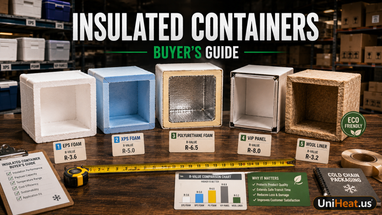
R-Value Comparison Across Common Materials
| Material | R-Value per Inch | Common Thickness | Cost per Liner (small box) |
|---|---|---|---|
| EPS foam (expanded polystyrene) | ~4 | 1″ to 3″ | $4-8 |
| XPS foam (extruded polystyrene) | ~5 | 1″ to 2″ | $6-12 |
| Polyurethane (PU) foam | ~6 | 1″ to 2″ | $8-15 |
| Vacuum insulated panels (VIP) | ~30 | 0.5″ to 1″ | $40-100+ |
| Wool liner | ~3.5 | 1″ to 2″ | $12-25 |
| Mushroom foam (mycelium) | ~3.5-4 | 1.5″ to 2″ | $15-30 |
| Cornstarch foam | ~3-3.5 | 1.5″ to 2″ | $10-20 |
| Reflective bubble wrap | ~1-1.5 | 0.25″ to 0.5″ | $1-3 |
The key insight from this table: EPS foam at 1.5″ delivers R-6 total, while VIP at 0.5″ delivers R-15 total. But EPS costs $5, VIP costs $50. For 24-72 hour transit windows, EPS delivers all the R-value most SMBs actually need. VIP is overkill for most applications.
Container Types Deep-Dive
EPS Foam (Expanded Polystyrene)
The workhorse of the shipping insulation industry. Manufactured by expanding polystyrene beads with steam, then molding into shipping-container shapes. Rigid, lightweight, dimensionally stable, and highly compatible with any product category.
Best for: Live plants, live animals, food shipping, beverages, general SMB cold-weather shipping.
Advantages: Low cost, wide availability, standard sizes, good thermal performance, works with heat packs and gel packs equally well.
Disadvantages: Not curbside recyclable in most areas, environmental impact concerns, requires proper disposal channels.
When to choose: Default choice for SMB cold-weather shipping. Standard 1.5″ EPS foam liner handles most applications reliably. Discussed in depth in our insulation guide.
XPS Foam (Extruded Polystyrene)
Similar to EPS but with a denser, more uniform structure. Higher R-value per inch. Typically blue or pink in color due to manufacturing processes. Better moisture resistance than EPS.
Best for: Higher-humidity destinations, longer transit windows, premium product shipping.
Advantages: Higher R-value per inch than EPS, better moisture resistance, denser structure resists compression.
Disadvantages: 30-50% more expensive than EPS, less commonly stocked by packaging suppliers, similar environmental concerns.
Polyurethane (PU) Foam
Higher-performing rigid foam. Used in premium shipping containers and often laminated with reflective foil layers to boost thermal performance. Common in high-end pharmaceutical shipping.
Best for: Premium chocolate shipping, pharmaceutical shipping, cross-country routes in extreme conditions.
Advantages: R-6 per inch (50% higher than EPS), often includes reflective layer, excellent dimensional stability.
Disadvantages: 2x cost of EPS, more difficult to source in standard sizes, environmental concerns.
When to choose: Premium applications where the 20-30% duration extension over EPS justifies the doubled cost. For most SMBs, this is a special-case choice rather than the default.
Vacuum Insulated Panels (VIP)
The highest-performance shipping insulation available. Ultra-thin panels with a vacuum-sealed core, providing R-30 per inch. Used in enterprise pharmaceutical shipping and specialty applications where extreme thermal performance is required.
Best for: Regulated pharmaceutical cold chain, high-value biologics, cross-continental transit where standard insulation can't meet duration requirements.
Advantages: Extraordinary R-value, allows for very thin container walls (more usable interior space), premium presentation.
Disadvantages: 5-10x cost of EPS, fragile (puncturing the vacuum destroys performance), limited size availability, requires specialty suppliers.
When to choose: Rare for SMB applications. Consider only when regulated pharmaceutical requirements or extreme routes make it necessary.
Wool Liners
Sheep's wool packed inside a food-safe fabric outer, treated for moisture resistance. Growing in popularity for eco-conscious brands. Renewable, biodegradable, moderately effective thermally.
Best for: Sustainability-focused DTC brands, food and beverage subscription boxes, artisan retail.
Advantages: Renewable resource, biodegradable, customer-friendly marketing story, moisture-managing.
Disadvantages: 2-3x cost of EPS, R-value slightly lower per inch, requires thicker material to match EPS performance, less dimensional stability.
When to choose: When customer sustainability values align with brand positioning. Premium subscription boxes often include wool as part of the unboxing experience.
Mushroom Foam (Mycelium-Based)
Grown from mycelium (mushroom root structures) on agricultural byproducts. Fully biodegradable, molded to any container shape. Increasingly available from specialty suppliers.
Best for: Eco-conscious brands, one-time premium shipments, marketing-forward sustainability positioning.
Advantages: Fully compostable/biodegradable, similar R-value to EPS, dimensionally stable, unique aesthetic.
Disadvantages: 3-5x cost of EPS, limited size availability, growing production capacity (not yet mainstream), variability in dimensional consistency.
Cornstarch Foam
Bio-based foam made from cornstarch and other plant materials. Water-soluble (dissolves in warm water), fully biodegradable. Similar handling to EPS but with sustainability advantages.
Best for: Consumer-facing brands where the biodegradability story matters.
Advantages: Fully biodegradable, water-soluble for easy disposal, made from renewable resources.
Disadvantages: 2-3x cost of EPS, moisture-sensitive during storage, slightly lower R-value, degrades during long storage in humid conditions.
Reflective Bubble Wrap
Bubble wrap with reflective foil layers. Very thin (0.25-0.5 inches), low R-value on its own, but effective as a supplement to primary insulation. Not suitable as sole insulation.
Best for: Supplementary insulation, budget short-transit shipping, occasional overflow packing.
Advantages: Very inexpensive, minimal space consumption, adds reflective heat management, easy to include with other packing materials.
Disadvantages: Insufficient alone for cold-weather shipping, marginal R-value contribution, environmental disposal concerns.
Size Selection Framework
Container size selection depends on three factors: product dimensions, heat pack or gel pack placement space, and total shipping weight optimization. Our resource on choosing the right box size and insulation walks through the framework in detail. Here's the practical version:
Common Container Sizes and Their Use Cases
| Interior Cavity | Total Outer Dimensions | Typical Use Cases |
|---|---|---|
| 6″×6″×6″ | 9″×9″×9″ | Small live animals, single specialty items, sample shipments |
| 8″×8″×8″ | 11″×11″×11″ | Wine 1-2 bottle, small chocolate boxes, small plants |
| 10″×10″×10″ | 13″×13″×13″ | Standard meal kits, medium wine cases, medium plants |
| 12″×10″×10″ | 15″×13″×13″ | Frozen meat 5-10 lb, larger meal kits, wine 3-6 bottle |
| 14″×12″×12″ | 17″×15″×15″ | Frozen meal delivery service, larger plant shipments, 12-bottle wine |
| 16″×14″×12″ | 19″×17″×15″ | Multi-item catering, large produce boxes, seafood |
| 18″×18″×18″ | 21″×21″×21″ | Wild game processors, large frozen shipments, bulk plant shipping |
The Interior-vs-Exterior Dimension Trap
The single most common size-selection mistake: specifying the wrong dimension. Insulated containers are measured by interior cavity (usable space) but shipped and priced by exterior dimensions. A "10″ foam liner" has an 10″ interior cavity but 13″ outer dimensions (accounting for 1.5″ foam on all sides).
When ordering, verify:
- Interior dimensions — must fit your product plus buffer materials plus heat pack placement space
- Exterior dimensions — determines carrier dimensional weight billing and outer box requirements
- Wall thickness — typically 1.5″ standard, 2″ for frozen, 1″ for budget/short transit
For multi-item shipments where pack placement matters, the framework in how many heat packs you really need per box covers the interior space budget calculation.
Cost Analysis: Per-Container by Type
Total container cost varies dramatically by material and size. Here's a comparison for a standard 10″×10″×10″ interior cavity across materials:
| Material | Thickness | Liner Cost | Outer Box | Total |
|---|---|---|---|---|
| EPS foam (budget) | 1″ | $3-5 | $2-3 | $5-8 |
| EPS foam (standard) | 1.5″ | $4-8 | $2-4 | $6-12 |
| EPS foam (heavy) | 2″ | $6-12 | $3-5 | $9-17 |
| XPS foam | 1.5″ | $8-14 | $2-4 | $10-18 |
| Polyurethane foam | 1.5″ | $10-18 | $2-4 | $12-22 |
| Wool liner | 1.5″ | $15-25 | $3-5 | $18-30 |
| Mushroom foam | 1.5″ | $20-35 | $3-5 | $23-40 |
| VIP panels | 0.5-1″ | $50-120 | $3-5 | $53-125 |
The economic reality: for most SMBs, standard 1.5″ EPS at $6-12 per shipment is the right economic choice. The premium alternatives make sense only when specific product requirements or brand positioning justify the additional cost. Full cost-vs-protection framework is in our piece on cost vs protection in heat pack usage.
Selection by Vertical
Different verticals have different optimal container specs based on their unique thermal protection requirements. Here's a category-by-category breakdown:
Live Plants
1.5″ EPS foam standard. Plants are moderately temperature-sensitive but can tolerate some transit variability. Standard size: 10″×10″×10″ to 14″×12″×12″ depending on plant size. Detailed guidance in our piece on heat mat vs heat pack for plant shipping.
Live Animals (Reptiles, Amphibians)
2″ EPS foam preferred for maximum thermal buffer. Live animal shipments have the highest stakes — failure means animal mortality. Custom-sized containers with air holes and animal-appropriate interior configurations. Standard sizes 8″×8″×8″ to 12″×10″×10″. Case study framework in our piece on ball python winter shipping.
Live Fish
1.5″ EPS foam adequate for most tropical fish. Fish are typically bagged with oxygen, and the bag provides some additional thermal buffering. Standard sizes 10″×10″×10″ to 12″×12″×12″. Guidance in shipping tropical fish safely in winter.
Food (Fresh)
1.5″ EPS foam standard for meal kits, fresh produce, cheese, honey. Standard sizes 10″×10″×10″ to 14″×12″×12″. FDA compliance details in our piece on heat packs for food shipping.
Food (Frozen)
2″ EPS foam minimum, 3″ for ice cream. Larger sizes typically needed due to dry ice quantities. Standard sizes 12″×10″×10″ to 18″×18″×18″. Complete frozen shipping guide in our recent piece on how to ship frozen meat and food overnight.
Beverages (Wine, Beer, Spirits)
1.5″ EPS foam standard, with molded pulp bottle inserts. Bottle-specific container designs are common (2-bottle, 6-bottle, 12-bottle configurations). Full guide in our piece on how to ship wine, beer, and spirits in winter.
Premium Chocolate and Confections
Often 2″ EPS foam with reflective bubble wrap supplement. Premium presentation matters (higher-quality outer box, sometimes fabric liner). Standard sizes 8″×8″×8″ to 12″×10″×10″. Guidance in specialty food and chocolate shipping.
Pharmaceuticals and Supplements
Varies widely by regulatory requirements. Standard supplements: 1.5″ EPS. Regulated pharma cold chain: often VIP panels for the highest performance. Standard sizes depend on the products.
Cheese and Dairy
1.5″ EPS foam standard, with food-safe buffer materials. Sizes match the product volume (small artisan cheese: 6-8″, subscription cheese boxes: 12″+).
Live Insects (Feeders)
1″-1.5″ EPS foam typically sufficient. Insects are shipped in ventilated containers with specific humidity requirements. Standard sizes 6″×6″×6″ to 10″×10″×10″. Guidance in shipping live insects and feeders.
Sustainability Considerations
Container sustainability has become a meaningful purchase consideration for many DTC brands. The trade-off spectrum:
Least Sustainable
Virgin EPS foam, single-use. Not curbside recyclable in most areas. Requires proper disposal channels or ends up in landfills. Cheapest per shipment.
Moderately Sustainable
Recycled-content EPS foam, single-use but with reduced virgin material footprint. Standard EPS liners increasingly available with 20-40% recycled content.
More Sustainable
Wool liners, cornstarch foam. Biodegradable or compostable. Higher cost but customer-facing sustainability story. Popular with premium subscription brands.
Most Sustainable
Mushroom foam, other fully-biodegradable options. Complete return-to-nature at end of life. Highest cost but strongest sustainability narrative.
Recycled and Reused
Some SMB operations partner with local nurseries, wineries, or breweries that accept used insulated containers for reuse. This can extend the effective lifecycle of EPS foam containers dramatically. Reddit's r/houseplants, for example, has active communities where reused shipping foam gets reused across shipments.
The Insulation-Pack System Approach
Container selection isn't isolated from heat pack (or gel pack, or dry ice) selection. They work as an integrated system:
Container + Heat Pack Combinations for Cold-Weather Shipping
- 1″ EPS + 40-hour heat pack — budget short-transit option; use only for mild winter routes
- 1.5″ EPS + 72-hour pack — standard winter shipping configuration for most SMBs
- 1.5″ EPS + 96-hour pack — cold-zone destinations, weekend delay tolerance
- 2″ EPS + 96-hour pack — premium categories (chocolate, wine, live animals) in cold zones
Container + Gel Pack Combinations for Refrigerated Shipping
- 1.5″ EPS + standard gel packs — refrigerated food shipping in summer/warm weather
- 2″ EPS + gel packs — extreme summer conditions or longer transit windows
Container + Dry Ice/Sub-Zero Combinations for Frozen Shipping
- 2″ EPS + sub-zero gel packs — standard frozen shipping without hazmat overhead
- 2″ EPS + dry ice — ice cream and extreme frozen requirements
- 3″ EPS + dry ice — premium ice cream operations, extended frozen transit
The complete decision framework is in our recent capstone piece on cold chain solutions for small businesses, which walks through the operational architecture.
Sourcing Insulated Shipping Containers
SMB operations have several sourcing channels available:
Packaging Suppliers
The most common sourcing channel. Companies like ULINE, PackNet, and regional packaging distributors stock standard EPS foam liners in dozens of sizes with next-day delivery. Prices are moderate, availability excellent.
Specialty Cold Chain Suppliers
Companies specializing in cold chain packaging offer premium options (XPS foam, polyurethane, VIP panels, custom-sized containers). Prices higher, minimum order quantities may apply. Best for operations shipping at scale or in demanding verticals.
Eco-Friendly Specialty Suppliers
For wool, mushroom foam, and cornstarch foam containers, specialty suppliers like Woolcool, Green Cell Foam, and Ecovative offer sustainable alternatives. Longer lead times, higher costs, but growing availability.
Custom Manufacturers
For operations with high volumes and specific requirements (unusual sizes, branded exteriors, specific R-value requirements), custom foam manufacturers can spec containers to exact specifications. Minimum order quantities typically 500-1,000+ units, but per-unit cost drops significantly.
Bulk Purchasing Considerations
For SMBs scaling their cold chain operations, bulk purchasing offers meaningful cost savings. Standard 1.5″ EPS liners at case-pack pricing typically run 30-50% below single-unit pricing. Combined with heat pack bulk pricing, this drives per-shipment costs meaningfully lower. The scaling framework is covered in our piece on how to scale heat pack usage for higher volumes. For UniHeat customers looking to consolidate purchasing, our UniHeat shop offers bulk pack options.
Common Container Selection Mistakes
Six patterns that show up repeatedly in container selection failures:
Mistake 1: Choosing 1″ foam to save cost. The savings are $2-3 per shipment. The failure rate increase can be 3-5x. False economy.
Mistake 2: Ignoring interior vs exterior dimensions. Ordering the wrong size means either products don't fit or you're paying for excessive dimensional weight. Verify both dimensions when ordering.
Mistake 3: Under-sizing the container for the product. Products crammed into too-small containers displace insulation and lose thermal protection. Better to size up than to squeeze.
Mistake 4: Choosing VIP panels for standard applications. VIP is overkill for 24-72 hour transit windows. The extra cost doesn't buy additional real-world reliability at those durations.
Mistake 5: Sourcing without a supplier relationship. One-off orders from generic packaging sites cost more and have less consistent quality than established supplier relationships. The relationship pays for itself in reliability. Common mistake framework covered in our piece on 5 common mistakes when using heat packs and similar operational patterns.
Mistake 6: Ignoring inventory buffer requirements. Running out of containers mid-shipping day is more costly than the modest inventory buffer required to prevent it. Standard inventory buffer: 30-60 days at typical volumes.
Real Container Selection Scenarios
Scenario 1: Reptile Breeder (30 shipments/week)
Origin: Florida. Product: captive-bred reptiles. Container spec: 2″ EPS foam, 8″×8″×8″ interior, with animal-appropriate air ventilation. Ships with 96-hour heat pack. Per-container cost: $12-15. Total per-shipment protection cost: $22-28. Justified by product values of $200-500 per animal and the mortality risk from thermal failure.
Scenario 2: Meal Kit Subscription (500 shipments/week)
Origin: California. Product: 3-meal fresh ingredient kit. Container spec: 1.5″ EPS foam, 12″×10″×10″ interior. Ships with 72-hour heat pack (winter) or gel packs (summer). Per-container cost: $6-8 at bulk pricing. Total per-shipment cost: $14-18. Standard for the category. Discussed in meal prep companies and cold-weather logistics.
Scenario 3: Frozen Meat DTC Startup (100 shipments/week)
Origin: Nebraska. Product: 8-piece mixed beef box. Container spec: 2″ EPS foam, 14″×12″×12″ interior. Ships with sub-zero gel packs. Per-container cost: $15-18. Total per-shipment cost: $45-55. Higher cost reflects frozen category requirements.
Scenario 4: Artisan Cheese Subscription (150 shipments/week)
Origin: Vermont. Product: monthly cheese selection. Container spec: 1.5″ EPS foam, 10″×10″×10″ interior. Ships with 72-hour heat pack (winter) or gel packs (summer). Per-container cost: $8-10. Total per-shipment cost: $17-22. Premium subscription pricing supports the packaging costs.
Scenario 5: Eco-Conscious Chocolate Brand (50 shipments/week)
Origin: Oregon. Product: premium chocolate assortments. Container spec: mushroom foam, 8″×8″×8″ interior, biodegradable outer. Ships with 96-hour heat pack (winter). Per-container cost: $28-35 (premium). Total per-shipment cost: $38-45. Higher cost reflects brand positioning; sustainability story justifies premium pricing.
Integrating Container Selection with Operations
Container selection isn't a one-time decision. It integrates with:
Inventory Management
Standard EPS foam containers have effectively unlimited shelf life. Inventory buffer of 30-60 days at typical volumes prevents stockouts. Bulk purchasing at case-pack pricing reduces per-shipment cost by 30-50%.
SOP Development
Pack-out procedures should reference specific container specs. A team member should be able to look at the SOP and know exactly which container size and foam thickness applies to which product. Standardization across products simplifies training and reduces errors. Details in our piece on building a reliable cold shipping system.
Route-Level Decisions
For cold-zone destinations or extreme routes, upgrading to a thicker container is often the right call. The three-point weather check framework (origin, hub, destination) covered in our piece on route package protection drives these decisions.
Documentation and Claims
Container specs matter for claims documentation. If a shipment fails, knowing exactly which container spec was used helps identify whether the failure was operational (wrong pack selection) or product-related (insufficient insulation for the route). Loss analysis framework in how to reduce winter shipping losses.
How Container Selection Connects to the Broader System
Container selection is one component of the SMB cold chain system. Combined with pack selection, route strategy, ship-day discipline, and operational SOPs, it delivers the reliability that makes the system work. The complete framework is consolidated in our capstone piece on cold chain solutions for small businesses.
For deeper coverage of individual components:
- Gel packs vs heat packs — foundational technology decision
- Insulated food delivery bags vs boxes — delivery vs shipping distinction
- Understanding heat pack activation and performance — chemistry and performance
- How long heat packs really last in transit — realistic duration framework
- Managing expectations around heat pack performance — setting realistic expectations
Highlights — The Container Selection Reference Card
Frequently Asked Questions
What are insulated shipping containers?
Insulated shipping containers are rigid foam liners or panels placed inside a corrugated outer box to slow heat transfer during shipping. They typically use expanded polystyrene (EPS) foam at 1.5-inch thickness, providing R-6 total thermal resistance. Combined with heat packs (winter), gel packs (summer/refrigerated), or dry ice (frozen), they maintain product temperature during 24-96 hour carrier transit. Standard sizes range from 6-inch to 18-inch cubed, with 10-12 inch sizes being most common for SMB shipping.
What size insulated shipping container do I need?
The right container size accommodates your product plus buffer materials plus heat pack or gel pack placement space. Standard sizes for common applications: 8-inch interior for 1-2 wine bottles or small live animals; 10-inch interior for standard meal kits and single-plant shipments; 12-inch interior for larger meal kits or 5-10 pound frozen meat; 14-inch interior for multi-item catering or wine cases; 18-inch interior for wild game processors or large frozen shipments. Verify both interior (usable space) and exterior (carrier billing dimensions) when ordering.
What's the best insulation material for shipping containers?
Expanded polystyrene (EPS) foam is the best all-around choice for SMB shipping, offering R-value of about 4 per inch at $4-8 per liner. It's affordable, widely available in standard sizes, and reliable for 24-96 hour transit windows. For premium applications, polyurethane foam offers R-6 per inch at 2x the cost. For extreme applications like regulated pharmaceutical shipping, vacuum insulated panels (VIP) offer R-30 per inch but cost 5-10x more. For sustainability-focused brands, wool liners and mushroom foam offer biodegradable alternatives at 2-5x the standard cost.
How much do insulated shipping containers cost?
Standard 1.5-inch EPS foam liners run $4-8 per shipment for a 10-inch cavity size. Adding the corrugated outer box brings total container cost to $6-12 per shipment. Frozen shipping with 2-inch EPS foam runs $9-17 per container. Premium materials increase costs: XPS foam adds 30-50%, polyurethane foam doubles cost, VIP panels increase cost 5-10x. Bulk purchasing at case-pack pricing reduces per-container cost by 30-50%. Sustainable alternatives (wool, mushroom foam) cost 2-5x more but appeal to eco-conscious brands.
Are insulated shipping containers recyclable?
EPS foam containers are technically recyclable but not accepted in most curbside recycling programs. Specialized EPS foam recycling exists but requires drop-off at specific centers. This limitation has driven growth in alternative materials: recycled-content EPS foam (20-40% recycled content), wool liners (biodegradable), cornstarch foam (compostable), and mushroom foam (fully biodegradable). Some SMBs partner with local nurseries or wineries for container reuse programs, extending the effective lifecycle of foam containers dramatically.
Can I reuse insulated shipping containers?
EPS foam containers can be reused multiple times if they arrive in good condition and are stored properly. Some SMB operations have customer return programs or partner with local businesses (nurseries, wineries, breweries) that accept used containers for their own shipping needs. Reuse extends the effective lifecycle dramatically and reduces overall environmental impact. However, containers should be inspected for cracks, damaged corners, or contamination before reuse. Damaged containers cannot provide reliable thermal protection and should be recycled.
What's the difference between EPS and polyurethane foam containers?
EPS (expanded polystyrene) foam is the standard shipping insulation, offering R-4 per inch at $4-8 per liner. It's manufactured by expanding polystyrene beads with steam, then molding into container shapes. Polyurethane foam is a higher-performing alternative offering R-6 per inch (50% higher R-value) at 2x the cost of EPS. Polyurethane containers often include reflective foil layers to further improve thermal performance. For most SMB shipping applications, EPS is the right economic choice; polyurethane foam makes sense for premium categories where the 20-30% duration extension justifies the cost premium.
Do I need vacuum insulated panels (VIP)?
Rarely for SMB applications. VIP panels offer R-30 per inch (7-8x standard EPS) but cost $50-120 per liner (5-10x standard EPS). They make sense only for regulated pharmaceutical cold chain, high-value biologics, cross-continental transit windows exceeding 96 hours, or applications where extremely thin container walls are required to maximize interior space. For standard SMB shipping in the 24-96 hour transit window, EPS foam delivers all the R-value needed at a fraction of the cost. VIP panels are also fragile — puncturing the vacuum destroys performance.
Summary
Insulated shipping container selection is a systematic decision with three main dimensions: material type (EPS foam is the SMB standard), thickness (1.5″ for cold-weather and refrigerated, 2″ for frozen), and size (matched to product volume plus buffer materials plus pack placement space). For the vast majority of SMB shipping applications, standard 1.5″ EPS foam at $4-8 per liner delivers all the thermal performance required at the right economic cost.
Premium alternatives (XPS foam, polyurethane foam, VIP panels) exist for specific use cases but are overkill for standard applications. Sustainable alternatives (wool liners, mushroom foam, cornstarch foam) cost 2-5x more but offer meaningful marketing value for eco-conscious brands.
Container selection integrates with pack selection, route strategy, and operational SOPs to deliver the reliability that makes SMB cold chain work. For the complete framework, see our capstone piece on cold chain solutions for small businesses, and for deeper coverage of specific verticals and use cases, browse our shipping solutions resource center and content across packaging solutions, insulated packaging, and cold weather packaging topics.