
Posted by UniHeatPacks on 18th Jul 2026
Dry Ice vs Heat Packs vs Gel Packs: When to Use Each (2026)
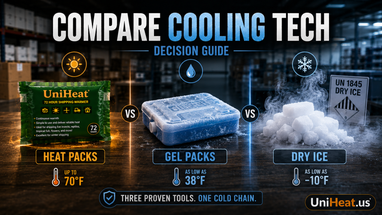
Three cooling technologies, three completely different use cases. Heat packs prevent freezing during cold-weather shipping. Gel packs maintain refrigerated temperatures during summer shipping. Dry ice maintains frozen temperatures for products that must stay below zero. They're not competing options for the same problem — they're specialized tools for three different problems, and choosing the wrong one causes complete failure. This guide walks through the decision framework: what each technology does, when each wins, cost and regulatory comparisons, and 6 real scenarios showing how the choice plays out in practice — building on the foundational decision framework we've developed across our cold-weather shipping resource center.
The Short Answer: Three Different Problems, Three Different Tools
The common mistake is treating heat packs, gel packs, and dry ice as interchangeable "cooling media." They're not. Each is engineered for a specific temperature range and use case:
- Heat packs generate warmth to prevent freeze damage in cold-weather transit. Iron oxidation chemistry produces sustained heat for 40, 72, or 96 hours.
- Gel packs absorb heat to maintain refrigerated or cool temperatures during transit. Pre-conditioned phase-change materials release cold slowly.
- Dry ice releases cold aggressively to maintain frozen temperatures throughout transit. Sublimation from -109°F solid to CO2 gas provides intense cooling.
The foundational decision between heat packs and gel packs is covered in depth in our piece on gel packs vs heat packs. This article extends that framework to include dry ice as the third technology option, completing the decision matrix for temperature-controlled shipping.
For shippers dealing with both cold-sensitive and heat-sensitive products across the year, understanding all three tools matters. Winter DTC operations often start with heat packs, add gel packs for summer, and eventually need dry ice for their frozen product lines. The full seasonal transition framework is in our piece on the complete fall-to-winter shipping transition guide.
Understanding Each Technology
Heat Packs — How They Work
Heat packs use an exothermic iron oxidation reaction. When exposed to air, iron powder combined with salt, activated carbon, and vermiculite reacts with oxygen to produce sustained heat. The temperature output is moderate (100-140°F at pack surface) but the duration is long (40, 72, or 96 hours depending on formulation).
The chemistry is well-established and food-safe. Heat packs are non-toxic, non-flammable, and have no carrier restrictions. They ship through USPS, FedEx, UPS, and international carriers without special declarations. For the deep chemistry, our piece on understanding heat pack activation and performance covers the reaction dynamics.
Heat pack use case: shipping products that would freeze in transit. Live plants, live animals, wine and beer, chocolate, food, supplements, and pharmaceuticals during cold-weather routes. The pack maintains the interior of an insulated box above freezing throughout transit. For duration selection, see our resource on how to select the perfect heat pack duration.
Gel Packs — How They Work
Gel packs are containers filled with phase-change materials that absorb heat as they warm. Standard gel packs are formulated for refrigerated ranges (34-40°F). Sub-zero gel packs use different chemistry to maintain -10 to 0°F.
Pre-conditioning matters. Gel packs need to be pre-frozen (or pre-chilled to the target temperature) for 24-48 hours before shipping. The phase-change material then releases cold slowly as it transitions from solid to liquid state. Standard duration is 24-72 hours depending on gel pack size, ambient conditions, and insulation quality.
Gel packs are non-toxic, non-hazardous, and have no carrier restrictions. They're reusable, though most operations treat them as single-use for simplicity. Cost varies from $3-6 for standard refrigerated gel packs to $8-15 for premium sub-zero gel packs.
Gel pack use case: shipping products that need to stay cool or refrigerated during warm-weather transit. Meal kits, produce, seafood, refrigerated pharmaceuticals, and probiotics. Also used for frozen products where dry ice complexity isn't justified.
Dry Ice — How It Works
Dry ice is solid carbon dioxide at -109°F. Unlike regular ice, it sublimates directly from solid to gas without a liquid phase. This produces intense cooling as it converts, maintaining sub-zero temperatures in the surrounding container throughout the sublimation period.
Sublimation rate varies with container insulation and ambient conditions. In a well-insulated 2″ EPS foam container, dry ice sublimates at approximately 5-10 lbs per 24 hours. A standard frozen overnight shipment uses 5-8 lbs of dry ice.
Dry ice is classified as a DOT hazardous material (UN 1845). Every shipment requires proper declaration, hazard labels, ventilation, and quantity limits. USPS does not accept dry ice under any circumstances. FedEx and UPS both accept dry ice with proper documentation. Full details on dry ice shipping in our recent piece on how to ship frozen meat & food overnight.
Dry ice use case: shipping products that must stay frozen throughout transit. Ice cream, frozen meats, frozen seafood, some biologics, and specialty pharmaceutical products.
The 3-Way Comparison Table
| Feature | Heat Packs | Gel Packs | Dry Ice |
|---|---|---|---|
| Primary function | Prevent freezing | Maintain refrigerated temp | Maintain frozen temp |
| Temperature range maintained | 50-70°F interior | 34-40°F (refrig) or -10-0°F (sub-zero) | -40°F to 0°F interior |
| Duration | 40, 72, or 96 hours | 24-72 hours | 24-48 hours (per 5-10 lbs) |
| Cost per shipment | $3-6 | $4-15 (regular), $15-40 (sub-zero) | $10-30+ |
| Carrier restrictions | None | None | UN 1845 hazmat, USPS prohibited |
| Pre-conditioning needed | Activation 20-30 min | 24-48 hours frozen | Fresh from supplier |
| Reusable | No (single-use) | Yes (usually treated as single-use) | No (sublimates away) |
| Storage shelf life | 18-24 months | Indefinite (frozen storage) | Days (sublimates in storage) |
| Ventilation requirement | None | None | Required (CO2 gas escape) |
| Best for | Cold-weather shipping | Refrigerated shipping year-round | Frozen shipping year-round |
Product Temperature Requirements Drive the Choice
The single most important factor in choosing between the three technologies is the product's temperature requirement, not the season or the ambient conditions at origin. A frozen product needs dry ice or sub-zero gel packs year-round, even in December. A cold-sensitive live plant needs heat pack protection in winter regardless of the destination climate.
Products That Need Freeze Prevention (Heat Packs)
- Live plants and seeds — freeze damage kills plants
- Live animals (reptiles, fish, amphibians) — freeze damage kills animals
- Wine (freezes at 22°F) — freeze damage cracks bottles, pushes corks
- Beer (freezes at 28°F) — freeze damage bursts bottles and cans
- Chocolate — freeze damage causes fat bloom and texture issues
- Honey and liquid supplements — freeze damage causes crystallization
- Cheese — freeze damage changes texture, cracks aged varieties
For any of these products, the framework is: use a 72-hour heat pack as standard, upgrade to 96-hour packs for cold-zone destinations or extended transit windows. Full framework in our piece on how to choose the right heat pack for your shipment.
Products That Need Refrigerated Maintenance (Gel Packs)
- Fresh meat and seafood (in refrigerated shipping)
- Fresh dairy products
- Fresh produce with cold storage requirements
- Meal kits with mixed fresh ingredients
- Fresh flowers
- Refrigerated pharmaceuticals (probiotics, some biologics)
- Cosmetics with active ingredients requiring cold storage
Standard configuration: pre-conditioned refrigerated gel packs in 1.5″ EPS foam. For duration and quantity guidance, see our piece on how many heat packs you really need per box, which covers gel pack quantity too.
Products That Need Frozen Maintenance (Dry Ice or Sub-Zero Gel Packs)
- Ice cream (requires dry ice for reliability)
- Frozen meat and seafood
- Frozen prepared meals
- Frozen breast milk (for delivery services)
- Some vaccines and biologics requiring frozen transport
- Frozen dairy products
Standard configuration: dry ice or sub-zero gel packs in 2″ EPS foam. The complete framework is in our recent piece on how to ship frozen meat & food overnight.
Cost Analysis: Full Per-Shipment Cost Comparison
| Component | Heat Pack Shipping | Gel Pack Shipping | Dry Ice Shipping |
|---|---|---|---|
| Cooling media | $3-6 (72hr pack) | $4-15 (regular) | $10-30 (5-8 lbs) |
| Insulation liner | $4-8 (1.5″ EPS) | $4-8 (1.5″ EPS) | $8-15 (2″ EPS) |
| Outer box | $2-4 | $2-4 | $4-6 (double-walled) |
| Buffer materials | $1-2 | $1-2 | $2-3 |
| Hazmat labels | N/A | N/A | $1-2 |
| Carrier service | $15-45 (standard/overnight) | $25-45 (Priority Overnight) | $40-70 (Priority Overnight) |
| Total per shipment | $25-65 | $36-74 | $65-126 |
The cost gap widens dramatically with dry ice. This is why frozen product businesses build shipping cost into product pricing rather than treating it as a separate line item. The full economics of the cost-benefit trade-off is covered in our piece on cost vs protection in heat pack usage, and the operational scaling framework is in how to scale heat pack usage for higher volumes.
Regulatory and Carrier Considerations
Only one of the three technologies has regulatory complexity, but it's a big one.
Heat Packs: Fully Unrestricted
Heat packs are non-hazardous and non-restricted. They ship via USPS, FedEx, UPS, and international carriers without special documentation. No hazmat declaration, no weight limits, no venting requirements. This makes them the simplest cooling technology to work with operationally.
Gel Packs: Fully Unrestricted
Gel packs are also non-hazardous and non-restricted. Same simplicity as heat packs from a regulatory perspective. The only operational consideration is the pre-conditioning time (24-48 hours frozen storage before use).
Dry Ice: DOT Hazmat (UN 1845)
Dry ice is classified as UN 1845 (Carbon Dioxide, Solid) under DOT hazardous materials regulations. Every shipment requires:
- UN 1845 hazard class label affixed to outer box
- "DRY ICE" or "CARBON DIOXIDE, SOLID" text on the outer container
- Declaration of dry ice weight on shipping label
- Container must allow CO2 gas venting (never airtight)
Carrier-Specific Rules for Dry Ice
- USPS: Does NOT accept dry ice shipments
- FedEx: 5 lbs limit ground service, 5.5 lbs limit air service
- UPS: 5 lbs air cargo limit (2.5 kg)
- International: More restrictive; consult with your carrier
The regulatory overhead is one reason many SMB operations prefer sub-zero gel packs over dry ice for frozen shipping. Sub-zero gel packs deliver similar temperature performance without the hazmat classification. Detailed comparison in our recent piece on how to ship frozen meat & food overnight.
The 3-Way Decision Framework
Run this quick decision tree to determine which cooling technology fits your shipment:
Question 1: What's the product's temperature requirement?
- Must stay frozen (below 32°F throughout transit) → Dry ice or sub-zero gel packs
- Must stay refrigerated (34-40°F) → Standard refrigerated gel packs
- Must not freeze (maintain above 32°F) → Heat packs (in cold weather)
- Shelf-stable at room temperature (no special requirements) → No cooling media needed (weather-permitting)
Question 2: What's the ambient condition of the route?
- Cold-weather route (winter, temperatures below 40°F) → Heat pack (for freeze-sensitive products) or dry ice (for products that must stay frozen)
- Warm-weather route (summer, temperatures above 70°F) → Gel packs (for refrigerated products) or dry ice (for frozen products)
- Mixed conditions → Depends on the limiting factor (usually product requirement)
Question 3: What's the transit duration?
- 24-48 hours (overnight or 2-day) → All three technologies work; choose by product requirement
- 48-96 hours (extended transit) → Heat packs (96hr tier), gel packs may need more units, dry ice may need more quantity
- 96+ hours → Approach limits of all three; consider expedited service or freight alternatives
Question 4: What's your operational tolerance for regulatory overhead?
- Prefer to avoid hazmat → Choose heat packs or gel packs; use sub-zero gel packs instead of dry ice for frozen shipping
- Comfortable with hazmat compliance → Dry ice available for extreme frozen requirements
Question 5: What's the shipping volume?
- Under 50 shipments/week → All three technologies scale down; choose by product
- 50-500 shipments/week → Consider operational simplicity; dry ice adds daily sourcing complexity vs stored gel packs and heat packs
- 500+ shipments/week → Volume drives some economics of scale; bulk purchasing available across all three
For most SMB operations, running through these five questions leads to a clear answer. The decision rarely creates real ambiguity once the product requirements are honestly identified. Framework in our capstone piece on cold chain solutions for small businesses.
Common Misuse Patterns
Several patterns show up repeatedly where the wrong technology gets used:
Using Heat Packs for Frozen Products
This is the most dangerous mistake. Heat packs would actively thaw frozen products. If your product needs to stay frozen, heat packs are the opposite of what you need. This confusion happens when operations shift from cold-weather shipping to also offering frozen products without fully understanding the different requirements.
Using Gel Packs for Freeze Prevention
Gel packs absorb heat — they don't produce it. In a cold-weather shipment, gel packs would actually accelerate freezing by drawing what little heat exists into their phase-change material. Freeze prevention requires heat packs, period.
Using Dry Ice for Refrigerated Products
Dry ice at -109°F would freeze refrigerated products solid. If your product needs to stay in the 34-40°F range, dry ice is too cold. Use refrigerated gel packs instead.
Skipping the Cooling Media Entirely
Some shippers try to save money by relying on insulation alone. This works for very short transit windows or mild conditions, but fails for anything demanding. The interaction between insulation and cooling media is covered in our piece on heat pack vs insulation in cold shipping.
Mixing Technologies Incorrectly
Some operations mix heat packs and gel packs in the same shipment thinking they'll "balance out" temperature. This actually creates unpredictable conditions with hot spots and cold spots. Combined technology should only be used with specific configuration guidance, covered in our piece on combining heat packs with cold packs for temperature-sensitive items.
Real Scenarios: Which Technology Wins Each Case
Scenario 1: DTC Live Plant Nursery Winter Shipment
Origin: Florida. Product: tropical houseplant ($40). Route: FL to Chicago in January. Ambient temperature at hub: 20°F. Product requirement: cannot freeze. Winner: 72-hour heat pack. The plant needs freeze protection, and cold-weather transit is the challenge. Configuration: 1.5″ EPS foam + 72-hour heat pack. Total shipping cost: $32-40. Framework in our piece on heat mat vs heat pack for plant shipping.
Scenario 2: Meal Kit Company Summer Delivery
Origin: California. Product: fresh ingredient meal kit ($60). Route: CA to Dallas in July. Ambient temperature at hub: 95°F. Product requirement: keep ingredients cool (34-40°F). Winner: Refrigerated gel packs. The fresh ingredients need refrigerated maintenance during summer transit. Configuration: 1.5″ EPS foam + 3-4 pre-conditioned refrigerated gel packs. Total shipping cost: $38-50. Framework in heat packs for food shipping.
Scenario 3: Ice Cream Retailer Nationwide Shipping
Origin: Vermont. Product: 4-pint ice cream assortment ($60). Route: VT to Arizona. Any season. Product requirement: stay frozen (-10°F throughout transit). Winner: Dry ice. Ice cream demands the sub-zero temperatures that only dry ice reliably provides. Configuration: 3″ EPS foam + 10-12 lbs dry ice + all hazmat labeling. Total shipping cost: $75-95. Sub-zero gel packs are a distant second choice for ice cream because dry ice provides better margin.
Scenario 4: Craft Winery Winter Wine Club
Origin: Napa Valley. Product: 3-bottle wine shipment ($120). Route: CA to New York in December. Ambient at hub: 25°F. Product requirement: cannot freeze (wine freezes at 22°F). Winner: 72-hour heat pack. Wine shipping in winter is a freeze-prevention problem, not a cooling problem. Configuration: 1.5″ EPS foam + 72-hour heat pack + molded pulp bottle inserts. Total shipping cost: $32-40. Framework in our piece on how to ship wine, beer & spirits in winter.
Scenario 5: Frozen Meat DTC Startup
Origin: Nebraska. Product: 8-piece frozen beef box ($180). Route: nationwide. Product requirement: stay frozen (below 32°F). Winner: Sub-zero gel packs (preferred) or dry ice. Frozen meat can be shipped with either technology, but sub-zero gel packs offer operational simplicity (no hazmat) at competitive cost. Configuration: 2″ EPS foam + 4 sub-zero gel packs OR 6-8 lbs dry ice. Total shipping cost: $50-70 (gel packs) or $65-85 (dry ice). Many operations start with dry ice and migrate to sub-zero gel packs as they scale.
Scenario 6: Refrigerated Pharmaceutical (Probiotic)
Origin: Colorado. Product: refrigerated probiotic capsules ($60). Route: nationwide. Product requirement: stay refrigerated (2-8°C or 36-46°F). Winner: Refrigerated gel packs. Refrigerated pharma needs the narrower temperature band that regular gel packs deliver. Configuration: 1.5″ EPS foam + 3 pre-conditioned refrigerated gel packs. Total shipping cost: $35-45. Framework in our piece on pharmaceutical cold chain packaging for small businesses.
Seasonal Transition Strategy
Operations shipping year-round often need multiple technologies across the seasonal calendar. The typical rhythm:
October-March (Winter Season)
- Heat packs dominant for freeze-sensitive products
- Gel packs limited to warm destinations
- Dry ice continues for frozen products year-round
April-June (Transition Season)
- Heat packs for cold-morning shipments to cold destinations
- Gel packs for warm-afternoon shipments to warm destinations
- Weather-based decision-making per shipment
July-September (Summer Season)
- Gel packs dominant for refrigerated products
- Heat packs minimal (extreme cold destinations only)
- Dry ice continues for frozen products
Ordering Cadence
Bulk purchasing of heat packs happens in August-September for the coming winter. Gel packs get pre-conditioned into freezer storage year-round. Dry ice is ordered day-of from local suppliers (it doesn't store beyond a few days). The full seasonal preparation framework is in our piece on preparing your shipping strategy for next year. For lessons from prior peak seasons, see lessons learned from peak season shipping.
Operational Considerations for Each Technology
Heat Pack Operations
Heat pack operations are the simplest of the three. Packs store on shelves for 18-24 months, are activated 20-30 minutes before pack-out, and require no special handling. Bulk purchasing scales cleanly with volume. The main operational discipline is timing the activation correctly — too early and the pack loses initial ramp-up heat; too late and the pack isn't at full output at carrier pickup. Framework in our piece on how long heat packs really last in transit.
Gel Pack Operations
Gel pack operations require freezer storage capacity for pre-conditioning. A typical SMB gel pack operation has a dedicated freezer holding pre-conditioned gel packs, rotated on a first-in-first-out basis. Bulk purchasing works well; storage requirements scale with shipping volume. Pack-out procedure includes verifying gel packs are still frozen at time of packing.
Dry Ice Operations
Dry ice operations are the most complex. Dry ice sublimates in storage (can't be stored more than a few days), requires daily or near-daily sourcing, needs hazmat-trained personnel, requires ventilated storage, and adds documentation overhead to every shipment. Operations scale with volume but require dedicated processes. For large operations, dry ice supplier relationships are critical — running out mid-shipping-day is catastrophic.
Insulation Pairing Considerations
Each technology pairs with slightly different insulation requirements:
- Heat packs — 1.5″ EPS foam standard, 2″ for premium/cold zones
- Gel packs — 1.5″ EPS foam standard, matches heat pack requirements
- Dry ice — 2″ EPS foam minimum, 3″ for ice cream and extreme applications
The full insulation framework is in our foundational piece on shipping container insulation guide. Container selection with pack considerations is in our recent piece on insulated shipping containers: types, sizes & selection guide. For box size framework, see our piece on choosing the right box size and insulation.
Common Packaging Materials That Complement Each Technology
Beyond insulation, common complementary materials:
- Kraft paper for buffer between heat pack/gel pack/dry ice and product
- Molded pulp inserts for glass bottle protection (wine, beverages)
- Corrugated dividers for multi-item shipments
- Reflective bubble wrap as supplement for premium shipments
Materials framework in our piece on the top 3 packing materials to pair with heat packs, which applies across all three technologies.
Choosing Between Sub-Zero Gel Packs and Dry Ice
For frozen shipping specifically, the choice between dry ice and sub-zero gel packs is nuanced:
Sub-Zero Gel Packs Win When...
- Operational simplicity matters more than temperature margin
- Volume is moderate (not extreme scale)
- You want to avoid daily dry ice sourcing
- Product tolerates -10 to 0°F range
- Hazmat compliance overhead is unacceptable
Dry Ice Wins When...
- Product needs true sub-zero temperatures (-40°F or below)
- Transit windows extend beyond 48 hours
- Cost per pound is competitive at your volume
- Ice cream or extremely temperature-critical products
- Established supplier relationships make daily sourcing easy
Many SMB operations start with dry ice due to industry familiarity, then migrate to sub-zero gel packs as they scale and appreciate the operational simplicity. Others stay with dry ice due to product-specific requirements or established supplier relationships.
Route and Ship-Day Considerations
The route strategy varies slightly by technology:
Heat Pack Ship-Day Discipline
Ship Monday through Wednesday only in active winter. Weekend delays don't necessarily kill the shipment (72 or 96-hour packs have buffer), but they compound risk. Framework in our piece on route package protection.
Gel Pack Ship-Day Discipline
Ship Monday through Wednesday in demanding categories, more flexibility for refrigerated products with longer stability windows. Weekend delays are more manageable than frozen shipping.
Dry Ice Ship-Day Discipline
Ship Monday or Tuesday only. Frozen shipments cannot survive weekend delays. This is the strictest ship-day rule of the three technologies.
Documentation for Each Technology
Standard documentation for all shipments includes tracking data and pack-out photos. Additional documentation:
- Heat packs — no additional regulatory documentation
- Gel packs — no additional regulatory documentation
- Dry ice — hazmat declaration on shipping label, UN 1845 label, weight declaration
For continuous improvement and loss reduction, tracking data helps identify patterns regardless of technology. Framework in our piece on how to reduce winter shipping losses. Common mistakes to avoid across all technologies are covered in 5 common mistakes when using heat packs.
How All Three Technologies Fit the Broader Cold Chain System
Heat packs, gel packs, and dry ice are three tools within one broader temperature-controlled shipping system. Understanding all three lets operations serve the full temperature range their products need. The complete framework is in our capstone piece on cold chain solutions for small businesses.
For operations building an integrated cold chain that handles multiple product categories, the operational architecture combines:
- Heat pack inventory and activation protocols for winter shipping
- Gel pack freezer capacity and pre-conditioning cycles
- Dry ice supplier relationships and hazmat-trained personnel
- Insulation and container inventory matched to volume and product mix
- SOPs that guide the technology choice for each product type
- Continuous monitoring across all product categories
For daily operational execution, see our winter shipping checklist for small businesses. For managing customer and internal expectations, our piece on managing expectations around heat pack performance applies principles that translate to all three technologies. For bulk purchasing options, our UniHeat shop stocks 40-hour and other heat pack options.
Highlights — The 3-Way Decision Reference Card
Frequently Asked Questions
What's the difference between heat packs, gel packs, and dry ice?
Heat packs use iron oxidation chemistry to produce sustained warmth (50-70 degrees Fahrenheit interior), preventing freezing during cold-weather shipping. Gel packs use phase-change materials to maintain refrigerated (34-40 degrees Fahrenheit) or sub-zero (-10 to 0 degrees Fahrenheit) temperatures, requiring pre-conditioning in a freezer. Dry ice is solid carbon dioxide at -109 degrees Fahrenheit that sublimates to gas, maintaining frozen temperatures throughout transit. They're not interchangeable — each is engineered for a specific temperature range and use case.
When should I use dry ice vs gel packs?
Use dry ice for products that need to stay very cold (frozen at -40 degrees Fahrenheit or below) throughout transit, such as ice cream or extremely temperature-sensitive biologics. Use sub-zero gel packs for standard frozen shipping (meat, seafood, prepared meals) where -10 to 0 degrees Fahrenheit is adequate. Sub-zero gel packs offer operational simplicity by avoiding UN 1845 hazmat compliance, which makes them the SMB-preferred choice for most frozen categories. Use standard refrigerated gel packs (not sub-zero) for products in the 34-40 degrees Fahrenheit range like fresh meal kits, produce, and dairy.
Does dry ice need a special shipping label?
Yes. Dry ice is classified as UN 1845 (Carbon Dioxide, Solid) under DOT hazardous materials regulations. Every shipment requires a UN 1845 hazard class label on the outer box, "DRY ICE" or "CARBON DIOXIDE, SOLID" text on the container, declaration of the dry ice weight on the shipping label, and the container must allow CO2 gas venting. FedEx has a 5-pound limit for ground service and 5.5-pound limit for air service. UPS has a 5-pound air cargo limit. USPS does not accept dry ice shipments under any circumstances.
Are heat packs and gel packs interchangeable?
No. They serve opposite functions. Heat packs produce warmth to prevent freezing during cold-weather transit. Gel packs absorb heat to maintain cool or refrigerated temperatures during warm-weather transit. Using gel packs in a cold-weather shipment would actually accelerate freezing by drawing heat away from the product. Using heat packs in a summer shipment would warm the product beyond safe refrigerated range. The correct choice depends on whether you're preventing freezing (heat packs) or preventing warming (gel packs).
How much does each shipping technology cost?
Heat packs are the most affordable, at $3-6 per shipment for a 72-hour pack. Standard refrigerated gel packs cost $4-15 per shipment depending on quantity. Sub-zero gel packs run $15-40 per shipment. Dry ice costs $10-30 for 5-8 pounds (standard frozen overnight shipment). Total per-shipment cost including insulation, container, and carrier service typically runs $25-65 for heat pack shipping, $36-74 for gel pack shipping, and $65-126 for dry ice shipping.
Can I use heat packs and gel packs in the same shipment?
Only with specific configuration guidance. Mixing heat packs and gel packs in the same box creates unpredictable conditions with hot spots and cold spots that can damage products. However, there are legitimate use cases for combined use, such as shipping a mix of frozen and refrigerated items in the same box, or handling extreme temperature swings during transit. The correct configuration requires care about pack placement and product separation. Detailed framework in our resource on combining heat packs with cold packs for temperature-sensitive items.
What day should I ship with each technology?
Heat pack shipments: Monday through Wednesday in active winter (some flexibility due to 72 or 96-hour buffer). Gel pack shipments: Monday through Wednesday for demanding categories, more flexibility for products with longer stability windows. Dry ice shipments: Monday or Tuesday only, never later in the week. Weekend delays are catastrophic for frozen shipments regardless of the amount of dry ice used. This ship-day discipline is one of the most important operational disciplines in temperature-controlled shipping.
Which technology should a new DTC business start with?
Start with the technology that matches your primary product's temperature requirement. Live plant nurseries and wineries typically start with heat packs (for cold-weather freeze prevention). Meal kit companies and fresh food DTC brands typically start with gel packs (for refrigerated maintenance). Frozen product businesses (ice cream, frozen meat) typically start with sub-zero gel packs due to operational simplicity, or dry ice if extreme temperature margin matters. As the business grows and adds product lines, you may need all three technologies across the seasonal calendar.
Summary
Heat packs, gel packs, and dry ice are three distinct cooling technologies for three distinct shipping challenges. Heat packs prevent freezing during cold-weather transit, using iron oxidation chemistry to maintain interior temperatures at 50-70°F for 40-96 hours. Gel packs maintain refrigerated temperatures (34-40°F) or sub-zero conditions (-10 to 0°F) using phase-change materials that require pre-conditioning. Dry ice maintains frozen temperatures using solid carbon dioxide that sublimates directly to gas at -109°F.
The choice between them is driven by product temperature requirement, not by season or ambient conditions alone. Frozen products need dry ice or sub-zero gel packs year-round. Refrigerated products need standard gel packs during warm weather. Freeze-sensitive products need heat packs during cold weather. Operations serving multiple product categories often need all three technologies at different times.
Cost differences are significant: heat packs are cheapest ($3-6 per shipment), gel packs middle ($4-15), and dry ice most expensive ($10-30+). Total per-shipment costs range from $25-65 for heat pack shipping to $65-126 for dry ice shipping. Only dry ice has regulatory restrictions (UN 1845 hazmat, USPS prohibited), which drives many SMB operations toward sub-zero gel packs for frozen shipping despite the higher per-shipment cost.
For the broader system view that integrates all three technologies into a coherent SMB cold chain operation, see our shipping solutions resource center, our recent capstone piece on cold chain solutions for small businesses, and our deep coverage across temperature control shipping and cold shipping topics.