
Posted by UniHeatPacks on 26th May 2026
Building a Reliable Cold Shipping System for Your Business: A Practical Framework
The first cold-weather shipment a business sends is usually a guess. The hundredth one is either a system or a recurring problem. The businesses that ship temperature-sensitive products year after year without losses are not the ones with the best heat packs — they are the ones who built the boring infrastructure around the heat packs. This article is about that infrastructure: how to turn cold shipping from a winter scramble into something your team can run on autopilot.
When You Actually Need a System
Not every business needs a formal cold shipping system. A breeder shipping 30 reptiles a year can run on memory and care, and most of them do. The threshold where ad-hoc becomes a liability tends to land at one or more of these markers:
- You ship more than ~20 cold-sensitive packages per week in peak season. At this volume, individual judgment calls become inconsistency, and inconsistency becomes losses.
- More than one person packs your boxes. The moment a second person is involved, "the way we always do it" becomes "the way we sometimes do it." A system is the difference.
- Your cost-per-loss is significant. Live animals, high-value plants, premium foods, regulated supplements. When one failed shipment costs hundreds or thousands of dollars, the math on systems pays itself back fast.
- You're scaling. A business shipping 100 packages a week today and planning 500 next year cannot run on ad-hoc. The bigger the volume, the more punishing the small process gaps become.
- You've had a bad winter. Honestly, this is the most common trigger. Losses force the conversation.
If you're nodding at two or more of these, you've hit the threshold where the rest of this article applies directly. If not, save it for when you do.
The Five Components of a Cold Shipping System
A working cold shipping system is built on five components. They reinforce each other. Skipping one undermines the rest.
- SKU rationalization — deciding what heat pack durations and packaging materials you actually stock, and matching them to clear routing rules.
- Standard packaging configurations — named, repeatable kits of box + insulation + heat pack that your team can grab and use without thinking.
- SOPs and team training — written procedures the packing team can actually follow, including activation timing, placement, and documentation.
- Carrier relationships and compliance — FedEx Live Animal Release agreements where applicable, pickup scheduling, claims protocols, and a real human relationship with your account rep.
- Feedback loops — data on losses, customer arrival temperatures, and seasonal patterns, reviewed on a regular cadence so the system improves over time.
The rest of this article walks through each component in turn.
Step 1: Rationalize Your Heat Pack SKUs
The instinct for most businesses is to stock every heat pack duration available, "just in case." This sounds prudent. In practice, it creates inventory complexity, packing confusion, and a steady risk of using the wrong pack for the wrong shipment.
A better approach is to stock the smallest number of SKUs that cover your real routing patterns, and write down the rules for which goes where.
The 2-SKU Rule (Most Small Operations)
For most businesses shipping in the lower 48, a two-SKU heat pack inventory works well:
- A 72-hour pack as the standard winter SKU.
- A 96-hour pack as the upgrade SKU for long routes, cold zones, and weekend-risk shipments.
The 40-hour pack stays out of the standard winter inventory. It's a shoulder-season tool (October, early March) and a short-route tool. If you don't have a meaningful volume of short-route mild-weather shipments, you don't need to stock it at all.
The 3-SKU Rule (Larger Operations)
For higher-volume operations with mixed product types or wider geographic spread, three SKUs makes sense:
- 40-hour for shoulder-season shipments and short routes (October–November, March–April, in-region routes).
- 72-hour as the winter standard (December–February, moderate routes).
- 96-hour for cold zones, long routes, and high-risk windows.
The point is to have a defined rule for which SKU goes on which shipment, not to have one of every duration available "just in case."
The Routing Decision Rule
Whatever SKU count you choose, write down the routing rule. Something like:
- Destination ZIP within USDA zones 7–10, ambient forecast above 30°F at all route points: use the 72-hour pack.
- Destination ZIP within USDA zones 3–6, OR any route point forecast below 20°F, OR weekend delivery risk: use the 96-hour pack.
- Shoulder-season in-region routes with all points above 50°F: use the 40-hour pack.
This rule lives on a laminated card at the packing bench. Anyone packing a box can apply it. There's no judgment call left to the individual.
Step 2: Standardize Packaging Configurations
The next layer of standardization is the packaging itself. Most businesses end up with a closet full of box sizes, foam thicknesses, and insulation materials, and the packing team makes ad-hoc decisions about what goes with what. This is a major source of inconsistency.
The fix is to define two or three named packaging configurations and use those almost exclusively.
Sample Configuration Set
Here's a sample 3-config setup that works for many businesses shipping small-to-medium temperature-sensitive items:
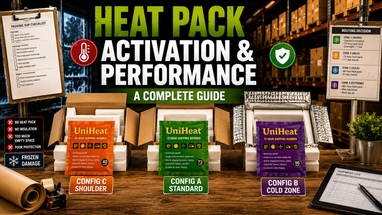
- Config A — "Standard Winter": 12″×10″×8″ corrugated outer box, 1.5″ expanded polystyrene foam liner, 72-hour heat pack on top, kraft paper buffer. Used for ~70% of winter shipments.
- Config B — "Cold Zone": Same box and foam as Config A, but 96-hour heat pack and a second layer of buffer paper. Used for cold-zone destinations or storm-window risk.
- Config C — "Shoulder": Same box, 1″ foam liner, 40-hour heat pack. Used in October, March, and mild-weather windows.
The exact dimensions don't matter — the principle does. Three named configurations, prepped ahead of season, with a clear rule for which gets used when.
Pre-Build Kits Before Peak Season
A practical move: pre-build a stock of each configuration before peak season hits. Boxes assembled and labeled, foam liners pre-cut, kraft paper portioned. The packing team grabs a complete kit, drops in the product and the heat pack, seals, and labels. This dramatically reduces packing time and eliminates the "is this the right insulation thickness" question entirely.
Resist the Temptation to Custom-Build
Every business eventually faces a request that doesn't fit a standard configuration. "This one's going to Alaska, can we build something special?" The instinct to custom-build is understandable. The discipline is to either expand your config set (add a fourth config if Alaska is a recurring route) or honestly decline the unusual order. Custom builds are where inconsistency creeps back in.
Step 3: Build SOPs Your Team Can Actually Follow
Standard Operating Procedures sound corporate. In practice, the best ones are short, visual, and live at the packing station where they're needed.
The One-Page Packing Checklist
The single most valuable document in a cold shipping system is a one-page packing checklist that fits in a laminated sleeve on the bench. It should cover:
- The configuration to use for this shipment (Config A, B, or C, with the routing rule visible).
- The heat pack activation timing (activate 20–30 minutes before carrier handoff).
- Heat pack placement (top of box, taped to inside of lid, never against the product).
- Buffer requirements (crumpled kraft paper between pack and product).
- Box labeling (live animal markings if applicable, "This Side Up" arrows, temperature warnings).
- Documentation requirements (photo of the assembled box, photo of the carrier receipt with timestamp).
That's it. One page. The team uses it every time. After a few weeks it becomes muscle memory, but the page stays at the bench as a reference for new staff and for the busy moments where judgment slips.
The Activation Timing Rule
Of all the SOP items, activation timing causes the most loss when it slips. The rule is simple: the heat pack outer wrapper does not get opened until 20 to 30 minutes before the carrier takes the box.
In practice, this means the team's packing flow is: build the box up to "ready to seal," print the label, hand off responsibility to whoever's doing the carrier drop-off, then open the pack, drop it in, seal, and go. The pack reaches working temperature in the car on the way to FedEx, not on the workbench while the team is finishing other boxes.
Documentation as a Habit
Every winter shipment should generate three pieces of documentation:
- A photo of the assembled box before sealing, showing the heat pack placement.
- A photo of the carrier receipt with timestamp visible.
- A tracking number entered into your shipment log with the configuration used.
This is your insurance policy. If a shipment goes wrong — either a loss or a claim — this documentation lets you reconstruct what happened. It also feeds the data layer of the system.
Train the Team On the Why
A small but meaningful detail: train the team on the why behind the SOP, not just the what. Why activation timing matters. Why placement matters. Why insulation thickness matters. People who understand the system follow it better than people who are just checking boxes. Twenty minutes of training a couple of times a year pays back across thousands of shipments.
Step 4: Establish Carrier Relationships and Compliance
Cold shipping is a partnership with your carrier, not just a transaction. The businesses that have the smoothest winters are the ones who built the carrier side of the equation deliberately.
FedEx Live Animal Release (For Animal Shippers)
If you ship live animals, FedEx requires a signed Live Animal Release (LAR) agreement before they'll accept your packages on Priority Overnight. This is non-negotiable. It also requires:
- A FedEx Express account (not just a retail counter account).
- A specific document on file with FedEx that acknowledges the contents and releases certain liabilities.
- Drop-off at a staffed FedEx location, not a drop box.
If you're scaling up animal shipments, set this up in summer for the coming winter. Trying to get it done in November when you're already at volume is unnecessarily painful.
Schedule Pickups Where Possible
Once volume justifies it, set up scheduled FedEx pickups. This eliminates the daily drive to the FedEx station, frees the team to keep packing through the afternoon, and gives you a more predictable handoff window. Pickups can be flat-rate or per-package depending on your account configuration; for most growing businesses, flat-rate becomes economical above 10–15 packages per week.
Build a Real Relationship with Your Account Rep
Most businesses don't realize they have a FedEx account rep until something goes wrong. The reverse is more useful: introduce yourself in advance, share what kinds of products you ship and your typical winter volume, ask about regional service patterns. When a claim or escalation comes up, you have a human to call rather than a 1-800 number.
Claims Protocol
Have a written claims protocol before you need one. Who at your business handles claims. What documentation is required. The 24-hour and 7-day windows for filing different types of claims. The threshold above which an animal-loss claim escalates to insurance. None of this is interesting until you need it, and then it's the most important thing in your operation.
Step 5: Build Feedback Loops
The difference between a system that gets better and a system that stagnates is feedback data. Without data, every winter is the same winter. With data, you find the small fixes that compound over years.
Track Losses by SKU and Route
Every shipment loss should be logged with at minimum:
- Date shipped and date arrived (or returned).
- Configuration used (A, B, or C).
- Heat pack SKU and lot number.
- Origin and destination ZIP codes.
- Lowest ambient temperature observed along the route.
- What went wrong (cold, delayed, damaged, other).
After one full winter, patterns emerge. Maybe one specific route is over-represented in losses. Maybe one configuration consistently underperforms. Maybe a single lot of heat packs ran bad. Without the data, you'd never know. With it, the fix is usually obvious.
Spot-Check Arrival Temperatures
For a sample of shipments — maybe one in twenty — include a small min/max thermometer or temperature data logger inside the box. Ask the customer to report the reading on arrival. This gives you a ground-truth measurement of how your system is performing in the real world, separate from whether the customer is satisfied.
The data here often surprises. Shipments that arrive without complaints can still have crossed into the cold-stress range for hours. Knowing this lets you adjust before the complaints start.
Quarterly Reviews
A 30-minute meeting at the end of each shipping quarter, with the operations lead and the packing team:
- What did we ship this quarter?
- How many losses or complaints?
- What configurations performed best? Worst?
- What's one thing we can change for next quarter?
This is the muscle that turns a static system into an evolving one.
Pre-Season Audit
Every September or early October, run a full system audit before peak season:
- Inventory check: enough heat packs of each SKU, all within date?
- Packaging check: enough kits prepped, foam liners cut, boxes assembled?
- SOP check: laminated checklist still legible? Any updates needed?
- Carrier check: LAR still active? Pickup schedule confirmed?
- Team check: new staff trained on the SOP? Returning staff refreshed?
An hour of audit in September saves a week of fire-fighting in December.
Common Pitfalls When Scaling Cold Shipping
A few patterns we see businesses fall into as they grow:
Over-engineering before you have data. The temptation to build elaborate temperature logging, complex SKU matrices, and tiered service offerings before you've shipped a thousand boxes. Start simple. Add complexity only when the data shows you need it.
Under-investing in insulation to save margin. Heat packs are the visible cost. Insulation is the invisible one. Businesses cut foam thickness to save shipping weight and find their pack performance drops dramatically. The 1.5-inch foam standard exists for a reason.
Treating heat packs as a commodity. All heat packs are not the same. Different manufacturers have different chemistry, different permeability profiles, and different quality control. Once you find a supplier whose product performs well in your system, sticking with them is worth more than the small savings from switching.
Skipping team training because it feels redundant. "Everyone already knows how to pack a box." This is almost always wrong, even when it's true for the senior staff. The new hire packing in December didn't get the training the senior staff got two years ago.
No pre-season inventory check. Running out of 96-hour packs on December 18th is the kind of mistake that costs entire batches of orders. Stock for the season in October, not December.
Letting the SOP drift. The original checklist gets modified informally over time. New steps get added in some shipments and not others. After two seasons, no one's quite sure what the official procedure is anymore. Re-audit the SOP every year and re-laminate the bench card.
A 90-Day Implementation Timeline
For a business going from ad-hoc to systematic for the first time, here's a realistic timeline.
Days 1–30: Foundation
- Decide on your SKU set (2-SKU or 3-SKU rule).
- Decide on your packaging configurations (2 or 3 named configs).
- Draft the one-page packing SOP.
- Order inventory: heat packs, boxes, foam liners, kraft paper, labels.
- Set up the FedEx LAR if you ship live animals and don't already have one.
Days 31–60: Roll-Out
- Train the team on the new SOP.
- Pre-build a stock of each configuration kit.
- Laminate the packing checklist and post at the bench.
- Set up the shipment tracking log (spreadsheet is fine for most businesses).
- Run the first week of shipments under the new system. Audit daily.
Days 61–90: Refinement
- Review the first month's shipment data. Adjust configurations if needed.
- Add a small number of spot-check shipments with temperature loggers.
- Establish quarterly review cadence.
- Schedule the next pre-season audit on the calendar.
- Document everything in a one-page system overview for future reference.
Ninety days, three meetings, one laminated card, one spreadsheet. That's a working cold shipping system.
Highlights — Save This For Your Operations Playbook
Frequently Asked Questions
When does my business need a formal cold shipping system rather than ad-hoc processes?
The thresholds that usually trigger the need are: shipping more than ~20 cold-sensitive packages per week in peak season, having more than one person involved in packing, dealing with high-cost-per-loss products (live animals, premium plants, regulated supplements), or actively scaling volume. If two or more of these apply, ad-hoc processes are likely costing you more than a system would.
How many heat pack durations should I stock?
For most small-to-medium operations, two SKUs is enough — a 72-hour pack as the winter standard and a 96-hour pack as the cold-zone upgrade. Larger operations or those with broader geographic spread may benefit from a third SKU (40-hour for shoulder season and short routes). Stocking every duration "just in case" creates inventory complexity and packing confusion without much real benefit.
What's the most important SOP for a cold shipping operation?
The single most valuable document is a one-page laminated packing checklist that lives at the packing bench. It should cover configuration selection, heat pack activation timing, pack placement, buffer requirements, box labeling, and documentation. Long manuals don't get used. A one-page reference at the point of work does.
How early should I activate the heat pack in my shipping process?
Activate the heat pack 20 to 30 minutes before the package leaves your facility for the carrier. Earlier than that and you burn duration on the workbench. Later than that and the pack is still in its ramp-up phase when transit begins. The right flow is to build the box up to ready-to-seal, print the label, then open the pack as the last step before handoff.
Do I really need a FedEx Live Animal Release agreement?
If you ship live reptiles, amphibians, invertebrates, or other live animals through FedEx, yes — it's a non-negotiable requirement for Priority Overnight service on live animal shipments. Set up the LAR in summer for the coming winter season. Trying to arrange it in the middle of peak shipping is unnecessarily stressful.
How do I track whether my cold shipping system is actually working?
Track losses by SKU, route, and ambient temperature in a simple log. For a sample of shipments, include a small min/max thermometer or temperature data logger and ask the customer to report the reading on arrival. This ground-truth data shows whether your configurations are actually delivering the protection you assume they are. Without this data, you're guessing about real-world performance.
What's the right time of year to set up a cold shipping system?
Late summer through early fall. Roughly August to October. This gives you time to source inventory, train the team, and run a few weeks of shoulder-season shipments under the new system before peak winter demand hits. Setting up a system in December is possible but stressful and will cost you some losses along the way.
How much does building a proper cold shipping system actually cost?
The largest costs are usually the heat pack and packaging inventory itself, which scale with your shipment volume regardless of whether you systematize. The incremental cost of the system — SOPs, kit prep, tracking spreadsheets, training time — is small. For most businesses, the system pays for itself in the first reduction of losses, which usually shows up in the first full winter under the new approach.
Summary
A cold shipping system isn't a fancy thing. It's five components that reinforce each other: a small number of carefully chosen heat pack SKUs, two or three named packaging configurations, a one-page SOP at the bench, a real relationship with your carrier, and a feedback loop that tells you what's working.
The businesses that ship temperature-sensitive products at scale year after year aren't lucky. They built the boring infrastructure. They standardized. They trained the team. They tracked the data. They audited before peak season. When something went wrong, they had documentation. When something went right, they understood why.
None of this is exotic. All of it requires discipline. And the difference it makes over a full winter is the difference between cold shipping as a cost center and cold shipping as a competitive advantage. For more on cold-weather shipping protection across reptiles, plants, foods, supplements, and live animals, our shipping solutions resource center consolidates protection guidance across product categories — useful when you're sizing the system for your specific mix of shipments.