
Posted by UniHeatPacks on 8th Jun 2026
Gel Packs vs Heat Packs: When to Use Which (Complete Guide)
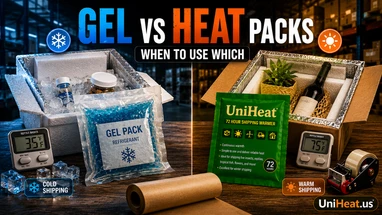
Gel packs and heat packs sound similar, but they solve opposite problems. One keeps things cold. The other keeps things warm. If you mix them up — or use the wrong one for the wrong season — you end up with damaged shipments and unhappy customers. This guide walks through what each one actually does, when to use each, and the surprisingly common situations where you need both at the same time.
The Short Answer: Cold vs Warm Shipping
Gel packs keep things cold. Heat packs keep things warm. If your product needs to stay below room temperature in transit, you need gel packs. If it needs to stay above room temperature — or above freezing — you need heat packs from a shop like UniHeat. The two products use completely different chemistry and serve completely different purposes.
The mistake most new shippers make: assuming "temperature control" means the same thing year-round. It doesn't. In July you need gel packs to keep ice cream from melting. In January you need heat packs to keep the same ice cream container from freezing solid and cracking. Same product, opposite tools.
What Gel Packs Actually Do
A gel pack is a flexible plastic pouch filled with a refrigerant gel — usually water mixed with a thickener like polyacrylamide or hydroxyethyl cellulose. The thickener keeps the gel from sloshing around and slows the rate at which it absorbs heat from the surrounding environment.
You freeze a gel pack before use. Once frozen, it acts as a heat sink: it absorbs heat from whatever's inside the shipping container, keeping the contents cold for the duration of transit. A standard gel pack frozen overnight will keep a small insulated container at refrigeration temperatures (around 35-40°F) for 24-48 hours.
Gel packs come in several formats:
- Pre-frozen flat gel packs — the most common shipping format, flexible and freezable
- Refreezable rigid containers — for repeated commercial use
- Single-use ice packs — lightweight, lower cost, common in meal kit shipments
- Dry ice substitutes — specialty gel packs designed for sub-zero shipping
The key thing to understand: gel packs only work if you freeze them first. They are not chemically active — they're just frozen water in fancy form.
What Heat Packs Actually Do
A heat pack works on completely different principles. It's not a "frozen-in-reverse" gel pack. It's a controlled chemical reaction.
Most shipping heat packs are air-activated. Inside the pouch is a mix of iron powder, salt, activated carbon, and a moisture source. When you tear open the outer wrapper, oxygen reaches the iron and triggers a slow exothermic oxidation reaction. The reaction releases heat steadily for 40, 72, or 96 hours depending on the engineered design of the pack.
Unlike gel packs, heat packs are single-use. Once activated, the reaction runs until completion. You can't refreeze them or restart them. We've covered this chemistry in detail in our article on heat pack activation and performance.
Common shipping heat pack durations:
- 40-hour heat pack — for short routes and mild winter conditions
- 72-hour heat pack — the winter shipping workhorse
- 96-hour heat pack — for cold zones, long routes, and weekend delivery windows
The duration matters because real-world transit time often exceeds expected delivery time. We've explained the full math in our breakdown of how long heat packs really last in transit.
Side-by-Side Comparison Table
| Feature | Gel Packs | Heat Packs |
|---|---|---|
| Primary purpose | Keep contents cold | Keep contents warm |
| How it works | Frozen mass absorbs heat from environment | Chemical reaction (iron oxidation) releases heat |
| Activation | Freeze 12-24 hours before use | Open wrapper to air, 20-40 min ramp-up |
| Duration | 24-48 hours (standard size) | 40, 72, or 96 hours (rated) |
| Reusability | Reusable (refreeze) | Single-use |
| Working temperature | ~30-40°F (cold) | 100-130°F surface (warm) |
| Best season | Summer (May-September) | Winter (October-March) |
| Typical cost per shipment | $1-3 | $2-5 |
| Insulation requirement | Yes, 1.5″ foam minimum | Yes, 1.5″ foam minimum |
| Storage requirement | Freezer space | Dry shelf storage |
| Shelf life (unused) | Indefinite if sealed | 18-24 months from manufacture |
When to Use Gel Packs
Gel packs are the right choice in these four scenarios:
1. Summer Shipping of Refrigerated Products
This is the most common gel pack use case. When outside temperatures climb above 75°F, anything that needs to stay refrigerated — meal kits, fresh produce, dairy, medication, fresh meat — needs active cooling in the shipping container. Gel packs are the standard solution for transit windows of 24-48 hours.
2. Frozen Product Shipping (with Dry Ice or Specialty Packs)
For products that must stay frozen — ice cream, frozen meals, frozen pharmaceuticals, certain biologicals — standard gel packs aren't cold enough. You need dry ice or specialty sub-zero gel packs that can maintain temperatures below 0°F. The principle is the same as standard gel packs, just with colder refrigerants.
3. Temperature-Controlled Pharmaceutical Shipping
Many pharmaceutical products have strict cold-chain requirements (typically 36-46°F). Gel packs paired with validated insulated containers and temperature loggers are the standard approach for shipping these products under cold-chain compliance protocols.
4. Live Tropical Fish and Some Aquatic Animals in Summer
Counterintuitively, some live aquatic shipments need gel packs in summer because tropical fish are stressed by water temperatures above 82-85°F. The gel pack keeps the bag water in the safe range during transit through hot summer climates.
When to Use Heat Packs
Heat packs are the right choice in these four scenarios:
1. Winter Shipping of Anything Sensitive to Cold
The most common heat pack use case. When outside temperatures drop below 50°F — and especially below freezing — products that would tolerate room temperature can freeze, crack, or sustain temperature-shock damage in transit. Heat packs maintain a safe internal box temperature during cold-weather shipping.
This applies to a huge range of products: live plants, reptiles, fish, beer, wine, certain medications, chocolate, baked goods with frosting, candles, vinyl records, and many cosmetics.
2. Live Animal Shipping in Cold Weather
Reptiles, amphibians, fish, and live invertebrates all require heat in winter transit. The animal can't regulate its own temperature, and a transit failure means a dead animal at delivery. We've covered this in detail in our guide to balancing cost and protection in heat pack selection.
3. Live Plant Shipping in Winter
Tropical houseplants, succulents, orchids, and most live plants are damaged or killed by exposure to freezing temperatures. Winter plant shipping — particularly through cold zones or to northern destinations — requires heat packs paired with proper insulation.
4. Freeze-Sensitive Products on Long Routes
Even products that don't seem temperature-sensitive can freeze on long winter routes through cold hubs. Liquids that freeze and expand can crack containers. Pastes and creams can separate. Some adhesives become permanently brittle. If a product's contents would be damaged by sitting overnight in a 20°F garage, it needs heat pack protection for winter shipping.
Can You Use Gel Packs and Heat Packs Together?
Yes, and in specific situations you should. The combination is more common than most shippers realize.
Three scenarios where the combination makes sense:
Scenario 1: Cold Climate, Heat-Sensitive Product
Example: chocolate shipped in January to a customer in Florida. The package travels through cold hubs in the north and Midwest (heat pack protects the chocolate from freezing or losing structural integrity), then arrives in warm Florida weather where it might sit on a porch in 85°F afternoon sun (gel pack protects it from melting during the final delivery window).
The heat pack works for the bulk of transit; the gel pack handles the last-mile heat exposure. Both are needed; neither alone would protect the shipment.
Scenario 2: Shoulder Season with Wide Temperature Swings
Example: a shipment in March or October where the origin might be 30°F overnight but the destination might be 75°F mid-day. A heat pack handles the cold side; a gel pack handles the warm side. Both small-format packs are used to manage the swing.
Scenario 3: Live Animal Shipping Across Climate Zones
Example: tropical fish shipped from Florida to Minnesota in October. Departure climate is warm enough to risk overheating in the warm-water bag (gel pack manages this). Hub transit and Minnesota delivery may be cold enough to risk thermal stress (heat pack manages this). Sophisticated fish shippers regularly use both packs in the same insulated container.
For more detail on this specific combination strategy, see our article on how to combine heat packs with cold packs for temperature-sensitive items.
Cost Comparison: Real Numbers
Many shippers assume one option is dramatically cheaper than the other. In practice, the per-shipment cost is similar:
- Gel packs: $1-3 per shipment for standard 8-16 oz gel packs. Specialty pharma-grade or sub-zero packs can run $5-15.
- Heat packs: $2-5 per shipment for standard 40-72 hour duration packs. Higher-duration 96-hour packs run $4-7.
The bigger cost factors are usually packaging and the cost of getting it wrong:
- Insulated shipping cooler: $4-12 per shipment (same regardless of pack type)
- Carrier service: $15-40 per shipment for FedEx Priority Overnight
- Cost of a failed shipment: full product value + replacement + customer goodwill
The math almost always favors paying for the right pack rather than risking a failed shipment. We've analyzed this in detail in our piece on cost vs protection in heat pack usage.
Storage and Shelf Life Differences
A practical consideration that affects which option works for your operation: how you store them.
Gel Pack Storage
- Requires freezer space — this is the limiting factor for most businesses
- Pre-freeze 12-24 hours before use
- Indefinite shelf life if kept frozen and sealed
- Reusable, so you build a "fleet" of gel packs that rotate through use and re-freezing
- Takes up significant freezer real estate at scale (a business shipping 50 packages a day needs 50+ frozen gel packs available)
Heat Pack Storage
- Standard dry shelf storage at room temperature
- Shelf life of 18-24 months from manufacture
- Single-use, so inventory must match expected volume per season
- No freezer or refrigeration cost
- Easier to stock for seasonal demand spikes (just order more in October)
For most small and medium businesses, heat packs are operationally simpler — no freezer needed, no rotation logistics, no risk of running out of frozen inventory mid-day. For high-volume cold shippers (meal kit subscription companies, for example), the math may favor gel packs because the cost-per-use of refreezing is low once you've made the freezer investment.
Common Mistakes Shippers Make
Five patterns that show up repeatedly:
Mistake 1: Using gel packs in winter as "insulation." A frozen gel pack in a winter box doesn't add insulation — it adds cold mass. The heat pack then has to work harder to keep the box warm, and the box temperature drops faster overall. Gel packs and heat packs should never be in the same box unless you're using both for the specific climate-zone reason described above.
Mistake 2: Skipping insulation because "the pack is doing the work." Both gel packs and heat packs need proper insulation to perform anywhere near their rated duration. A pack of either type in a thin cardboard box loses effectiveness in hours instead of days. We cover this in detail in choosing the right box size and insulation.
Mistake 3: Mismatching pack duration to transit time. A 24-hour gel pack on a Thursday shipment that gets weekend-delayed arrives at a 70°F box temperature instead of 40°F. Same logic for heat packs. Always size up duration relative to expected transit, with buffer for delays.
Mistake 4: Reusing single-use packs. Gel packs are reusable. Heat packs are not. Trying to "save" a partially-active heat pack by resealing it doesn't work — the chemistry continues to degrade and the pack will not deliver rated duration in the next shipment.
Mistake 5: Wrong placement inside the box. Gel packs should sit on top of the product (cold sinks down). Heat packs should also sit on top of the product (heat rises but the pack should not directly contact the contents). Both should have buffer material between them and the product, and neither should be pressed flat against the cold outer wall of the box.
How Heat Packs and Insulation Work as a System
A point that applies equally to both gel packs and heat packs: the pack and the insulated container are one system, not two separate purchases.
A 72-hour heat pack rated for 72 hours is rated assuming a quality insulated container. Drop that same pack in a thin corrugated box and it might give 12-18 hours of usable warmth before burning through. Same logic for gel packs: a frozen gel pack in poor insulation thaws fully in 6-10 hours instead of the expected 24-48.
For both pack types, the industry standard is at least 1.5 inches of foam insulation on all six sides of the inner cavity. Detailed packaging guidance is available in our breakdown of top packing materials to pair with heat packs.
Decision Framework: Which One for Your Shipment?
Run this quick decision tree for any cold-sensitive or warm-sensitive shipment:
- What's the temperature constraint on the product? Must stay cold? Gel packs. Must stay warm? Heat packs. Sensitive to both extremes? Possibly both.
- What's the season at the destination? Summer = gel pack territory. Winter = heat pack territory. Shoulder season = read the forecast carefully.
- How long is the transit? Pack duration should be approximately 2× expected transit time, with buffer for delays.
- What's the route? Look at the coldest or warmest point on the route, not just the destination. A summer route through a hot southern hub needs more gel pack capacity than a route through a cooler northern hub.
- What's the value of the product? For shipments above $50 in product value, upgrading one tier of protection almost always pays for itself.
For comprehensive guidance across all cold-weather shipping scenarios, our cold-weather shipping resource center consolidates protection guidance across 9 product verticals.
Highlights — Save This For Your Reference
Frequently Asked Questions
What's the difference between a gel pack and a heat pack?
A gel pack is a flexible plastic pouch filled with refrigerant gel that you freeze before use. It absorbs heat to keep shipments cold during transit. A heat pack uses a chemical reaction (typically iron oxidation) that you activate by exposing it to air. It releases heat to keep shipments warm during transit. They are opposites in function and chemistry.
Can I use a gel pack to keep something warm?
No. Gel packs work by absorbing heat from the surrounding environment when they are cold. They cannot release heat. Even at room temperature, a gel pack is passive — it doesn't add warmth to a shipment, it just adds mass at the ambient temperature of the storage area. To keep shipments warm in cold weather, you need a heat pack.
Can I use a heat pack to keep something cold?
No. Heat packs generate heat through a controlled chemical reaction. They release warmth into the surrounding environment and cannot cool a shipment. Putting a heat pack in a summer shipment would actively damage cold-sensitive products by raising the internal box temperature.
How long do gel packs and heat packs last during shipping?
A standard gel pack frozen overnight maintains refrigeration temperatures (35-40°F) inside a properly insulated container for 24-48 hours. Heat packs come in rated durations of 40, 72, and 96 hours, designed to maintain a warm box interior throughout cold-weather transit. Both products require proper foam insulation to achieve their rated duration in real shipping conditions.
Do I need both gel packs and heat packs?
Most shipments need only one or the other, matched to the season and the product's temperature requirements. Some shipments do benefit from both, particularly when the route crosses extreme climate zones (cold origin, warm destination), during shoulder seasons with wide temperature swings, or for live animals that need protection from both heat and cold during the same transit.
Are gel packs reusable?
Yes, standard gel packs are designed to be refrozen and reused multiple times. They have an indefinite shelf life if stored properly. This makes them economical at scale once you have adequate freezer storage. Single-use ice packs sold for meal kit shipping are exceptions — these are designed for one-time use and disposal.
Are heat packs reusable?
No. Air-activated chemical heat packs are single-use. Once the wrapper is opened and the iron oxidation reaction begins, the reaction cannot be paused or restarted. Refrigerating or resealing an active pack only slows the reaction slightly while wasting duration. Always activate within 30 minutes of sealing the shipping box.
What is the best season to use each type?
Gel packs are typically used May through September when outside temperatures climb above 75°F and refrigerated products risk warming damage. Heat packs are typically used October through March when outside temperatures drop below 50°F and cold-sensitive products risk freezing damage. During shoulder seasons (April, October-November), the right choice depends on the specific route and destination weather forecast.
Summary
Gel packs and heat packs are not competing products — they are seasonal opposites. Gel packs handle the summer cold-shipping problem. Heat packs handle the winter warm-shipping problem. Choosing the right one is a matter of matching the tool to the temperature constraint, the route, and the season.
For most cold-weather shippers operating between October and March, heat packs are the primary tool. A 72-hour pack with proper insulation handles the majority of winter shipments to USDA zones 6 and warmer. A 96-hour pack handles cold zones, long routes, and weekend-delay risk. For summer shippers of refrigerated or frozen products, gel packs are the equivalent default, with sizing matched to the duration of transit and the ambient heat exposure expected.
The cost difference between options is small. The cost of getting it wrong — a frozen plant, a melted chocolate, a dead reptile — is large. When in doubt, size up on duration and pair every pack with adequate insulation. For more on building a complete cold-weather shipping system, see our shipping solutions resource center and our deep-dive on heat packs for shipping.