
Posted by UniHeatPacks on 3rd Jun 2026
How to Reduce Shipping Losses During Winter Season: A Practical Playbook
Every business that ships temperature-sensitive products in winter has a number they don't talk about — the percentage of shipments that arrive cold, damaged, or dead. For some operations it's under 1%. For others it's 10% or higher. The difference is rarely luck. It's the accumulation of small decisions made before peak season, during packing, at handoff, and after delivery. This article is a working playbook for closing the gap between where your loss rate is and where it could be.
Why Winter Loss Rates Vary So Much Across Similar Businesses
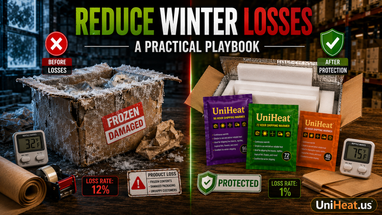
Two businesses shipping similar products at similar volumes can have winter loss rates that differ by a factor of 10. Same heat pack supplier, same FedEx service, similar destinations. One business runs a 1% loss rate; the other runs 12%. The difference isn't the product, the carrier, or even the weather. It's the system.
Across the businesses we work with, the patterns are remarkably consistent. The operations with the lowest loss rates share a small number of behaviors. The operations with the highest loss rates share a different small number of behaviors. The good news is that the high-loss patterns are fixable, often within a single shipping season. The rest of this article is about which fixes actually move the numbers and which are theater.
The Five Categories of Winter Shipping Loss
Every winter loss traces back to one or more of five root causes. Understanding which category your losses fall into is the first step to fixing them.
1. Pack Selection Errors
The pack didn't have enough duration for the route. A 40-hour pack on a cold-zone shipment, a 72-hour pack on a route that ran into a weekend delay, a single pack where redundancy was warranted. This is the most common category and usually the easiest to fix.
2. Packaging Failures
The insulation was inadequate, the box was oversized for the contents, the pack was placed wrong, or the buffer between the pack and the product was missing. The pack worked as designed; the rest of the system let it down.
3. Timing Mistakes
Activation too early, activation too late, ship day on Thursday or Friday, drop-off outside the day's pickup window. The pack and the packaging were right; the clock was wrong.
4. Carrier Handling Issues
Weather delays, missed connections, hub holds, residential delivery attempts to absent recipients. Some of this is outside your control, but a meaningful portion is controllable through carrier choice, service tier, and delivery instructions.
5. Operational Drift
Not a single mistake but the cumulative effect of small process slips: the SOP that gradually stopped being followed, the new hire who wasn't fully trained, the inventory that got too old, the audit that was skipped this year. This is the hardest category to spot and the most expensive over time.
Most businesses don't have losses in just one category. They have a mix, with one or two categories dominant. The starting point for any loss-reduction effort is honestly diagnosing where yours are concentrated.
Fix 1: Upgrade One Pack Duration Tier
The single highest-leverage change most businesses can make in their first season of focused loss reduction is to upgrade their default pack duration by one tier.
A business shipping mostly with 40-hour packs in winter is almost certainly under-protecting. Moving the winter default to the 72-hour pack typically cuts cold-arrival losses by 50-70% in one season. The marginal cost is small — usually a couple of dollars per shipment — and the return on that investment shows up immediately.
A business already using 72-hour packs as the standard but losing shipments to cold-zone destinations should upgrade those specific routes to the 96-hour pack. Not every shipment — just the ones going to USDA zones 3-5 or the ones with weekend-risk windows.
The rule of thumb: if your winter loss rate is above 3%, upgrading one duration tier on your most-affected routes is almost certainly the right first move. If your loss rate is already under 1%, you're past the point where pack upgrades alone will help — the remaining losses are in the other four categories.
Fix 2: Standardize Packaging Configurations
The second highest-leverage fix is standardizing how you pack, not what you pack. Most businesses have invisible variance in their packaging — different box sizes, different foam thicknesses, different packing styles — and that variance shows up as inconsistency in safe arrival rates.
The fix is to define 2-3 named packaging configurations and use those almost exclusively:
- A standard winter configuration (mid-sized box, 1.5″ foam insulation, 72-hour pack).
- A cold-zone configuration (same box, 1.5″ foam, 96-hour pack, extra buffer paper).
- A shoulder-season configuration if applicable (smaller box, 1″ foam, 40-hour pack).
Pre-build a stock of each configuration before peak season. The packing team grabs the right kit based on a simple routing rule (a laminated card at the bench), drops in the product and the heat pack, seals, and labels. Variability drops dramatically. Losses traced to "I packed it differently because we ran out of foam panels" disappear.
This single fix typically reduces packaging-failure losses by 60-80% within a few weeks of implementation.
Fix 3: Lock Down Ship-Day Discipline
This is the fix that sounds too simple to matter but consistently shows up as one of the largest loss drivers.
Ship Monday, Tuesday, or Wednesday only. Never Thursday or Friday in winter.
The reason is delivery delay risk. A package shipped on Thursday for next-day delivery has a chance of running into Friday weather delays, which then push delivery to Saturday or Monday. A package shipped on Friday has an even higher chance of weekend-long delays. Once a package is sitting in a hub or on a truck for 60-72 hours past the activation point, even a 96-hour pack is running out of margin.
A business that ships seven days a week often discovers that 70-80% of its winter losses come from the 30-40% of shipments that went out Thursday through Friday. Restricting peak-season shipping to Monday-Wednesday alone can drop the overall loss rate by 40-60% with no other changes.
The trade-off is operational: you compress the week's shipments into three days, which puts pressure on packing capacity and inventory flow. For most businesses, that pressure is far less expensive than the losses it prevents.
Fix 4: Get Activation Timing Right
Heat pack activation timing is the single most controllable variable in the entire winter shipping process, and the one most commonly mishandled.
The rule: open the pack 20-30 minutes before the package leaves your facility for the carrier.
Open it earlier and you burn through pack duration on the workbench. Open it later and the pack is still in its ramp-up phase when transit begins, leaving the box under-protected for the first hour or more.
Common timing mistakes that drive losses:
- Activating at the start of the packing process. A breeder or shipper opens packs while assembling boxes, then takes 60-90 minutes to finish packing and drive to the carrier. That's 60-90 minutes of duration lost before the package is in transit.
- Activating in batches. Someone opens 20 packs at once "to save time" while building 20 boxes. The first box gets a fully-warmed pack; the last box gets a pack that's been losing duration for an hour.
- Activating and storing. Someone activates a pack, gets distracted, and the package doesn't ship until the next day. The pack runs overnight. By morning it has 18-24 fewer hours of usable duration.
The fix is simple but requires discipline: open packs one at a time, one per box, in the last 30 minutes before the package leaves your hands. Build the box up to ready-to-seal, print the label, then activate, drop in, seal, and go.
Operations that tighten activation timing typically see a 15-25% reduction in losses, with no other changes.
Fix 5: Optimize Carrier Choice and Service
For live animal shipments, FedEx Priority Overnight with a Live Animal Release agreement is effectively the only option in the United States. There isn't much carrier flexibility here.
For non-live shipments, the calculus is different. FedEx Priority Overnight is still the most reliable winter option, but some businesses successfully use 2-Day Air or other carriers for less time-sensitive cold shipments. The risk increases significantly with transit time, so this only works when paired with longer-duration packs.
Two operational moves that consistently reduce carrier-related losses regardless of carrier choice:
Hold for Pickup at the destination terminal. Instead of residential delivery, the package waits at the destination FedEx station for the recipient to pick up. This eliminates the worst failure mode in winter shipping — a package sitting on a porch at 20°F because no one was home. For high-value or live-animal shipments, Hold for Pickup is almost always worth the customer friction.
Schedule pickups instead of drop-offs. A scheduled FedEx pickup at your facility means the package transfers from your control to the carrier's control on a predictable schedule, with documentation. It also reduces the activation timing slop that comes with driving to the FedEx station.
Fix 6: Improve Weather Awareness
Most winter losses are predictable from weather data 48 hours in advance. The losses that happen anyway are usually the result of shippers either not checking the forecast or checking it for the wrong points.
The right weather check covers three locations:
- Origin city. Cold conditions at pickup affect the pack's ramp-up phase.
- The carrier hub. For FedEx Priority Overnight, this is usually Memphis. For other services, it varies. The hub is often the coldest single point in the journey.
- Destination city. Especially for residential delivery, the destination's overnight low and delivery-window temperature matter.
The simple rule: if any of those three points is forecast below 25°F in the 48 hours following pickup, and you have flexibility, delay the shipment by a day or two until the cold snap passes. The cost of a one-day delay is almost always less than the cost of a cold-weather loss.
For shipments that must go regardless of weather, the right move is upgrading the pack duration for that specific shipment. A 72-hour-pack standard becomes a 96-hour-pack shipment when the route runs through a cold snap.
Fix 7: Document Every Loss
You cannot reduce what you don't measure. Every winter loss should generate a documented record with at minimum:
- Date shipped, date arrived (or returned).
- Origin and destination ZIP codes.
- Heat pack SKU and lot number.
- Packaging configuration used.
- Lowest ambient temperature along the route.
- What the customer reported on arrival (cold, frozen, dead, damaged).
- Photo documentation from the customer where possible.
After one full winter of disciplined logging, patterns become visible. Maybe one specific route accounts for 40% of losses. Maybe one packaging configuration consistently underperforms. Maybe a single heat pack lot is responsible for an unusual cluster of failures. The data tells you where to focus next season's improvements.
Most businesses skip this step because it feels like extra work. It's also why most businesses repeat the same losses winter after winter.
Fix 8: Run the Pre-Season Audit
Every September or early October, before peak season hits, run a full audit of the cold shipping system:
- Inventory check. Enough heat packs of each SKU. All within shelf life. Confirmed lot numbers and order dates.
- Packaging check. Enough configuration kits prepped. Foam liners cut. Boxes assembled. Backup stock for surge days.
- SOP check. Laminated checklist at the bench still legible. Any updates needed for this season.
- Carrier check. FedEx LAR agreement still active for live animal shippers. Pickup schedule confirmed. Account rep contact information current.
- Team check. New staff trained on the SOP. Returning staff refreshed. Activation timing discipline re-emphasized.
- Data check. Last winter's loss log reviewed. Patterns identified. Specific fixes for this season agreed.
An hour spent on this audit in September prevents days of fire-fighting in December. It's the highest-ROI hour of the entire shipping year.
The Loss Reduction Sequence: What to Fix First
If you're starting from a high-loss baseline and don't know where to begin, here's the sequence that consistently produces results.
- Diagnose your loss categories. Pull last winter's loss data. Which of the five root-cause categories dominates? You can't fix what you haven't named.
- Make the highest-leverage pack upgrade. If you're using 40-hour packs in winter, move to 72-hour as the default. If you're using 72-hour and losing cold-zone shipments, add 96-hour for those routes specifically.
- Lock down ship-day discipline. Restrict winter shipping to Monday-Wednesday. This alone often cuts losses 40-60%.
- Standardize packaging configurations. Define 2-3 named configs, pre-build kits before peak season, train the team to them.
- Tighten activation timing. 20-30 minutes before handoff, one pack per box, no batching, no early opens.
- Improve weather awareness. Three-point forecast check before any winter shipment. Delay or upgrade for cold snaps.
- Document everything. Every loss logged with route, SKU, weather, and cause. Data drives next season's improvements.
- Audit before next peak season. Pre-season audit in September. Identify what worked, what didn't, what to change.
A business that works through this sequence in one winter season typically cuts its loss rate by 60-80%. The remaining losses are usually edge cases that require category-specific fixes or are genuinely outside the operator's control.
Common Myths About Winter Shipping Losses
A few patterns of thinking that consistently prevent businesses from reducing losses.
Myth: Losses are unavoidable in winter. Some losses are. Most aren't. The lowest-loss-rate businesses in cold shipping run at 1-2% even in active winter. If your loss rate is meaningfully higher, the gap is systemic, not seasonal.
Myth: Better heat packs alone will fix everything. Pack upgrades are one fix among several. A 96-hour pack in inadequate insulation, shipped on Friday, is still a high-risk shipment. The system has to work together.
Myth: The carrier is the problem. Carrier-related losses are real but usually a smaller share than internal operational issues. Most "FedEx delayed my package" losses are also "I shipped on Friday" or "I didn't have weekend buffer in my pack duration" losses.
Myth: A premium shipping service eliminates the need for protection. Priority Overnight still goes through unheated cargo facilities and hub holds. The pack and packaging matter regardless of service tier.
Myth: Customer complaints mean a loss happened. Many losses never generate a customer complaint — the customer is too polite, the loss is partial (the product survived but was stressed), or the customer doesn't realize what cold arrival means for their product. Spot-checking arrival temperatures with data loggers usually reveals more issues than complaints alone.
Highlights — The Loss Reduction Playbook
Frequently Asked Questions
What's a normal winter shipping loss rate?
Well-run cold shipping operations typically run a 1-2% winter loss rate even in active cold weather. Average operations run 3-6%. High-loss operations run 8-15% or higher. If your rate is above 3%, there's almost certainly leverage available through the fixes in this article. The biggest gap between businesses with similar products is usually system discipline, not luck or weather.
Which fix should I implement first if I can only do one thing?
Lock down ship-day discipline. Restricting winter shipping to Monday through Wednesday alone often cuts losses by 40-60% with no other changes, no incremental cost, and no new procurement. It's the highest-ROI single change available to most operations. Other fixes layer on top of this foundation.
Why do my losses cluster on certain routes?
Usually because the pack duration is matched to typical conditions but doesn't have margin for the cold-zone or long-route exceptions. A 72-hour pack works well for zone 7-9 destinations but starts losing shipments to zone 3-5 destinations. The fix is route-specific SKU selection: use the 96-hour pack on the routes that consistently cause problems, not as a blanket upgrade.
How long does it take to see results from these fixes?
Some fixes show results immediately. A pack upgrade on the next shipment performs to the new spec. Ship-day discipline shows results within a week. Packaging standardization shows results within a few weeks. Operational discipline and pre-season audits show results over the course of a full winter. Most businesses see meaningful improvement within one shipping cycle of disciplined implementation.
Is it ever worth absorbing losses rather than preventing them?
Almost never. The direct cost of a loss is just the visible portion — the refund, the replacement product, the return shipping. The hidden costs (customer churn, negative reviews, customer service time, wholesale account risk) typically multiply the visible cost by 2-5 times. The math on prevention almost always favors investment.
What's the most common cause of "the pack didn't work" complaints?
Three causes dominate: activation timing errors (the pack was opened too early or burned out before transit completed), insulation inadequacy (the pack worked but the box couldn't retain the heat), and selection errors (the pack duration didn't match the route conditions). Manufacturing defects are real but rare with quality suppliers. Most "the pack failed" complaints trace back to one of the first three causes.
Should I use insurance for cold-weather shipping?
Insurance for high-value cold shipments can be worth it as backup coverage, but it should not be the primary loss mitigation strategy. Insurance claims are time-consuming, often dispute documentation, and rarely cover the hidden costs of a failed shipment (customer churn, reviews, service time). Better protection costs less than insurance premiums for most operations.
How do I get my packing team to actually follow the new procedures?
Three things matter. First, keep the SOP short and visual — a laminated one-page checklist at the bench. Second, train on the why, not just the what. People who understand the system follow it better than people checking boxes. Third, audit randomly during peak season. A weekly walk-through of one or two packed boxes catches drift before it becomes losses.
Summary
Winter shipping losses are not random. They cluster in five categories — pack selection, packaging, timing, carrier handling, and operational drift — and each category has specific, well-understood fixes. Businesses with low loss rates aren't lucky; they've worked through these fixes systematically over multiple seasons.
The highest-leverage moves for most operations are the same ones that show up in every loss-reduction case study: upgrade one pack duration tier, standardize packaging configurations, restrict winter shipping to Monday-Wednesday, tighten activation timing, check the weather, document every loss, and audit before peak season. None of these are exotic. All of them require discipline.
The math on loss reduction is almost always favorable. The direct cost of prevention is small. The hidden costs of losses — lost customers, negative reviews, regulatory exposure, brand damage — are usually large enough that even modest improvements in safe arrival rates pay back the investment within a single season.
For broader frameworks on cold-weather shipping systems and protection guidance across reptiles, plants, foods, supplements, and live animals, our shipping solutions resource center consolidates the principles in this article into category-specific playbooks. Loss reduction starts with the right foundation, and the foundation looks similar across product categories even when the specifics differ.