
Posted by UniHeatPacks on 10th Jul 2026
How to Ship Frozen Meat & Food Overnight (2026 Complete Guide)
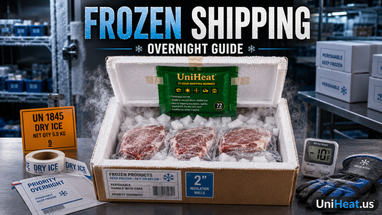
Shipping frozen food is the opposite problem from shipping cold-sensitive food. Instead of preventing freezing, you're preventing thawing. Instead of heat packs, you're using dry ice or specialty frozen-shipping gel packs. Instead of maintaining above-freezing temperatures, you're maintaining sub-zero conditions through 24-48 hours of transit. It's a different playbook entirely, with different regulations, different packaging, and different cost economics. This guide walks through how to ship frozen meat, seafood, ice cream, and prepared meals overnight in 2026 — the carrier rules, the packaging math, and the real-world scenarios that show what works — drawing on the framework we've built across our broader cold-weather shipping resource center.
The Short Answer: Dry Ice or Sub-Zero Gel Packs, Never Heat Packs
The foundational rule for shipping frozen products is that you're using the exact opposite technology from cold-weather shipping. When you ship a live plant or a bottle of wine in winter, you're preventing freezing with a heat pack. When you ship frozen steaks or ice cream, you're preventing thawing with dry ice or specialty gel packs designed to stay below 32°F.
This distinction matters because the technologies aren't interchangeable. A 72-hour heat pack in a frozen meat shipment would thaw the product within hours, potentially causing spoilage and creating food safety risk. Same principle in reverse: a sub-zero gel pack in a wine shipment would crack the bottles. The complete framework for choosing between technologies is laid out in our foundational piece on gel packs vs heat packs, which covers the seasonal and directional logic. For products that need warmth in winter (opposite scenario), our recent piece on how to ship wine, beer & spirits in winter covers the freeze-prevention side.
For frozen shipping, the technology stack is:
- Dry ice — solid carbon dioxide at -109°F, sublimates directly to gas over 12-36 hours
- Sub-zero gel packs — specialized phase-change materials that maintain -10°F to 0°F for 24-48 hours
- Insulated container — 2″ EPS foam standard (thicker than cold-weather shipping)
- Outer corrugated box — typically double-walled for frozen shipments
- Adequate ventilation — dry ice sublimation requires the box to breathe (never airtight)
Why Frozen Shipping Is Different from Cold-Weather Shipping
The mental model most cold-weather shippers have doesn't transfer directly to frozen shipping. Several key differences:
Direction of Temperature Control
Cold-weather shipping fights heat loss — the outside is cold, the box needs to stay above freezing. Frozen shipping fights heat gain — the outside is warmer than the frozen product, the box needs to stay below freezing. Same insulation principle (slow heat transfer), opposite direction.
Duration Requirements
Frozen shipments are almost always overnight or 2-day. The math on maintaining sub-zero temperatures for 72+ hours gets prohibitively expensive quickly, so operations that need frozen shipping default to expedited service. This is different from cold-weather shipping where 72 and 96-hour heat packs enable extended transit windows — see our piece on how long heat packs really last in transit for that framework. The underlying chemistry of heat generation for cold-weather protection is covered in understanding heat pack activation and performance.
Regulatory Complexity
Dry ice is classified as a DOT hazardous material (Class 9, UN 1845). Every dry ice shipment requires proper declaration, hazard labels, ventilation, and quantity limits. Cold-weather shipments with heat packs have no such regulatory burden — heat packs are non-hazardous. This regulatory layer adds operational complexity to frozen shipping.
Cost Structure
Frozen shipping costs are 2-3x higher than cold-weather shipping. Dry ice runs $2-4 per pound, and a typical frozen overnight box uses 5-10 lbs. Sub-zero gel packs cost $8-15 each vs $3-5 for standard gel packs. Add mandatory expedited service and the per-shipment cost typically lands at $40-80 all-in vs $12-25 for cold-weather shipping. The cost math is covered in our piece on cost vs protection in heat pack usage, applied here to the frozen category.
Dry Ice Basics — What You Need to Know
What Dry Ice Is
Dry ice is solid carbon dioxide (CO2) frozen to -109°F. Unlike regular ice, it doesn't melt into liquid — it sublimates directly to gas. This has three implications for shipping:
- No liquid mess as the product cools (an advantage vs regular ice)
- Gaseous CO2 must be allowed to escape (ventilation required in packaging)
- The dry ice quantity decreases over time as it sublimates (need enough at the start to last the transit window)
Sublimation Rate
Dry ice sublimates at approximately 5-10 lbs per 24 hours in a well-insulated shipping container. Some rules of thumb:
- 1-2 lbs of dry ice: sufficient for a 4-6 hour local delivery of small items
- 3-5 lbs: 12-18 hour overnight shipment of a small parcel
- 5-8 lbs: standard 24-hour overnight frozen shipment
- 8-12 lbs: extended 36-48 hour shipment for larger items or challenging routes
Under-packing dry ice is the most common frozen shipping failure. Better to over-pack by 20% than to arrive with thawed product.
Safety Considerations
Dry ice can cause cold burns on skin contact. Always use insulated gloves when handling. Never store dry ice in a sealed container (pressure buildup can rupture the container). Never store in confined unventilated spaces (CO2 accumulation can cause asphyxiation in extreme cases).
Sub-Zero Gel Packs — When to Use Them Instead
Sub-zero gel packs are an alternative to dry ice for many frozen shipping applications. They're specially formulated phase-change materials that maintain temperatures around -10°F to 0°F for 24-48 hours when properly pre-conditioned. Compared to standard cold-weather gel packs discussed in our piece on gel packs vs heat packs, sub-zero packs are formulated for lower temperature ranges.
When Sub-Zero Gel Packs Beat Dry Ice
- Regulatory simplicity — no hazmat declaration required
- Availability — can be purchased and stored in advance vs dry ice which needs to be sourced fresh
- Predictable duration — consistent 24-48 hour performance vs dry ice which varies with insulation quality
- No sublimation gas — can be sealed in airtight containers
- Reusable — customer can refreeze and reuse for their own applications
When Dry Ice Beats Sub-Zero Gel Packs
- Extreme cold requirements (below -10°F) — only dry ice reaches these temperatures
- Longer transit windows (36+ hours) — dry ice maintains sub-zero longer
- Large-volume shipments — dry ice per-lb is cheaper than gel packs at scale
- Ice cream shipping — the ice cream industry standard is dry ice
For SMB frozen shipping operations, sub-zero gel packs are often the easier choice for products like frozen meat, seafood, and prepared meals. For ice cream and very cold-critical products, dry ice remains the standard.
FedEx and UPS Rules for Dry Ice Shipments
Both FedEx and UPS accept dry ice shipments with proper documentation. USPS does not accept dry ice under any circumstances. The general requirements:
FedEx Dry Ice Shipping
- Quantity limit: 5 lbs domestic ground, 5.5 lbs air (200g equivalent)
- Declaration required on shipping label (weight of dry ice must be shown)
- UN 1845 hazard label affixed to outer box
- "CARBON DIOXIDE, SOLID" or "DRY ICE" clearly marked
- Container must allow CO2 gas venting (never airtight)
- Insulated container required (dry ice + non-insulated box is unsafe)
UPS Dry Ice Shipping
- Quantity limit: 5 lbs air cargo (2.5 kg)
- Similar declaration and labeling requirements to FedEx
- UN 1845 label on outer box
- Ventilation and insulation requirements identical
- Some UPS service tiers restrict dry ice acceptance — verify with your account rep
Documentation Required
For any dry ice shipment, you'll need:
- Shipping label with dry ice weight declared
- UN 1845 hazard class label affixed to outer container
- "Dry Ice" or "Carbon Dioxide, Solid" text on the outer container
- Shipper's contact information if hazmat questions arise
For carriers you ship with regularly, work with your account rep to set up a hazmat shipping arrangement in advance. This streamlines the daily operations of frozen shipping. The full framework for building repeatable operations is in our piece on building a reliable cold shipping system.
Packaging Configuration for Frozen Shipments
The standard frozen shipping configuration is more robust than cold-weather shipping, primarily because the failure mode (thawed product) is more visible and immediate.
Standard Frozen Overnight Configuration
- Outer corrugated box — double-walled for structural integrity
- EPS foam liner — 2″ thick on all six sides (thicker than cold-weather 1.5″ standard)
- Product — in original vacuum-sealed or food-grade packaging
- Dry ice or sub-zero gel packs — placed on top of and around the product
- Buffer material — kraft paper to fill air gaps and prevent shifting
- Ventilation — if using dry ice, box must allow CO2 gas escape
For insulation material selection specifically for frozen shipping, our recent shipping container insulation guide covers the R-value comparisons that determine how long a frozen shipment maintains temperature. The 2″ EPS foam standard for frozen shipping isn't arbitrary — it's the threshold below which sub-zero temperatures can't reliably be maintained for a 24-hour overnight window. Our piece on heat pack vs insulation in cold shipping covers the fundamental insulation-is-what-slows-heat-transfer principle that applies equally to frozen shipping. For multi-item frozen shipments where cooling media distribution matters, the framework in how many heat packs you really need per box translates to gel pack and dry ice quantity questions.
Ventilation for Dry Ice
Dry ice ventilation is a common failure point. The outer box needs small perforations or vent holes to allow CO2 gas to escape as the dry ice sublimates. Without ventilation, gas pressure can build up and rupture the box. Standard practice: 4-6 pinhole vents in the top or side of the outer box, positioned to not compromise structural integrity.
Buffer Materials
For frozen shipping specifically, the buffer material serves two purposes: preventing product shifting and providing thermal mass. Crumpled kraft paper works for both. For premium shipments, cardboard dividers can compartmentalize the box and protect individual items. Full material guidance is in our piece on the top 3 packing materials to pair with heat packs, and box size framework is in our resource on choosing the right box size and insulation.
Frozen Meat Shipping Specifics
Frozen meat is the most common frozen shipping category for SMB operations. Steakhouses, direct-to-consumer beef brands, wild game processors, and specialty meat retailers all ship frozen meat regularly.
Meat Category Considerations
- Beef, pork, lamb — standard vacuum-sealed cuts, most tolerant of transit conditions
- Poultry — more sensitive to temperature fluctuations, needs consistent sub-zero
- Ground meat — higher surface area means faster thawing, needs extra dry ice
- Prepared/marinated meat — higher moisture content, more sensitive
- Wild game — often larger cuts or whole animals, requires larger boxes and more dry ice
Standard Frozen Meat Configuration
For a typical 5-10 lb frozen meat shipment:
- 10-14″×10-12″×10-12″ outer box, double-walled
- 2″ EPS foam liner on all six sides
- 5-8 lbs of dry ice on top of and around the vacuum-sealed meat
- Kraft paper filling remaining air space
- Ventilation holes in outer box
- "DRY ICE" and UN 1845 labels affixed
- FedEx Priority Overnight service
- Ship Monday or Tuesday only
For scaling frozen meat operations, the operational discipline covered in our piece on how to scale heat pack usage for higher volumes applies with the caveat that dry ice sourcing (fresh product, not stored) adds a daily operational layer.
Frozen Seafood Shipping
Frozen seafood has some unique considerations. Fish and shellfish are more temperature-sensitive than land meat, and quality degradation from partial thawing is more noticeable. Best practices:
- Deep frozen at origin — product should be at -20°F or lower before packing
- Extra dry ice buffer — use 20-30% more dry ice than the calculated minimum
- Vacuum sealing critical — frost damage and freezer burn are worse for seafood than meat
- Overnight only — never ship frozen seafood 2-day or ground
- Monday shipping only in most operations — weekend delay risk is too high
For premium seafood retailers, the additional cost of enhanced protection is well justified. Customer complaints about seafood quality carry heavier reputational weight than complaints about slightly wilted vegetables. The framework for weighing this trade-off is in our piece on cost vs protection in heat pack usage. The same premium-product logic applies to specialty food and chocolate shipping, though the direction of temperature control differs. For customers looking to stock up on heat packs and shipping supplies, our UniHeat shop offers 40-hour, 72-hour, and 96-hour pack options for the cold-weather side of the business.
Ice Cream Shipping
Ice cream is one of the most demanding frozen shipping categories. Even brief temperature excursions above 32°F cause ice crystal formation and texture changes that customers notice immediately. The ice cream industry standard is dry ice, not gel packs, because of the extreme temperature requirement.
Ice Cream-Specific Requirements
- 10-15 lbs of dry ice for a standard pint or quart order (much more than meat)
- 3″ EPS foam insulation preferred (2″ minimum)
- Overnight shipping only, never 2-day
- Ship Monday or Tuesday only, never later in the week
- Freeze-hard the product before packing (packed while soft = thaws faster)
- Consider adjacent product like dry-shipping items separately if the recipient wants both
Ice Cream Shipping Cost Reality
Per-shipment costs for ice cream typically run $50-90 all-in due to the dry ice quantities and premium insulation requirements. Many artisan ice cream companies build this cost into their product pricing rather than treating it as an add-on. A 4-pint gift assortment might retail at $60-80, with the shipping baked in at $25-40 built into the product margin. Ice cream operations often draw operational lessons from other demanding shipping categories — our piece on lessons learned from peak season shipping covers the operational rhythms that apply.
Frozen Prepared Meals
Frozen meal delivery services (heat-and-eat family meals, meal-kit alternatives) have unique packaging considerations. Products are typically flat pouches, trays, or freezer-safe containers packed together in a shipping box.
Frozen Meal Configuration
- Larger boxes to accommodate multi-meal orders (often 12-15″ per side)
- 2″ EPS foam insulation minimum
- Dry ice or 3-4 sub-zero gel packs (depending on order size)
- Product organization: place highest-value or most sensitive items closest to the cooling source
- Kraft paper filler between individual meals
- Insulated fabric liner as optional add-on for premium shippers
For meal delivery operations at scale, standardization matters more than customization. Same box size, same insulation configuration, same dry ice/gel pack quantity across all shipments simplifies training and reduces errors. The scaling framework is covered in our piece on meal prep companies and cold-weather logistics, which applies to the frozen meal category with adjustments for the sub-zero requirement.
Cost Breakdown for Frozen Overnight Shipping
The economics of frozen overnight shipping are less forgiving than cold-weather shipping. Higher costs across every line item mean the per-shipment total lands significantly higher.
| Cost Component | Frozen Shipping | Cold-Weather Shipping |
|---|---|---|
| Cooling media | Dry ice $10-30 or gel packs $15-40 | Heat pack $3-6 |
| Insulation | 2″ EPS foam $8-15 | 1.5″ EPS foam $4-8 |
| Outer box (double-walled) | $4-6 | $2-4 |
| Buffer materials | $2-3 | $1-2 |
| Hazmat labeling | $1-2 (if dry ice) | N/A |
| Carrier service (Priority Overnight) | $40-70 | $25-45 |
| Total per shipment | $40-90 | $12-25 |
For SMBs operating frozen shipping alongside cold-weather shipping (many DTC food companies do both, seasonally), the cost differential drives operational decisions about which product lines to offer and at what price points. Some operations restrict frozen shipping to premium product lines where the shipping cost is a smaller percentage of total product value.
Common Frozen Shipping Failures
Six patterns that account for the majority of frozen shipping failures:
Failure 1: Under-packing dry ice. The single most common failure. Trying to save on dry ice costs by using the minimum quantity means any transit delay results in thawed product. The rule of thumb: pack 20% more dry ice than the calculated minimum for the expected transit time.
Failure 2: Airtight boxes. Sealing the box airtight to "preserve cold" traps sublimating CO2 gas. Pressure buildup can rupture the box during transit. Always ventilate. This is the frozen-shipping equivalent of the 5 common mistakes we detailed in our piece on 5 common mistakes when using heat packs, with a dry-ice-specific twist.
Failure 3: Shipping later in the week. Thursday shipments risk weekend delays that add 48-72 hours to transit. Frozen shipments cannot survive this. Monday and Tuesday are the only safe frozen shipping days in most operations. The ship-day discipline framework is in our piece on route package protection.
Failure 4: Under-insulating to save space. A 1.5″ foam liner might work for cold-weather shipping, but frozen shipping needs 2″ minimum. Cutting corners on insulation dramatically shortens the safe transit window.
Failure 5: Missing hazmat declaration. Shipping dry ice without proper UN 1845 labeling can result in carrier refusal at pickup, package delays, or fines. Every dry ice shipment requires proper declaration.
Failure 6: Warm product at pack-out. Frozen products need to be at -20°F or below at packing. Product that's only at 15°F (freezer temperature but soft) will thaw faster in transit than product that's rock-hard frozen. Deep-freeze products before packing. The realistic performance expectations for temperature-control shipping are covered in our piece on managing expectations around heat pack performance, which applies equally to gel pack and dry ice performance. For the technology-selection framework that reduces the frequency of these failures, our piece on how to choose the right heat pack covers the selection logic that also applies to sub-zero gel pack sizing.
Real Frozen Shipping Scenarios with Numbers
Scenario 1: Premium Steakhouse to Home Customer
Origin: Texas. Product: 4 filet mignon steaks ($120 total). Route: TX to NY, 24-hour FedEx Priority Overnight. Configuration: 12″×10″×10″ double-walled outer box, 2″ EPS foam liner, 6 lbs dry ice on top of vacuum-sealed steaks, 4 vent holes, UN 1845 label, "DRY ICE" label, ship Monday only. Total per-shipment cost: $55. Protection cost as % of product value: 46%. This is high but standard for premium meat shipping.
Scenario 2: DTC Beef Subscription (Weekly Box)
Origin: Nebraska. Product: 8-piece mixed beef box ($180). Route: nationwide, 24-48 hour FedEx Priority Overnight. Configuration: 14″×12″×12″ box, 2″ EPS foam, 8 lbs dry ice OR 4 sub-zero gel packs. Ship Monday or Tuesday only. Sub-zero gel packs increasingly preferred for regulatory simplicity. Total per-shipment cost: $60-70. Volume subscription pricing brings this closer to 35-40% of product value at bulk rates.
Scenario 3: Artisan Ice Cream Gift Assortment
Origin: Vermont. Product: 4-pint ice cream assortment ($60). Route: VT to CA. Configuration: 12″×12″×12″ box, 3″ EPS foam, 12 lbs dry ice, freeze-hard product 24 hours before packing, vent holes, all labeling. Ship Monday only. FedEx Priority Overnight. Total per-shipment cost: $75-85. Ice cream is one of the toughest categories economically because product value doesn't scale up with shipping cost as easily as meat or seafood.
Scenario 4: Frozen Meal Delivery Service
Origin: Illinois. Product: 12-meal weekly delivery ($150). Route: nationwide, 24-hour overnight. Configuration: 16″×14″×12″ box, 2″ EPS foam, 4 sub-zero gel packs, meals packed with product separation dividers. Ship Monday or Tuesday. Sub-zero gel packs preferred over dry ice for operational simplicity at scale. Total per-shipment cost: $45-55. Meal delivery services often build the shipping cost into subscription pricing to hide the per-order impact.
Scenario 5: Wild Game Processor
Origin: Montana. Product: whole processed venison ($200). Route: MT to hunter's home in TX. Configuration: 18″×14″×14″ large box, 2″ EPS foam, 10 lbs dry ice, individual cuts vacuum-sealed and organized in packing. Ship Monday only. FedEx Priority Overnight. Total per-shipment cost: $85-100. Wild game processors typically charge shipping as an add-on rather than building it into product price because the routes and shipping windows vary.
Alternative Options When Standard Overnight Isn't Enough
For extreme routes or high-value shipments where standard overnight isn't reliable enough:
FedEx Custom Critical
FedEx's premium expedited service for time-critical shipments. Guaranteed delivery windows, dedicated handling, higher cost ($150-400 per shipment). For high-value seafood, premium ice cream, or specialty pharmaceuticals, the reliability premium may be worth it. Not economical for standard consumer frozen shipments.
Local Delivery (Same-City)
For high-value frozen products serving a local market, same-day courier delivery can outperform overnight shipping. Sub-2-hour delivery windows are common in major metros through services like same-day courier services or ghost kitchen delivery networks. This applies to premium steakhouses, ice cream shops, and specialty caterers serving nearby customers.
Refrigerated LTL (For Bulk Volumes)
For B2B shipments to restaurants, distributors, or institutional customers, refrigerated LTL (less-than-truckload) freight is often the right choice. Full-scale operations at $200-600 per shipment carry much more product per unit cost than parcel-sized dry ice shipping. Not the right choice for DTC consumer shipments, but standard for wholesale operations.
Regulatory Compliance for Frozen Food Shipping
Frozen food shipping falls under FDA Food Safety Modernization Act (FSMA) regulations in the same way fresh food shipping does. The Sanitary Transportation Rule applies to any commercial food shipping operation, whether frozen, refrigerated, or fresh.
Key FSMA Requirements for Frozen Shippers
- Prevent temperature abuse during transit (maintaining below-freezing throughout)
- Document shipping conditions when required
- Maintain sanitary conditions in packaging and transit
- Comply with allergen labeling requirements on food packaging
- Some businesses require Food Safety Preventive Controls plans
Frozen shipping methodology is fully compatible with FSMA when executed properly. The dry ice or sub-zero gel pack system reliably maintains the required temperature range, and the documentation practices needed for FSMA compliance mirror the operational documentation practices for reliable shipping generally — the same photos, tracking logs, and route data serve both purposes. This overlap with cold-weather food shipping is covered in our piece on heat packs for food shipping, where FSMA compliance for above-freezing food shipping is detailed.
Building a Frozen Shipping SOP
The SOP for frozen shipping differs from cold-weather shipping SOP in several places. Key SOP components:
Pre-Ship SOP
- Verify ship day is Monday or Tuesday (unless expedited beyond standard overnight)
- Confirm product is at -20°F or below (rock-hard frozen)
- Weather check for the route (extreme heat destinations require extra dry ice)
- Verify carrier account has dry ice hazmat authorization
- Prepare labels including UN 1845, "DRY ICE" declaration, weight
Pack-Out SOP
- Assemble foam liner in outer box (2″ foam, no gaps)
- Add product in the center of the cavity
- Add dry ice on top of and around product (not below product to prevent thawing from the wrong direction)
- Fill remaining space with kraft paper
- Ventilate the box (4-6 pinhole vents)
- Seal outer box (not airtight)
- Affix labels: shipping label, UN 1845 hazmat, DRY ICE, weight declaration
- Document with photo of packed box (before sealing)
Post-Ship SOP
- Log tracking number and route metadata
- Customer notification with expected delivery window
- Reminder to accept and immediately refreeze on receipt
- Track any customer-reported issues within 24 hours
The full framework for operational SOPs is in our piece on building a reliable cold shipping system, which applies to frozen shipping with the modifications noted above. For the daily operational checklist, our resource on the winter shipping checklist for small businesses covers cold-weather practices that also apply to frozen shipping.
Integrating Frozen and Cold-Weather Shipping
Many SMB food operations do both frozen and cold-weather shipping. Meal kit companies ship fresh ingredients (cold-weather) plus frozen proteins (frozen). Specialty food retailers offer both fresh and frozen product lines. Operating both systems in parallel requires attention to a few operational realities:
Separate Packing Stations
Cold-weather and frozen shipping have different supply inventories and different pack-out procedures. Mixing them at a single station leads to errors. Even for small operations, separating the physical setup helps.
Different Ship Days
Cold-weather shipping tolerates Monday-Wednesday. Frozen shipping is often Monday-Tuesday only. Building the ship day discipline into the two systems separately prevents confusion.
Different Customer Communication
Customers receiving frozen product need to know to accept and refreeze immediately. Customers receiving cold-weather product just need to know the delivery window. Different communication templates for different product types.
Different Compliance Layers
Frozen shipping adds dry ice hazmat compliance. Cold-weather shipping has no equivalent regulatory layer. Training team members on the difference matters.
The unified framework for running both systems is covered in our recent capstone piece on cold chain solutions for small businesses, which walks through the operational architecture that accommodates both temperature-control directions within one SMB operation.
How Frozen Shipping Connects to the Broader System
Frozen shipping is one part of a broader temperature-controlled shipping system. The complete SMB cold chain covers freeze prevention (heat packs), refrigerated stability (cold-weather gel packs), and sub-zero maintenance (dry ice / sub-zero gel packs). Understanding all three lets operations serve the full temperature range their products need.
For the full system view, see our resources on:
- Gel packs vs heat packs — the foundational decision framework
- Combining heat packs with cold packs — for products with both requirements
- Scaling heat pack usage — scaling principles that apply to dry ice operations too
- How to reduce winter shipping losses — the loss reduction framework applies to frozen shipping
- Insulated food delivery bags vs boxes — the containers side of the equation
Highlights — The Frozen Shipping Reference Card
Frequently Asked Questions
How do you ship frozen meat overnight?
Ship frozen meat overnight using a double-walled corrugated outer box with 2-inch EPS foam insulation on all six sides, 5-8 pounds of dry ice or 3-4 sub-zero gel packs placed on top of and around the vacuum-sealed meat, kraft paper filling remaining air space, and 4-6 ventilation holes in the outer box (if using dry ice). Affix UN 1845 hazmat labels and "DRY ICE" declaration. Use FedEx Priority Overnight or UPS Next Day Air. Ship Monday or Tuesday only. Total per-shipment cost typically runs $50-70 all-in.
How much does it cost to ship frozen food overnight?
For most SMB frozen shipping operations, the all-in cost runs $40-90 per shipment. This includes the cooling media (5-10 pounds of dry ice at $10-30 or 3-4 sub-zero gel packs at $15-40), 2-inch EPS foam insulation ($8-15), double-walled outer corrugated box ($4-6), buffer materials ($2-3), hazmat labeling if using dry ice ($1-2), and FedEx or UPS Priority Overnight service ($40-70). Frozen shipping costs are 2-3x higher than standard cold-weather shipping due to the dry ice or specialty gel pack requirement and mandatory expedited service.
Does dry ice need a special shipping label?
Yes. Dry ice is a DOT hazardous material classified as UN 1845 (Carbon Dioxide, Solid). Every dry ice shipment requires: a UN 1845 hazard class label affixed to the outer box, "DRY ICE" or "CARBON DIOXIDE, SOLID" text clearly marked on the outer container, declaration of the dry ice weight on the shipping label, and the container must allow CO2 gas venting (never airtight). FedEx and UPS both accept dry ice shipments with proper documentation. USPS does not accept dry ice under any circumstances.
Can I ship frozen food with USPS?
USPS does not accept dry ice shipments, which are the standard for frozen shipping. USPS does accept shipments with sub-zero gel packs, which have no hazmat classification, but their delivery time reliability makes them a poor choice for frozen shipping. For any commercial frozen food shipping operation, FedEx Priority Overnight or UPS Next Day Air with proper insulated packaging and dry ice or sub-zero gel packs are the standard choices. USPS Priority Mail is not suitable for frozen shipping.
What's the difference between shipping frozen and refrigerated food?
Frozen shipping uses dry ice or sub-zero gel packs to maintain temperatures below 32 degrees Fahrenheit, typically in the range of -10 to 0 degrees Fahrenheit. It requires 2-inch EPS foam insulation minimum and expedited overnight or 2-day service. Refrigerated shipping uses standard gel packs to maintain temperatures in the 34-40 degrees Fahrenheit range without freezing the product. It uses 1.5-inch insulation and typically ships via FedEx Priority Overnight. Cold-weather shipping uses heat packs to prevent freezing during cold-weather transit, maintaining the box interior above 32 degrees Fahrenheit.
How long can frozen food stay safely in transit?
Properly packed frozen shipments can maintain sub-zero temperatures for 24-48 hours depending on the cooling media quantity and insulation quality. A standard configuration (5-8 pounds of dry ice, 2-inch EPS foam) reliably handles 24-hour overnight transit. Larger dry ice quantities (10-12 pounds) extend the window to 36-48 hours. Sub-zero gel packs maintain temperature for 24-48 hours depending on ambient conditions. Beyond 48 hours, frozen shipments become unreliable regardless of packaging quality.
Should I use dry ice or sub-zero gel packs?
For SMB operations shipping frozen meat, seafood, and prepared meals, sub-zero gel packs are often the easier choice due to regulatory simplicity (no hazmat declaration required), predictable duration, and easier operational handling. For ice cream and very cold-critical products, dry ice remains the industry standard because it maintains lower temperatures and lasts longer under demanding conditions. Many operations use both, with gel packs for standard categories and dry ice reserved for temperature-sensitive premium products.
What day should I ship frozen food?
Monday or Tuesday only for most operations. Frozen shipments cannot survive the weekend delays that can occur when shipping Wednesday, Thursday, or Friday. A Monday-shipped overnight package delivers Tuesday, well within the safe transit window. A Thursday-shipped package can face weekend delays that put delivery on Monday, exceeding the safe window. Ice cream operations sometimes restrict shipping to Monday only for extra margin. This ship-day discipline is one of the most important operational rules in frozen shipping.
Summary
Shipping frozen meat, seafood, and prepared foods overnight requires a different playbook than cold-weather shipping. The technology is dry ice or sub-zero gel packs (not heat packs), the insulation is thicker (2″ EPS foam standard vs 1.5″ for cold-weather), the outer container is more robust (double-walled corrugated), and the shipping days are more restricted (Monday-Tuesday only for most operations).
Total per-shipment cost typically lands at $40-90 all-in, 2-3x the cost of cold-weather shipping, driven by dry ice costs, premium insulation requirements, and mandatory expedited service. For SMB operations shipping premium meat, seafood, ice cream, or prepared meals, this cost is justified by the product values (typically $60-200 per shipment) and the customer expectation of frozen-product quality on arrival.
Sub-zero gel packs are increasingly preferred over dry ice for standard SMB categories because they eliminate hazmat regulatory overhead. Dry ice remains the standard for ice cream and other extreme-temperature-critical products. Both integrate into a broader SMB cold chain system that also handles cold-weather (heat pack) shipping seasonally — the plant-shipping side of this system is covered in our piece on heat mat vs heat pack for plant shipping. For the broader system view, see our shipping solutions resource center and our deep coverage on perishables shipping, food shipping, temperature control shipping, and cold shipping topics.