
Posted by UniHeatPacks on 28th Jun 2026
Insulated Food Delivery Bags vs Boxes: Which One Wins?
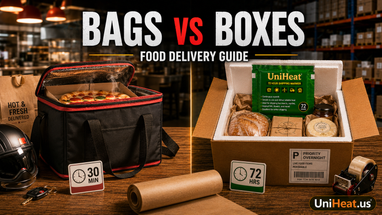
Two products solve different versions of the same problem. Insulated food delivery bags are designed for last-mile, 30-minute trips between a restaurant kitchen and a customer's door. Insulated shipping boxes are designed for multi-day cold-weather transit between a fulfillment center and a customer hundreds of miles away. They look similar at first glance, but they're built for completely different use cases. Choose wrong, and you either over-spend on shipping protection or under-protect a delicate product. This guide breaks down when each option makes sense, with cost analysis, performance comparisons, and operational considerations that complement our broader cold-weather shipping framework.
The Short Answer: Bags for Local Delivery, Boxes for Shipping
The fundamental distinction is transit time. Insulated delivery bags are engineered for short-duration use — typically 15 to 60 minutes between pickup and dropoff. They maintain food temperature for the length of an Uber Eats run or a catering delivery to an office, then return to the restaurant for the next trip.
Insulated shipping boxes are engineered for long-duration use — typically 24 to 96 hours between fulfillment and customer receipt. They go inside a corrugated outer box, get sealed shut, and ride on FedEx Priority Overnight or USPS Ground for multi-day transit, often paired with a 72-hour heat pack or 96-hour heat pack for cold-weather protection.
Both technologies use foam or fabric insulation to slow heat transfer, but the materials, construction, and operational economics are different. We covered the materials side in detail in our shipping container insulation guide, which applies directly to the box side of this comparison. For the question of whether you need warm or cold protection in the first place, see our piece on gel packs vs heat packs, which lays out the seasonal logic.
The Fundamental Difference Between Delivery and Shipping
The vocabulary matters here, and many operations get confused by treating these as interchangeable terms.
Delivery implies last-mile transport from a local source to a local customer. A pizza restaurant delivering to a neighborhood. A catering company delivering to a corporate lunch meeting. A DoorDash driver picking up a meal and dropping it off 15 minutes away. The shared characteristic: short distance, short time, direct handoff.
Shipping implies multi-day transit through a carrier network. A meal kit subscription sending a weekly box from a fulfillment center to a customer in another state. A specialty bakery sending wedding favors across the country. A chocolatier shipping a gift box for the holidays. The shared characteristic: long distance, multi-day transit, carrier handoff.
The technology you need for each is fundamentally different. A delivery bag would not protect food for 72 hours of FedEx transit through cold winter hubs. A shipping box would be wildly impractical for a 20-minute pizza delivery. The mismatch isn't just expensive — it can cause real product damage when applied incorrectly.
Insulated Bags — Strengths and Limitations
How Insulated Bags Work
A typical insulated food delivery bag has three or four layers: an outer durable fabric (often nylon or polyester), a middle layer of foam or thermal insulation (typically 0.5 to 1 inch thick), an inner waterproof lining, and sometimes a reflective inner surface to reduce radiant heat loss. Most bags zip closed or use a heavy-duty Velcro flap, and many include compartments for separating hot and cold items.
The thermal performance is moderate by design. A quality insulated delivery bag maintains hot food (around 140°F) within food-safe range for about 30-45 minutes. Cold items (around 38°F) stay within safe range for about 1-2 hours. This is plenty for a typical delivery run but nowhere near enough for shipping.
Where Bags Excel
- Reusable — quality bags last hundreds of trips with proper care
- Cost-efficient per use — a $30 bag used 200 times costs $0.15 per trip
- Easy to clean — most are wipeable or machine washable
- Operationally simple — no assembly, no consumable cost per trip
- Customizable — logos and branding straightforward to print on
- Driver-friendly — handles, shoulder straps, stable bases
Where Bags Fall Short
- Thermal protection limited to about 1-2 hours, depending on outside temperature
- Not suitable for carrier shipping (would not survive hub sorting environments)
- Cannot pair effectively with heat packs — no controlled internal cavity
- Wear and tear accumulates — bags need replacement every 12-18 months in heavy use
- Performance degrades with each use, especially after cleaning cycles
Insulated Boxes — Strengths and Limitations
How Insulated Boxes Work
An insulated shipping box is typically a polystyrene foam (EPS) cooler — or rigid foam panels — placed inside a corrugated outer box. The foam thickness is usually 1.5 inches on all six sides, providing R-value of about 5-6 per inch and reliable thermal performance for 24-96 hours when paired with a heat pack or gel packs.
The science behind the foam thickness standard is explained in our piece on heat pack vs insulation in cold shipping. The 1.5-inch standard isn't arbitrary — it's the threshold below which thermal performance drops rapidly under real shipping conditions.
Where Boxes Excel
- Long thermal protection — 24-96 hours with proper heat pack pairing
- Survives carrier handling — rigid foam absorbs impact, outer box protects everything
- Compatible with heat packs and gel packs — sealed cavity is exactly what these need
- Stackable and dimensionally stable — works in fulfillment automation
- Scalable to any volume — same configuration works for 10 or 10,000 shipments
- Standard configurations — same box works across product categories
Where Boxes Fall Short
- Single-use in most cases — not designed for return cycles
- Higher per-shipment cost ($8-15 all-in vs $0.50-2 for bags)
- Dimensional weight adds to carrier shipping costs
- EPS foam has recycling and sustainability concerns
- Not practical for short-distance deliveries (overkill)
Side-by-Side Comparison Table
| Feature | Insulated Bags | Insulated Boxes |
|---|---|---|
| Use case | Local delivery (15-60 min) | Multi-day shipping (24-96 hr) |
| Insulation thickness | 0.5-1 inch | 1.5 inch standard |
| Material | Fabric + foam | Rigid EPS foam + corrugated |
| Thermal duration | 1-2 hours | 24-96 hours (with pack) |
| Reusability | 100-500+ uses | Single-use typical |
| Cost per use | $0.15-2.00 | $8-15 |
| Upfront cost | $20-100 per bag | $8-15 per shipment |
| Carrier compatible | No | Yes (FedEx, UPS, USPS) |
| Heat pack compatible | Limited / not practical | Designed for it |
| Branding | Easy (printed fabric) | On outer corrugated box |
| Best for | Restaurants, caterers, couriers | DTC food, meal kits, e-commerce |
Cost Analysis: Per-Use vs Per-Shipment
The cost calculation looks dramatically different between bags and boxes, but the right comparison is total cost per food unit delivered, not just packaging cost.
Bag Cost Math (Reusable)
- Quality insulated delivery bag: $30-80 upfront
- Useful life: 200-500 trips before replacement
- Cost per use over lifetime: $0.10-0.40
- Annual cleaning and maintenance: minimal
- Effective annual cost for a delivery business: $50-200 per bag
Box Cost Math (Single-Use)
- EPS foam liner (1.5″): $4-8 per shipment
- Outer corrugated box: $2-4 per shipment
- Heat pack (72hr standard): $3-5 per shipment
- Tape, kraft paper, labels: $1-2 per shipment
- Total all-in per shipment: $10-19
The cost comparison is roughly $0.30 per delivery (bag) vs $14 per shipment (box). But these aren't comparing the same thing. A bag delivery covers a 5-mile radius in 30 minutes; a box shipment covers a 2,000-mile route over 48 hours. The economics are appropriate for each use case — you'd lose money trying to use the wrong technology for either.
We covered the broader cost-vs-protection trade-off in our piece on cost vs protection in heat pack usage, which applies particularly to the box side of this comparison where heat pack pairing matters.
Reusability and Sustainability
Sustainability is becoming a meaningful purchase consideration for food businesses, and it pushes in opposite directions for the two technologies.
Bags: Highly Sustainable
Reusable bags generate minimal waste per delivery cycle. A quality bag used 300 times displaces 300 single-use packaging items. The fabric and foam construction can typically be replaced or recycled at end of life. Many delivery operations market their bag reuse as part of their sustainability story.
Boxes: Sustainability Trade-Offs
EPS foam is not widely recycled in municipal waste streams, which has driven the development of alternatives we discussed in our insulation guide: wool liners, mushroom foam, recycled paper denim, and plant-based starch foams. For DTC food brands where sustainability matters, evaluating these alternatives against the standard EPS foam is increasingly common.
The trade-off: alternative insulation materials cost 1.5-3x more than EPS foam at equivalent R-value. Some operations split the difference by using EPS foam for standard shipments and premium alternatives for high-end product lines.
Temperature Retention Performance
A practical comparison of how long each option holds food within safe temperature ranges:
| Scenario | Bag Performance | Box Performance |
|---|---|---|
| Hot food (140°F) in 70°F ambient | 30-45 min above 140°F | Not designed for this use case |
| Cold food (38°F) in 75°F ambient | 1-2 hours below 41°F | 24-48 hr with gel packs |
| Cold food (38°F) in 95°F ambient | 45 min below 41°F | 24 hr with gel packs |
| Freeze prevention (35°F target) in 20°F ambient | 15-30 min before freeze | 72 hr with heat pack |
| Freeze prevention in 0°F ambient | Minutes only | 72-96 hr with heat pack |
The performance gap widens dramatically in extreme weather. A bag in 0°F outdoor conditions provides essentially no useful protection beyond a few minutes. A properly assembled box with a 96-hour heat pack maintains usable temperature for days. This is exactly why DTC food companies operating across the US in winter use boxes, not bags — the failure mode in a bag scenario is catastrophic, while the box scenario is well-engineered. We've documented the performance side of heat packs in extreme conditions in our piece on whether heat packs work in extreme cold.
When Restaurants Need Each
Restaurants typically need bags as their primary delivery technology. The use case is short-distance, fast-cycle delivery to local customers or via third-party platforms like DoorDash, Uber Eats, or Grubhub.
A restaurant might also occasionally need boxes for:
- Mail-order specialty items (signature sauces, gift baskets, branded merch)
- Catering deliveries that exceed the 1-hour transit window
- Holiday gift shipping for customers ordering from a distance
- Cookbook and merch fulfillment with food samples
For restaurants entering the e-commerce or DTC channel, transitioning from bag-only thinking to box-based thinking is a meaningful operational shift. The framework for building this capability is covered in our piece on building a reliable cold shipping system for your business.
When Caterers Need Each
Caterers usually need bags for the same reasons restaurants do: local delivery to corporate clients, event venues, and consumer addresses. Catering delivery times are typically 30-90 minutes, which is at the upper end of bag thermal protection but still within the use case.
Caterers might also need boxes for:
- Long-distance event catering (out-of-town weddings, conferences)
- Pre-positioned bulk food shipments to venues
- Holiday catering shipping (corporate gift baskets, gift meal services)
- DTC product extensions (artisan sauces, signature dishes)
For caterers expanding into multi-day shipping, the same principles that apply to specialty food and chocolate shipping apply directly. The packaging shifts from bags to boxes, the protection methodology shifts from passive insulation to active heat packs, and the operational SOPs need to expand to cover multi-day transit decisions.
When Meal Kit Companies Need Each
Meal kit subscription companies almost universally need boxes, not bags. The use case is multi-day FedEx or UPS transit from a fulfillment center to a customer's home, typically with mixed fresh and shelf-stable ingredients packed together. The transit time is 24-72 hours, the route may go through cold hubs in winter, and the destination may not be local at all.
For meal kit operations specifically, our piece on meal prep companies and cold-weather logistics covers the full operational framework, and our recent piece on heat packs for food shipping walks through pack selection by food category.
A meal kit company might use bags only in narrow cases:
- Local delivery within a specific metro area (rare but growing for hybrid models)
- Same-day delivery promotions during peak periods
- Internal staff use during fulfillment
But the primary technology for meal kit shipping is always boxes with appropriate thermal protection for the season — gel packs in summer, heat packs in winter.
How Heat Packs Fit Both Scenarios
Heat packs are primarily a box technology. They work because they're designed for the sealed, insulated cavity that a foam-lined box provides. The chemistry needs the controlled environment to deliver the rated duration. The pack heat needs to be retained by the insulation around it. The buffer-layer rule (no direct contact between pack and food) needs space to be observed.
In a delivery bag scenario, heat packs don't make practical sense for several reasons:
- The transit window is too short to need pack chemistry
- The bag's thin insulation means the pack heat dissipates quickly
- The mixed-temperature nature of delivery (hot food + cold drinks) doesn't suit a heat pack's "warm everything" output
- The operational complexity (activate, then deliver within 30 minutes) doesn't match how delivery bags are used
For full guidance on heat pack chemistry and how it shapes use cases, see our piece on heat pack activation and performance. For the related question of duration matching, see our piece on how long heat packs really last in transit.
Delivery Bag Care and Maintenance
A practical consideration for delivery bag operations: bags need cleaning and maintenance to deliver their full lifetime value. Most bag failures come from poor maintenance, not from the bag itself wearing out.
Standard bag maintenance:
- Wipe down interior after each use to remove food spills
- Deep clean weekly for high-volume operations
- Inspect zipper, seams, and insulation monthly for damage
- Replace bags showing visible insulation degradation
- Rotate bag inventory to spread wear evenly across the fleet
A delivery operation running 50 active bags might budget $400-800 annually for bag replacement at typical usage rates. This is fundamentally different from the box economics, where each shipment consumes a fresh container.
Box Configuration for Food Shipping
For DTC food operations, the standard box configuration matters significantly. Our piece on choosing the right box size and insulation walks through the sizing framework, and our broader piece on top 3 packing materials to pair with heat packs covers complementary materials.
The standard food shipping box configuration:
- Outer corrugated box — single or double-walled depending on weight
- EPS foam liner — 1.5″ on all six sides for standard winter shipping
- Heat pack — 40-hour for short routes, 72-hour standard, or 96-hour for cold zones, taped to inner lid
- Buffer layer — crumpled kraft paper between pack and product
- Food product — in original packaging or food-safe containers
- Fill material — additional kraft paper or biodegradable packing peanuts
This configuration handles most winter food shipping at $10-18 per shipment all-in. For high-value premium products, the upgrade to thicker insulation and longer-duration packs is worth the additional $5-10 per shipment.
Real Scenarios: When Each Wins
Scenario 1: Local Pizza Restaurant
A neighborhood pizza restaurant delivers within a 5-mile radius. Average delivery time: 25 minutes. Need: temperature retention for the cheese and toppings during transit. Bags win. A $40 insulated bag used 300 times per year costs $0.13 per delivery. A box would be operationally impossible and economically absurd.
Scenario 2: Meal Kit Subscription Service
A meal kit company ships fresh ingredient boxes to subscribers nationwide. Average transit time: 48 hours. Need: keep ingredients above freezing and below dangerous warm temperatures throughout multi-day FedEx transit. Boxes win. The $12 per-shipment cost of foam insulation + heat pack + corrugated outer is small relative to the $80-120 product value, and the protection is reliable across thousands of routes. The same logic applies to plant shippers using similar configurations — covered in our piece on heat mat vs heat pack for plant shipping. For bulk pack purchasing options, see our UniHeat shop.
Scenario 3: Wedding Catering with Long Travel
A caterer delivering to a wedding 90 minutes away from the kitchen. Need: temperature retention for hot entrees and cold appetizers during transit. Bags win — barely. The 90-minute window is at the upper edge of bag performance. The caterer should consider whether the menu can survive that window or whether on-site finishing is part of the plan. For a wedding 4+ hours away, the logistics shift to either on-site preparation or specialized food transport — not the same as boxes for DTC shipping.
Scenario 4: Specialty Bakery Holiday Gift Boxes
A bakery sells holiday gift boxes of cookies, fudge, and decorated treats via their e-commerce site. Customers order from across the country. Average transit time: 24-72 hours, often during cold weather. Need: prevent freeze damage during winter shipping. Boxes win. Quality packaging is part of the brand experience, and the $15 per-shipment cost is reasonable relative to the $50-80 product value.
Scenario 5: Restaurant Mail-Order Sauce Line
A restaurant builds a side business shipping their signature hot sauce nationwide. Need: protect glass bottles from cold-snap freeze damage during winter transit. Boxes win. The bottles need to survive multi-day transit through cold hubs, and a 72-hour heat pack with foam insulation handles this reliably. This is a "specialty food" use case that benefits from the same framework we cover in our piece on shipping beverages safely during winter.
Multi-Pack Strategies and Volume Scaling
For high-volume operations, the choice between bags and boxes affects operational design at scale. Bag operations scale by adding more bags and more drivers. Box operations scale by adding fulfillment capacity, packaging materials inventory, and carrier pickup arrangements.
For box-based operations approaching higher volumes, the considerations include bulk pack inventory management, larger fulfillment areas, and standardized SOPs. Our piece on scaling heat pack usage for higher volumes walks through the operational details.
For boxes with multiple products inside (catering or gift box assortments), the question of pack count becomes relevant. The framework is covered in our piece on how many heat packs you really need per box. The short version: more packs do not extend duration, but they do provide more total heat output for larger boxes where one pack's heat doesn't reach all corners.
The Decision Framework
Run this quick decision tree:
- What's the transit time? Under 1 hour = bags. Over 12 hours = boxes. 1-12 hours is the gray zone where neither is ideal (consider on-site service or specialized logistics).
- Who delivers it? Your driver = bags. Carrier (FedEx, UPS, USPS) = boxes.
- What's the volume? Reusable infrastructure (bags) for repeated local delivery. Single-use infrastructure (boxes) for one-way carrier shipping.
- What's the temperature challenge? Mild (50-90°F ambient) = bags work. Extreme cold (below 32°F ambient) = boxes with heat packs required.
- What's the product value? Both technologies scale to product value, but boxes are required for protection windows long enough to justify $50+ product values shipped via carrier.
For most food businesses, the answer is obvious once these questions are answered. Restaurants and caterers need bags. DTC food companies and meal kit subscriptions need boxes. The choice rarely creates real ambiguity if the use case is honestly described.
How This Connects to the Broader Cold-Weather System
Box-based food shipping is part of the larger cold-weather shipping system that applies across verticals — plants, animals, beverages, pharma, food. The same insulation principles, the same heat pack chemistry, the same route awareness, the same ship-day discipline.
For the system view, see our resources on:
- Route package protection — the routing component
- How to reduce winter shipping losses — the loss reduction framework
- Fall-to-winter shipping transition — the seasonal preparation
- Winter shipping checklist — the daily operational checklist
- Managing expectations around heat pack performance — the realistic performance framing
Highlights — The Bag vs Box Decision Card
Frequently Asked Questions
What's the difference between an insulated food delivery bag and an insulated shipping box?
An insulated food delivery bag is designed for local delivery trips of 15-60 minutes by drivers or couriers. It uses fabric and foam construction, is reusable hundreds of times, and costs $0.15-2.00 per use over its lifetime. An insulated shipping box is designed for multi-day carrier transit of 24-96 hours. It uses rigid EPS foam inside a corrugated outer box, is typically single-use, and costs $10-18 per shipment all-in. The two technologies serve completely different use cases and aren't interchangeable.
Can I use a delivery bag for FedEx or UPS shipping?
No. Delivery bags are not designed to survive carrier handling, hub sorting environments, or multi-day transit times. The thin insulation (0.5-1 inch) provides only 1-2 hours of useful thermal protection, far short of the 24-96 hour windows carriers operate on. The fabric construction is also not built for the impact and weight handling that carrier sorting requires. For carrier shipping, use insulated boxes with appropriate heat pack pairing.
How long can food stay safe in an insulated delivery bag?
A quality insulated delivery bag maintains hot food (around 140 degrees Fahrenheit) within food-safe range for about 30-45 minutes. Cold items (around 38 degrees Fahrenheit) stay within safe range for about 1-2 hours. Performance varies with outdoor temperature, bag quality, and how full the bag is. For trips longer than about 90 minutes, consider whether the bag thermal performance is sufficient or whether you need a different logistics approach.
What does an insulated shipping box cost per shipment?
For most food shipping operations, the all-in cost per shipment lands around $10-18. This includes the EPS foam liner ($4-8), the outer corrugated box ($2-4), the heat pack for winter shipping ($3-5), and additional materials like kraft paper and tape ($1-2). Premium options for high-value chocolate or specialty products may run $15-25 all-in. Relative to typical food shipment values of $50-150, this protection cost is reasonable insurance against loss.
How long do insulated food delivery bags last?
Quality insulated delivery bags last 200-500 uses with proper care. High-volume delivery operations typically replace bags every 12-18 months due to accumulated wear, stained interiors, or damaged zippers. The cost per use over a bag's lifetime works out to $0.10-0.40 for a $30-80 bag. Regular maintenance (wiping interiors after use, weekly deep cleaning, monthly damage inspection) extends bag lifetime significantly.
Do I need both bags and boxes for my food business?
Most food businesses need one or the other based on their primary delivery model, not both. Restaurants and caterers focused on local delivery need bags. DTC food companies and meal kit subscriptions focused on multi-day shipping need boxes. Some businesses develop hybrid models — for example, a restaurant launching a mail-order specialty line — in which case they need both, but the operational systems for each are quite separate.
How do heat packs work with insulated shipping boxes?
Heat packs are designed for the sealed insulated cavity that shipping boxes provide. The pack is taped to the inside of the lid or upper wall, with a buffer layer of kraft paper between the pack and the food product. The chemical reaction releases heat steadily for 40, 72, or 96 hours depending on the pack rating, keeping the box interior above freezing throughout transit. The foam insulation around the cavity retains the pack's heat, and the buffer layer prevents direct contact damage. This system reliably protects food from freeze damage during winter shipping.
Are insulated bags or boxes more sustainable?
Insulated delivery bags are inherently more sustainable than single-use shipping boxes because they generate minimal waste per delivery. A quality bag used 300 times displaces 300 single-use packaging items. However, the use cases are different, so this comparison applies only within the same logistics scenario. For shipping operations where bags aren't viable (multi-day transit), sustainable alternatives include recycled EPS foam, wool-based insulation liners, mushroom foam, and plant-based starch foam alternatives.
Summary
The choice between insulated food delivery bags and insulated shipping boxes is really a choice between two completely different logistics models. Bags solve the last-mile delivery problem for restaurants, caterers, and food couriers. Boxes solve the multi-day shipping problem for DTC food companies, meal kit subscriptions, and specialty food brands.
The transit time threshold is roughly 1-2 hours. Under that window, bags work well, cost less per use, and integrate naturally with driver-based delivery operations. Over 12 hours, boxes are the only practical choice, and they require heat packs in cold weather plus quality insulation to deliver reliable protection. The 1-12 hour gray zone is best handled through on-site service or specialized logistics rather than either standard technology.
For DTC food operations specifically, the box configuration with a 72-hour heat pack in 1.5″ EPS foam handles most winter shipping needs at $10-18 per shipment all-in. Premium products and cold-zone destinations may justify the 96-hour pack upgrade. For the broader system view that connects food shipping to the rest of the cold-weather shipping landscape, see our shipping solutions resource center and our deep coverage on food shipping, cold-weather shipping, and heat pack topics.