
Posted by UniHeatPacks on 15th Aug 2026
Cold Shipping Insurance & Liability: Small Business Guide
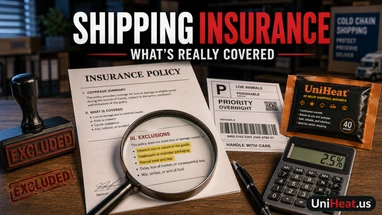
Cold-weather shipping introduces risk that other shipping doesn't have — freeze damage, live-animal mortality, perishable spoilage, and package delays that turn premium products into total losses. Understanding how insurance works (and often doesn't work) for cold shipping is critical for small businesses building sustainable DTC operations. This guide walks through the reality of carrier declared-value coverage, live-arrival guarantees, third-party shipping insurance, self-insurance economics, and practical risk management. Building on the broader operational framework we've developed across our cold-weather shipping resource center, this piece focuses specifically on the financial and legal risk side of cold shipping.
The Short Answer: Carrier Insurance Rarely Covers Cold Shipping
The most important thing small business shippers need to understand: carrier declared-value coverage generally does NOT cover the things that go wrong in cold shipping. Live animals are excluded. Perishable food is typically excluded or heavily restricted. Freeze damage is often excluded even for products that would otherwise be covered. Reading the fine print of your FedEx, UPS, or USPS declared-value coverage will reveal exclusions specifically targeting cold-chain-relevant categories.
This creates a specific reality for cold shipping small businesses: you are essentially self-insuring. The "live arrival guarantee" or "freshness guarantee" you offer customers is functionally a promise to replace or refund products that fail during transit — and that cost comes out of your margin, not carrier reimbursement.
Understanding this reality drives everything else: product pricing (build in expected loss cost), operational discipline (reduce failure rate through better packaging), documentation practices (support claims when they do occur), and customer communication (set clear expectations). The framework connects to the operational architecture in our capstone piece on cold chain solutions for small businesses.
What Carrier Declared-Value Coverage Actually Covers
FedEx Declared Value
FedEx provides automatic declared value coverage of $100 on most shipments. Additional coverage can be purchased at approximately $3.35 per $100 of declared value up to $50,000.
Key FedEx exclusions relevant to cold shipping:
- Live animals — explicitly excluded from declared value coverage
- Perishable food — excluded unless specifically negotiated in writing
- Plants and plant material — typically excluded
- Consequential damages — lost profits, replacement product costs, customer refunds not covered
- Damage from inadequate packaging — carrier can deny claim if packaging deemed insufficient
For non-cold-chain shipments, FedEx declared value works as expected. For cold shipping, it's often functionally useless.
UPS Declared Value
UPS provides similar automatic $100 coverage with paid upgrades available. Exclusions parallel FedEx:
- Live animals — excluded
- Perishable items — excluded
- Plants — excluded
- Special commodities — excluded or restricted
USPS Insurance
USPS insurance is available on most services (Priority Mail includes up to $100 automatic; Priority Mail Express includes $100 automatic with option to purchase more).
- Live animals — excluded (and USPS doesn't accept live animals except invertebrates)
- Perishable items — covered with restrictions but claims denied for spoilage due to delay
- Plants — covered with restrictions
The Common Thread
Every major carrier excludes the categories that dominate cold shipping. This isn't an oversight — it's intentional risk allocation. Carriers know cold shipping has higher failure rates and shift that risk back to shippers.
How Shipments Actually Fail in Cold Chain
Understanding failure modes helps understand what insurance would need to cover:
Delay-Induced Failures
The most common cold shipping failure. A package that would have arrived fine on the expected schedule fails when carrier delays extend transit time beyond safe windows. Weekend delays, weather delays, and mechanical delays all cause this.
Temperature-Related Failures
Freeze damage, heat damage, or extreme temperature exposure during hub transit. Even properly packaged shipments can fail when hub temperatures are extreme.
Handling Damage
Rough handling that breaks bags, cracks bottles, crushes decorated products, or damages live-animal containment.
Lost or Misrouted Packages
Package that never arrives or arrives after safe transit window has expired.
Customer-Related Failures
Customer not present at delivery, package left outside in cold conditions, delayed opening of live-animal shipments.
Each failure mode has different insurance implications. Some are potentially recoverable through carrier claims; most are not. Framework for understanding loss patterns in our piece on how to reduce winter shipping losses.
Third-Party Shipping Insurance Options
Shipsurance
Third-party shipping insurance provider that offers alternatives to carrier declared-value coverage. Broader coverage terms in some cases.
- Coverage available across FedEx, UPS, USPS, DHL
- Rates typically $0.60-$1.20 per $100 declared value
- Some perishable coverage available (with restrictions)
- Live animals typically still excluded
U-PIC (United States Postal Insurance Corporation)
Specialty parcel insurance provider covering multiple carriers.
- Coverage across major carriers
- Competitive rates for volume shippers
- Perishable coverage with restrictions
- Live animals typically excluded
Route Package Protection
E-commerce-focused package protection sold to customers at checkout. Different model from traditional shipping insurance.
- Customer pays small fee at checkout for protection
- Route covers lost, damaged, stolen shipments
- Perishable coverage limited
- Live animals typically excluded
InsureShield (UPS Capital)
UPS's own third-party insurance product with more flexibility than declared value coverage.
- Better coverage terms than standard UPS declared value
- Perishable coverage available
- Live animals still excluded
Specialty Live-Animal Insurance
Very limited market. Some specialty providers offer live-animal shipping insurance, but rates are high (often 5-15% of shipment value) and terms are restrictive. Most reptile and fish breeders find self-insurance more economical than third-party live-animal coverage.
Self-Insurance: The Standard Approach
Most cold shipping small businesses use self-insurance through live-arrival guarantees or freshness guarantees. This is functionally what "insurance" looks like in practice for cold chain DTC operations.
The Economics
Self-insurance works when overall mortality/damage rates stay within manageable limits. Standard framework:
- Build 2-5% expected loss cost into product pricing
- Track actual loss rates monthly/quarterly
- Adjust pricing if loss rates exceed built-in provision
- Improve operational discipline to reduce loss rates
Category-Specific Loss Targets
| Category | Loss Rate Target | Pricing Provision |
|---|---|---|
| Reptile shipping (established operations) | Under 2% | 3-5% of product price |
| Tropical fish shipping | Under 5% | 5-8% of product price |
| Live plant shipping | Under 3% | 3-5% of product price |
| Feeder insect shipping | Under 5% | 5-8% of product price |
| Wine and premium beverages | Under 1% | 2-3% of product price |
| Frozen food shipping | Under 3% | 3-5% of product price |
| Baked goods shipping | Under 3% | 3-5% of product price |
| Chocolate and premium sweets | Under 2% | 3-5% of product price |
For operations meeting these loss rate targets, self-insurance economics work. Operations with higher loss rates need to improve packaging and processes (see our piece on 5 common mistakes when using heat packs) rather than turn to insurance as a solution.
Building Effective Live-Arrival and Freshness Guarantees
Standard Live-Arrival Guarantee Elements
- Guarantee scope (DOA replacement, refund, or store credit)
- Customer requirements (adult signature, immediate opening, photo documentation)
- Reporting window (30 minutes to 24 hours depending on category)
- Exclusions (customer not present at delivery, package left outside, etc.)
- Documentation required (photos, tracking data)
- Resolution timeline (typical 1-2 weeks)
Category-Specific Guarantee Windows
- Reptiles: 30-60 minutes from delivery for DOA reports
- Fish: 1-2 hours from delivery for DOA reports
- Plants: 24-72 hours from delivery (freeze damage may appear later)
- Perishable food: Same-day reports with photo documentation
- Baked goods: 24 hours from delivery
What NOT to Guarantee
- Delivery within specific timeframes (carriers control this, not you)
- Post-arrival survival (once the animal is your customer's responsibility)
- Customer errors (improper acclimation, inadequate housing)
- Weather force majeure (extreme storms, unusual delays)
Guarantee Language Examples
Effective guarantee language is clear, specific, and enforceable:
"We guarantee your reptile will arrive alive. If your animal is DOA (Dead on Arrival), please document with photos within 60 minutes of delivery and contact us. We will replace the animal or refund the purchase price (shipping cost not refunded). Customer must be present for delivery with adult signature. Package must not be left outside in cold conditions. Refunds and replacements at our discretion."
Documentation Best Practices
Documentation is the foundation of both guarantee enforcement and carrier claims:
Pre-Ship Documentation
- Product photos before packaging
- Packaging photos showing configuration
- Sealed box photos with tracking label
- Heat pack activation timestamp
- Weather forecast for route
In-Transit Documentation
- Tracking log for the shipment
- Any carrier updates on delays or issues
- Weather observations at hub cities during transit
Delivery Documentation
- Delivery signature confirmation
- Delivery time from tracking
- Customer confirmation of package receipt
Issue Documentation
- Customer photos of package condition
- Customer photos of product condition
- Customer statement of what happened
- Timeline from delivery to unboxing to issue discovery
This documentation supports self-insurance decisions and any carrier claim attempts. Framework connects to our piece on managing expectations around heat pack performance.
When to File Carrier Claims
Even though most cold shipping categories are excluded from carrier declared value, some claims are worth filing:
Worth Filing
- Lost packages (regardless of contents)
- Physical damage to packaging visible on delivery (bottle breakage, crushed box)
- Signature confirmation failures
- Documented mishandling caught on tracking
Rarely Worth Filing
- Freeze damage on properly declared perishable shipments (usually denied due to exclusions)
- Live animal mortality (excluded)
- Delay-induced spoilage (usually denied due to consequential damage exclusions)
Claim Process
- File claim within carrier's window (typically 60-180 days)
- Provide all documentation (photos, receipts, tracking)
- Expect claim to be reviewed for 2-4 weeks
- Appeals process available if denied
- Track claim outcomes for internal analytics
The Economics of Cold Shipping Loss
Understanding the full cost of shipping loss goes beyond product replacement:
Direct Costs
- Product replacement cost (typically full retail value, not COGS)
- Replacement shipping cost
- Customer service time
- Refund processing (if refund vs replacement)
Indirect Costs
- Customer lifetime value at risk (unhappy customers don't reorder)
- Reputation impact (online reviews)
- Word-of-mouth impact (negative referrals)
- Support burden for future orders from concerned customers
Real Loss Cost Calculation
A single failed reptile shipment often costs 3-5x the shipment's revenue when all costs are considered. A $300 ball python shipment that dies costs: $300 replacement animal, $75 replacement shipping, $50 customer service time, $500-1500 lost future revenue from that customer, and potential reputation damage. Total realistic cost: $1000-2500 for a single failure.
This is why operational discipline matters more than insurance. A 1% reduction in mortality rate saves far more than any insurance premium reduces. Framework in our piece on cost vs protection in heat pack usage.
Building a Risk Management Program
Component 1: Prevention
The best insurance is not needing to file claims. Prevention includes:
- Premium packaging appropriate to product value
- Ship-day discipline (Monday only for high-stakes items)
- Weather-aware routing decisions
- Species/product-appropriate handling
- Ongoing operational training
Component 2: Detection
Early detection reduces loss cost:
- Tracking every shipment through delivery
- Weather monitoring at hub cities
- Delay alerts and customer communication
- Post-delivery follow-up
Component 3: Response
When failures occur, effective response minimizes total impact:
- Clear guarantee terms and prompt claim processing
- Customer communication during resolution
- Replacement or refund based on guarantee terms
- Root cause analysis for continuous improvement
Component 4: Learning
Every failure is data:
- Log failures with route, weather, packaging details
- Analyze patterns quarterly
- Adjust operations based on findings
- Update guarantee terms as data warrants
Framework connects to broader operational patterns in our piece on lessons learned from peak season shipping.
Product Categories and Insurance Considerations
Live Animals (Reptiles, Fish, Insects)
Universally excluded from carrier declared value. Third-party insurance available but expensive. Self-insurance via live-arrival guarantee is industry standard. Loss rates need to stay under category benchmarks (2-5%) for self-insurance economics to work. Framework in our pieces on reptile winter shipping, shipping live aquarium fish, and shipping live feeder insects.
Live Plants
Typically excluded from carrier declared value. Third-party insurance sometimes available. Self-insurance via freshness/live-arrival guarantee standard. Loss patterns often cumulative (chilling injury appears days after shipping). Framework in our piece on heat mat vs heat pack for plant shipping.
Perishable Food
Typically excluded or heavily restricted. Third-party perishable insurance available with restrictions. Self-insurance via freshness guarantee standard. Cold-chain-related failures usually excluded from carrier claims. Framework in our piece on heat packs for food shipping.
Frozen Products
Similar to perishable food but with additional complications from dry ice hazmat considerations. Framework in our piece on how to ship frozen meat & food overnight.
Wine and Alcohol
Bottle breakage often covered by carrier declared value. Freeze damage typically not covered. Third-party wine shipping insurance exists but expensive. Self-insurance via replacement guarantee standard. Framework in our piece on how to ship wine, beer & spirits in winter.
Pharmaceuticals and Supplements
Regulated products may have specific insurance requirements. Standard SMB supplement shipping uses self-insurance. Framework in our piece on pharmaceutical cold chain packaging for small businesses.
Baked Goods
Perishable food category with same exclusions. Self-insurance via freshness guarantee standard. Framework in our piece on how to ship baked goods, cakes & cookies nationwide.
Customer Communication About Guarantees
Setting Expectations Pre-Purchase
- Guarantee terms clearly stated on product page
- Shipping FAQ addressing common questions
- Weather-related shipping delay policies
- Customer responsibility statements
Confirming During Order
- Order confirmation reiterates guarantee terms
- Shipping confirmation includes delivery expectations
- Delivery-day reminders about signature and immediate opening
Handling Claims Professionally
- Respond promptly to guarantee claims
- Request appropriate documentation
- Make decisions consistently based on guarantee terms
- Communicate outcomes clearly with reasoning
Managing Difficult Situations
Some claims involve edge cases where guarantee terms are ambiguous. Standard approaches:
- Err on the side of customer satisfaction for close cases
- Document decisions for consistency
- Update guarantee terms when patterns emerge
- Recognize that reputation damage from disputed claims exceeds replacement cost
Legal Considerations
Terms of Service
Cold shipping businesses should have clear terms of service covering:
- Guarantee terms and conditions
- Documentation requirements
- Limitation of liability
- Dispute resolution process
- Governing law and jurisdiction
Consumer Protection Laws
State consumer protection laws vary. Cold shipping businesses selling nationwide need to consider:
- Different state warranty laws
- Different state guarantee enforceability standards
- Interstate sales tax obligations
- Payment processing dispute rules (chargebacks)
Payment Processor Considerations
Chargebacks from customer disputes can be more costly than guarantee claims. Payment processors like Stripe, PayPal, and Shopify Payments have specific rules for:
- Dispute response requirements
- Documentation for chargeback defense
- Threshold rates that can trigger account issues
- Reserve requirements for high-chargeback merchants
Common Cold Shipping Liability Mistakes
Mistake 1: Not reading carrier declared-value exclusions. Assuming your $500 declared value provides real coverage for a live animal shipment.
Mistake 2: Vague guarantee terms. Guarantees like "we guarantee your happiness" are impossible to enforce and lead to disputes.
Mistake 3: No documentation practices. Being unable to prove packaging quality or delivery condition when disputes arise.
Mistake 4: Inconsistent claim handling. Treating similar cases differently based on customer pressure creates precedent problems.
Mistake 5: Under-pricing for loss rate. Failing to build adequate loss provision into product pricing forces margin absorption.
Mistake 6: Confusing guarantee scope. Not clarifying what's covered (DOA) vs not covered (post-arrival death).
Mistake 7: Ignoring reputation costs. Winning individual claims while losing customer relationships and generating negative reviews.
Case Studies: How Different Categories Handle Insurance
Ball Python Breeder (Reptile Specialty)
Business model: 30 shipments per week averaging $400 per animal. Guarantee: DOA replacement or refund with 60-minute documentation window. Loss rate: 1%. Loss cost: 3 animals per week = $1,200 per week absorbed as replacement. Built into pricing: 3% of product cost. Third-party insurance not used (economically unfavorable). Self-insurance sustainable.
Discus Fish Retailer (Fish Specialty)
Business model: 25 shipments per week averaging $200. Guarantee: 2-hour DOA reporting with photo evidence. Loss rate: 3%. Loss cost: $150 per week average. Built into pricing: 5% of product cost. Third-party insurance considered but excluded live animals. Self-insurance is the only viable model.
Meal Kit DTC Brand (Food Category)
Business model: 500 shipments per week averaging $80. Guarantee: Same-day damage/spoilage reports. Loss rate: 2%. Loss cost: $800 per week. Built into pricing: 3% of product cost. Also uses Route Package Protection at checkout for lost/stolen shipments. Combined approach works well.
Craft Winery Wine Club
Business model: 100 shipments per month averaging $150. Guarantee: Bottle breakage replaced (usually covered by carrier declared value), freeze damage replaced (self-insured). Loss rate: 0.8%. Loss cost: $120 per month. Built into pricing: 2% of product cost. Wine-specific shipping insurance available but not economical at their volume.
Home Bakery (Cottage Food)
Business model: 20 shipments per week averaging $40. Guarantee: Damaged/stale product replaced. Loss rate: 4%. Loss cost: $32 per week. Built into pricing: 4% of product cost. No third-party insurance used. Self-insurance is standard for small home operations.
Building Long-Term Sustainable Operations
Focus on Prevention
The best insurance is not needing to file claims. Investment in premium packaging, operational discipline, and staff training pays back in reduced loss rates. Framework in our piece on building a reliable cold shipping system.
Track Loss Metrics Religiously
Monthly review of:
- Total shipments
- Failure rate by category
- Failure rate by route
- Failure rate by carrier
- Failure rate by weather condition
- Failure rate by ship day
Continuous Improvement
- Root cause analysis for each significant failure
- Test packaging changes with controlled shipments
- Monitor competitor practices for industry evolution
- Update SOPs based on findings
Financial Planning
- Reserve funds for guarantee claims
- Track loss cost as line item
- Adjust pricing when loss rates change
- Consider volume economics for scaling
How Insurance Considerations Connect to Broader Operations
Cold shipping insurance and liability considerations affect every aspect of operations. Product pricing must include loss provisions. Packaging decisions balance cost against loss prevention. Ship-day discipline reduces delay-related failures. Customer communication sets expectations for guarantee scope. Documentation practices support both self-insurance decisions and any carrier claims that might be filed.
For the broader operational system view:
- Cold Chain Solutions for Small Business — unified operational framework
- How to reduce winter shipping losses — loss prevention framework
- Winter shipping checklist for small businesses — daily discipline
- Route package protection — route strategy
- How to scale heat pack usage for higher volumes — scaling framework
- Insulated shipping containers guide — container framework
- How to select the perfect heat pack duration — pack framework
- Cold-weather shipping protection reference — product-specific configurations
- Complete freezing points reference — temperature science
For bulk pack purchasing that supports proper operational protection, our UniHeat shop stocks 40-hour, 72-hour, and 96-hour options. Full shipping solutions across the SMB cold chain.
Highlights — Insurance & Liability Reference Card
Frequently Asked Questions
Does FedEx insurance cover live animals?
No. FedEx declared value coverage explicitly excludes live animals. This applies to all carriers (FedEx, UPS) that accept live animals. USPS also excludes live animals from insurance, though USPS doesn't accept most live animals anyway (except invertebrates like feeder insects). If you ship live animals, your live-arrival guarantee is essentially self-insurance funded by your product margin. Third-party live-animal shipping insurance exists but is expensive and restrictive, making self-insurance the industry standard for reptile, fish, and other live-animal DTC operations.
Does shipping insurance cover freeze damage?
Rarely. Standard carrier declared value coverage typically excludes perishable items and consequential damages from delays. This means a wine bottle broken during handling might be covered, but a wine bottle that froze during weekend delay in transit typically is not. Third-party shipping insurance (Shipsurance, U-PIC, InsureShield) sometimes covers freeze damage with restrictions, but premiums for cold-sensitive shipments are high. Most cold shipping businesses self-insure freeze damage through their freshness or replacement guarantees rather than purchasing coverage.
What's a live arrival guarantee?
A live arrival guarantee is a promise by a live-animal shipper to replace or refund animals that arrive DOA (Dead on Arrival). Standard terms include: customer must be present at delivery with adult signature, photo documentation within 30 minutes to 24 hours of delivery (varies by category), package must not have been left outside in cold conditions, and reasonable customer preparation (appropriate housing, water parameters). Live arrival guarantees are self-insurance funded by product margin, not carrier or third-party insurance. They're the industry standard for reptile, fish, plant, and feeder insect DTC shipping.
How much should I budget for shipping loss?
Category-specific benchmarks: reptile shipping build 3-5% into product pricing (targeting under 2% actual loss rate), tropical fish shipping build 5-8% (targeting under 5% actual), live plants build 3-5% (targeting under 3% actual), feeder insects build 5-8% (targeting under 5% actual), wine and premium beverages build 2-3% (targeting under 1% actual), frozen food build 3-5% (targeting under 3% actual), baked goods build 3-5% (targeting under 3% actual). Track actual loss rates monthly. If actual loss exceeds pricing provision, improve operations rather than raising prices. Real cost of loss (including customer lifetime value impact) is typically 3-5x direct replacement cost.
Should I offer Route Package Protection at checkout?
Route Package Protection is a customer-paid checkout option that covers lost, damaged, or stolen shipments. It's popular in general e-commerce and works well for standard shipments. For cold shipping specifically, Route has limitations: live animals typically excluded, some perishable coverage restrictions, and it doesn't cover many cold-chain-specific failure modes. Route can complement a self-insurance approach by covering non-cold-chain failures (lost/stolen packages) while your own guarantee covers cold-chain-specific failures (freeze damage, live arrival). Consider adding Route if it fits your customer expectations and doesn't replace your primary guarantee.
What documentation do I need for guarantee claims?
Standard documentation includes: pre-ship photos of product and packaging, sealed box photos with tracking label, delivery confirmation from tracking (time, signature), customer photos of package condition upon receipt, customer photos of product condition (or dead animal for live arrival claims), timeline from delivery to unboxing to issue discovery, and customer statement of what happened. This documentation supports your decision-making on guarantee claims and protects against chargebacks from disputed cases. It also creates data for continuous improvement of your operations.
What if the carrier delays my perishable shipment?
Carrier delays that cause perishable spoilage are typically not covered by carrier declared value (consequential damages exclusion). Your options: file a service failure claim for shipping cost refund (many carriers refund shipping cost for missed delivery windows), honor your freshness guarantee to the customer at your cost, document the delay for your internal analytics, and consider adjusting your carrier strategy if delays are recurring on specific routes. For time-sensitive shipments, premium services (Priority Overnight vs Ground) reduce delay risk but don't eliminate it. Weather-related delays are typically excluded from any service guarantees.
Can I sue the carrier for cold shipping losses?
Generally no. Carrier shipping contracts (the terms you accept when you use FedEx, UPS, or USPS) specifically limit liability to declared value coverage terms. These contracts are legally binding and courts have upheld the limitations. Small claims court might be worth exploring for individual disputed claims, but building a business model around suing carriers is not viable. The realistic path is: prevent losses through better operations, self-insure through guarantees priced into products, and accept that carrier declared value has significant exclusions for cold shipping categories. Focus energy on operational improvement rather than legal recovery.
Summary
Cold shipping insurance and liability is a specialized area where standard carrier coverage often doesn't apply. Carrier declared value coverage excludes live animals and most perishables. Third-party shipping insurance (Shipsurance, U-PIC, Route, InsureShield) covers some categories but excludes live animals. The practical reality for most cold shipping small businesses is self-insurance through live-arrival guarantees or freshness guarantees, funded by 2-5% loss provisions built into product pricing.
Operational discipline matters more than insurance. Better packaging, ship-day discipline, weather-aware routing, and species/product-appropriate handling all reduce failure rates. A 1% reduction in mortality saves more than any insurance premium reduces. Documentation practices support both guarantee decisions and any carrier claims that might succeed.
Real loss cost is 3-5x direct replacement value when customer lifetime value, reputation impact, and dispute-handling time are included. This makes prevention economically favorable to any insurance strategy. Track loss metrics religiously, run root cause analysis on failures, and update operations continuously based on findings.
For the broader operational system that supports effective cold shipping risk management, see our shipping solutions resource center, our capstone piece on cold chain solutions for small businesses, and comprehensive coverage across heat pack topics, cold shipping, and temperature control shipping. For product-specific insurance considerations, our vertical guides on reptile shipping, fish shipping, food shipping, and beverage shipping cover category-specific patterns.