
Posted by UniHeatPacks on 7th Aug 2026
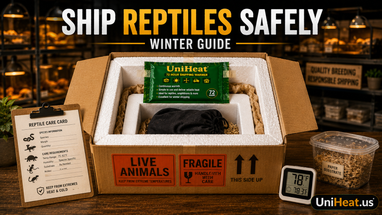
Reptile Winter Shipping: Complete Guide for Breeders (2026)
Shipping reptiles is one of the highest-stakes categories in the live-animal shipping world. Unlike feeder insects (small, low value) or plants (tolerant of moderate cold), reptiles are high-value animals where mortality means real financial loss and real customer disappointment. A ball python shipment can be $200-2,000. A rare morph gecko can be $500-5,000. Getting reptile shipping right requires species-specific knowledge, disciplined packaging, and operational rigor that goes beyond generic live-animal frameworks. This guide walks through everything reptile breeders and hobby shippers need to know: species tolerances, packaging protocols, carrier selection, live-arrival guarantees, and how reptile shipping fits into the broader SMB cold chain framework we've built across our cold-weather shipping resource center.
The Short Answer: Species-Specific Care, Monday-Only Shipping, Premium Packaging
Reptile shipping success comes down to three fundamentals: matching packaging to species-specific temperature requirements, disciplined Monday-only ship days, and premium-quality materials that don't cut corners on protection. Getting any of these three wrong causes mortality — and mortality in reptile shipping is catastrophic because animals are high-value, customers are attached, and reputational damage compounds quickly.
Ball pythons need 96-hour heat packs and 2″ EPS foam for winter transit. Colubrids can tolerate 72-hour packs. Bearded dragons need premium heat protection due to their extreme heat adaptation. Leopard geckos handle shipping well but need proper substrate. Turtles have USDA regulatory considerations. Every species has its own profile.
The framework parallels our recent piece on ball python winter shipping, which covers the specific case in depth. This broader guide extends those principles to the full range of reptile species that breeders ship regularly. For the foundational cold chain framework that supports reptile shipping, see our capstone piece on cold chain solutions for small businesses.
Understanding Reptile Physiology and Shipping
Reptiles are ectothermic, meaning they rely entirely on external heat sources to regulate body temperature. This has critical shipping implications:
No Internal Heat Generation
Unlike mammals or birds, reptiles produce almost no metabolic heat. A ball python in a 45°F container doesn't stay warm through metabolism — it cools to ambient temperature. This is different from live mammal shipping (rarely done via parcel) where the animal generates significant body heat.
Temperature Directly Affects Physiology
Reptile digestion, immune function, muscle activity, and even respiration all depend on adequate temperature. A reptile shipped too cold arrives lethargic, immunocompromised, and often with digestive issues from stress. Even survived shipments can result in weeks of recovery time.
Species-Specific Temperature Ranges
Different species evolved in different climates and have different tolerance ranges. Tropical species (ball pythons, boas, most geckos, chameleons) need warmer transit conditions than temperate species (colubrid snakes, some lizards). Desert species (bearded dragons, uromastyx) tolerate warmer conditions but not necessarily colder.
Stress Compounds Temperature Damage
Shipping is inherently stressful to reptiles. Adding cold stress on top of transit stress compounds physiological damage. A reptile that would survive 55°F in captivity for a short period may die at 55°F during shipping due to the combined stressors.
Cumulative Exposure Matters
Reptile mortality from cold isn't always immediate. A reptile that spends 12 hours at 50°F may appear fine on arrival but develop complications (respiratory infection, digestive issues) over the following days. This makes mortality tracking harder than for immediate-death categories.
Species-by-Species Shipping Guide
Ball Pythons (Python regius)
The most-shipped snake species in the US pet trade. Tropical African origin, medium-sized (3-5 feet), highly cold-sensitive.
- Safe transit range: 70-85°F
- Stress threshold: 65°F
- Mortality risk: Below 55°F for extended periods
- Standard configuration: 96-hour heat pack, 2″ EPS foam, snake bag or deli cup with airflow
- Container size: 10″×10″×8″ for juveniles; 12″×12″×10″ for adults
- Loss rate target: Under 1% with proper packaging
Ball pythons are the flagship species for reptile shippers. The market is enormous (thousands of shipments daily during active breeding season) and the packaging framework is well-established. Full framework in our piece on ball python winter shipping.
Colubrid Snakes (Corn Snakes, King Snakes, Milk Snakes)
Native to temperate North America, more cold-tolerant than tropical species.
- Safe transit range: 65-80°F
- Stress threshold: 55°F
- Mortality risk: Below 45°F for extended periods
- Standard configuration: 72-hour heat pack, 1.5-2″ EPS foam, snake bag
- Container size: 8″×8″×6″ for juveniles; 10″×10″×8″ for adults
- Loss rate target: Under 1%
Boas (Boa constrictor, Ball Python Cousins)
Tropical species, similar profile to ball pythons but often larger and requiring larger packaging.
- Safe transit range: 70-85°F
- Stress threshold: 65°F
- Mortality risk: Below 55°F
- Standard configuration: 96-hour heat pack, 2″ EPS foam
- Container size: Varies significantly by animal size; up to 18″×14″×10″ for larger animals
- Loss rate target: Under 1%
Bearded Dragons (Pogona vitticeps)
Australian desert species, extremely warm-adapted. Popular pet lizard.
- Safe transit range: 75-90°F
- Stress threshold: 65°F
- Mortality risk: Below 55°F
- Standard configuration: 96-hour heat pack, 2″ EPS foam, ventilated deli cup with substrate
- Container size: 10″×10″×8″ standard
- Loss rate target: Under 2% (higher stakes due to heat adaptation)
Bearded dragons have a narrower ideal range than ball pythons because their heat adaptation makes cold exposure particularly stressful. Some shippers use dual 72-hour packs for extra warmth reserve on bearded dragon shipments.
Leopard Geckos (Eublepharis macularius)
Small nocturnal desert species, popular pet lizard. Smaller thermal mass than larger species.
- Safe transit range: 70-85°F
- Stress threshold: 60°F
- Mortality risk: Below 50°F
- Standard configuration: 72-96 hour heat pack, 2″ EPS foam, ventilated deli cup
- Container size: 8″×8″×6″ standard
- Loss rate target: Under 1%
Crested Geckos (Correlophus ciliatus)
Cooler-tolerant than leopard geckos (New Caledonian origin, arboreal). Often shipped without heat packs in mild weather.
- Safe transit range: 65-80°F
- Stress threshold: 55°F
- Mortality risk: Below 45°F
- Standard configuration: 72-hour heat pack (winter), 1.5-2″ EPS foam
- Container size: 8″×8″×6″
Chameleons (Various Species)
Extremely sensitive to temperature changes and stress. Considered the most challenging reptile to ship successfully.
- Safe transit range: 70-80°F (narrow window)
- Stress threshold: 65°F or above 85°F
- Mortality risk: Below 60°F or extended stress
- Standard configuration: 96-hour heat pack, 2″ EPS foam, custom cup with vertical perching
- Container size: Varies; often taller than wider (arboreal orientation)
- Loss rate target: Under 3% (industry high; chameleons stress-die more than other reptiles)
Turtles and Tortoises
Wide range of species with different temperature needs. Additional regulatory considerations.
- Aquatic turtles: Water provides thermal buffer; 65-80°F range
- Land tortoises: Species-varying (tropical vs temperate origins)
- Standard configuration: 72-96 hour heat pack, 2″ EPS foam
- USDA considerations: Turtles under 4″ carapace length regulated as potential salmonella carriers; interstate shipping restrictions apply
Amphibians (Frogs, Salamanders, Newts)
Related but distinct from reptiles. Include here because many reptile shippers also handle amphibians.
- Safe transit range: 65-75°F (narrower than most reptiles)
- Humidity needs: Critical — damp substrate required
- Standard configuration: 72-96 hour heat pack, 2″ EPS foam, damp paper towel substrate
Species Comparison Table
| Species Group | Safe Range | Winter Pack Tier | Insulation | Shipping Difficulty |
|---|---|---|---|---|
| Ball pythons | 70-85°F | 96-hour | 2″ EPS | Moderate |
| Colubrid snakes | 65-80°F | 72-hour | 1.5-2″ EPS | Easy |
| Boas | 70-85°F | 96-hour | 2″ EPS | Moderate |
| Bearded dragons | 75-90°F | 96-hour | 2″ EPS | Moderate |
| Leopard geckos | 70-85°F | 72-96 hour | 2″ EPS | Easy |
| Crested geckos | 65-80°F | 72-hour | 1.5-2″ EPS | Easy |
| Chameleons | 70-80°F | 96-hour | 2″ EPS | Hardest |
| Turtles (aquatic) | 65-80°F | 72-96 hour | 2″ EPS | Moderate |
| Amphibians | 65-75°F | 72-96 hour | 2″ EPS | Moderate |
Standard Reptile Shipping Configuration
The core reptile shipping setup has several layers, each serving a specific function:
Layer 1: Animal Containment
The animal itself is contained in either a snake bag (for snakes) or a ventilated deli cup (for lizards, geckos, small animals). This inner containment prevents the animal from moving around inside the box, protects it from packaging shifts, and keeps it in a stable microenvironment.
Layer 2: Substrate and Moisture Management
Species-appropriate substrate lines the containment: paper towels for snakes, damp paper towels for amphibians, dry paper for lizards. Some substrate absorbs any moisture the animal produces during transit.
Layer 3: Cushioning
Kraft paper or crumpled newspaper around the containment prevents the deli cup or bag from shifting. This is where structural stability comes from.
Layer 4: Insulation
2″ EPS foam liner surrounds the cushioned containment. This is critical — reptile shipping requires premium insulation, not the 1.5″ standard used for most other categories. The additional thermal buffer prevents cold-hub exposure damage.
Layer 5: Heat Pack Placement
The heat pack is placed on top of the EPS foam, not in direct contact with the containment. This creates a warmed air layer around the animal without risking direct thermal contact or overheating. Standard placement: opposite side of the box from the animal, or top-layer placement above the animal.
Layer 6: Outer Box
Heavy-duty corrugated box, adequately sized. Reptile shipping typically uses double-walled corrugated for structural rigidity. The box has vent holes near the top for adequate airflow (reptile respiration produces some CO2 over 24-48 hour transit windows).
Layer 7: Documentation and Labels
The outer box needs "Live Animals" declaration, "Fragile" or "Handle With Care" labels, "This Side Up" indicators, and shipping labels. Signature required at destination for standard live-animal handling.
For container sizing framework, see our recent piece on insulated shipping containers: types, sizes & selection guide. For box selection specifics, see choosing the right box size and insulation for heat packs.
Carrier Options for Live Reptile Shipping
Only FedEx and UPS accept live reptiles. USPS does not accept live reptiles under any circumstances.
FedEx
The industry standard carrier for reptile shipping. FedEx Priority Overnight (Priority Overnight to residential, Priority Overnight to business) is the standard service tier.
- Live animal declaration required
- Priority Overnight service required (no ground for live animals)
- Signature required, adult signature preferred
- Some FedEx accounts require pre-approval for live animal shipping
- FedEx Live Animal Desk provides customer support for issues
UPS
Alternative carrier for reptile shipping. UPS Next Day Air is the standard service tier.
- Live animal declaration required
- Next Day Air required
- Signature required
- Some restrictions vary by species and destination
- UPS is less commonly used than FedEx in reptile industry
USPS
USPS does not accept live reptiles. Do not attempt to ship live reptiles via USPS — packages are intercepted and animals typically die. This is different from feeder insects (which USPS does accept) and highlights the importance of understanding carrier rules by category.
Regional Considerations
Some FedEx facilities have better reptile handling than others. Memphis (SuperHub) is a common transit point and its handling reputation is generally good. Some destination facilities (rural, small) may have less experience with live-animal shipments. Route strategy in our piece on route package protection.
Ship-Day Discipline for Reptile Shipping
Reptile shipping has the strictest ship-day discipline in all live-animal categories. The rule is:
Monday Only Standard
Monday shipping is the industry standard for reptile shipping. This guarantees Tuesday delivery for overnight service, with Wednesday as the last acceptable delivery day before weekend delay risk begins.
Tuesday Rare Exception
Tuesday shipping is acceptable for very short routes (within 500 miles) where reliability is high. Beyond that distance, Tuesday shipping creates unnecessary weekend risk.
Never Wednesday-Friday
Never ship reptiles Wednesday, Thursday, or Friday during active winter. Weekend delays cause mass mortality. Even during summer, Wednesday-Friday shipping creates unnecessary handling risk.
The Weekend Death Zone
A Thursday-shipped reptile package that experiences any delay could sit at a hub through Sunday, arriving Tuesday of the following week — 5+ days in transit. No heat pack lasts 5 days. Almost no reptile survives this.
This ship-day discipline connects to the broader framework in our piece on how to reduce winter shipping losses. Similar strict Monday-only discipline applies to other high-stakes categories — see our piece on pharmaceutical cold chain packaging for small businesses where the same weekend-delay concerns drive similar operational rules.
Cost Analysis for Reptile Shipping
| Component | Cost per Shipment |
|---|---|
| 96-hour heat pack (tropical species) | $5-8 |
| 2″ EPS foam liner | $8-15 |
| Snake bag or deli cup | $1-3 |
| Double-walled corrugated box | $3-6 |
| Buffer materials (kraft paper) | $1-2 |
| Substrate | $0.50-1 |
| Live animal declaration + labels | $1-2 |
| FedEx Priority Overnight | $35-70 |
| Total per shipment | $55-107 |
Reptile shipping is more expensive than most SMB cold chain categories due to the premium packaging (2″ foam vs 1.5″) and mandatory overnight service. This cost is justified by the animal value — a $500-2,000 ball python easily absorbs $60-90 shipping cost. The cost-vs-protection economics in our piece on cost vs protection in heat pack usage.
Live-Arrival Guarantees
Every reptile breeder offering shipping should have a live-arrival guarantee. Standard industry terms:
Standard Live-Arrival Guarantee
- Replace or refund if animal arrives deceased
- Customer must be present at delivery (adult signature required)
- Photo documentation required within 30-60 minutes of delivery
- Package must not have been left outside in cold conditions
- Customer must have appropriate housing ready before delivery
Documentation Required
- Photo of unopened package showing shipping labels
- Photo of opened package showing packaging condition
- Photo of animal condition (deceased or distressed)
- Temperature reading if possible
- Time of delivery vs time of unboxing
Shipping Insurance Considerations
Standard carrier insurance (FedEx, UPS) does not cover live animals. Declared value coverage excludes live animals entirely. This means the live-arrival guarantee is essentially self-insurance by the breeder. Some third-party live-animal shipping insurance exists but is expensive and often has restrictive terms.
The economics work when overall shipping mortality stays under 2% for the operation. Framework in our piece on how to reduce winter shipping losses.
Real Reptile Shipping Scenarios
Scenario 1: Ball Python Morph Breeder (30 shipments/week)
Origin: Texas. Product: ball python morphs ($200-800 average). Route: nationwide. Configuration: 10″×10″×8″ double-walled box, 2″ EPS foam, snake bag with paper substrate, 96-hour heat pack, FedEx Priority Overnight, adult signature required. Ship Monday only. Per-shipment cost: $75-90. Loss rate under 0.8%. Standard high-quality reptile shipping operation.
Scenario 2: Corn Snake Volume Breeder (100 shipments/week)
Origin: Florida. Product: corn snake hatchlings ($30-150). Route: nationwide. Configuration: 8″×8″×6″ box, 1.5-2″ EPS foam, snake bag, 72-hour heat pack (winter), FedEx Priority Overnight. Ship Monday. Per-shipment cost: $50-70. Loss rate under 1%. Volume operation leveraging colubrid's cold tolerance for slightly lower packaging tier.
Scenario 3: Bearded Dragon Breeder (50 shipments/week)
Origin: Arizona. Product: juvenile bearded dragons ($150-500). Route: nationwide. Configuration: 10″×10″×8″ box, 2″ EPS foam, ventilated deli cup with paper substrate, 96-hour heat pack, FedEx Priority Overnight. Ship Monday. Per-shipment cost: $70-95. Loss rate under 1.5%. Higher cost reflects premium species care requirements.
Scenario 4: Leopard Gecko Direct-to-Consumer (200 shipments/week)
Origin: California. Product: leopard gecko morphs ($50-500). Route: nationwide. Configuration: 8″×8″×6″ box, 2″ EPS foam, ventilated deli cup, 72-96 hour heat pack (varies by destination), FedEx Priority Overnight. Ship Monday. Per-shipment cost: $55-75. Loss rate under 0.5%. Volume operation with well-refined processes.
Scenario 5: Rare Chameleon Specialty (20 shipments/week)
Origin: Michigan. Product: rare chameleon species ($400-2,000). Route: nationwide. Configuration: 12″×10″×12″ tall box (arboreal orientation), 2″ EPS foam, custom vertical cup with perch, 96-hour heat pack, FedEx Priority Overnight, adult signature required. Ship Monday only. Per-shipment cost: $85-110. Loss rate 2-3% (higher due to chameleon stress sensitivity). Premium pricing offsets higher operational risk.
Scenario 6: Small-Scale Corn Snake Hobbyist
Origin: Ohio. Product: occasional corn snake ($75-150). Route: occasional single shipments. Configuration: 8″×8″×6″ box, 1.5″ EPS foam, snake bag, 72-hour heat pack (winter), FedEx Priority Overnight. Ship Monday only. Per-shipment cost: $50-70. Hobbyist scale where each shipment is a significant single event.
Common Reptile Shipping Mistakes
Seven patterns that account for most reptile shipping failures:
Mistake 1: Wrong ship day. Thursday or Friday shipping is the fastest path to reptile mortality. Weekend delays kill animals reliably. Monday-only discipline is non-negotiable. Similar principle to our piece on 5 common mistakes when using heat packs.
Mistake 2: Under-insulating. Using 1.5″ EPS foam instead of 2″ for tropical species. Reptiles need premium insulation. The interaction between insulation and pack performance is covered in heat pack vs insulation in cold shipping.
Mistake 3: Wrong pack tier. Using 40 or 72-hour packs for ball pythons when 96-hour is standard. Cost savings ($3-5 per shipment) don't justify the mortality risk on $500+ animals. Pack selection framework in how to choose the right heat pack for your shipment.
Mistake 4: Heat pack in direct contact. Placing heat packs against the containment can cause overheating. Always position heat packs on top of insulation, with air gap to the animal container.
Mistake 5: Skipping the live animal declaration. Unmarked live animal packages get standard handling, which is rougher than "live animals" treatment. Adult signature ensures proper delivery timing.
Mistake 6: Ignoring species differences. Applying one-size-fits-all configuration kills sensitive species. Tropical vs temperate vs desert species have different requirements.
Mistake 7: Rushing customer communication. Customers need pre-shipment notification, delivery-day preparation reminders, and unboxing instructions. Skipping these steps increases mortality claims.
Customer Communication for Reptile Shipping
Reptile shipping requires extensive customer communication:
Pre-Shipment
- Confirmation that customer has appropriate housing ready
- Delivery date and expected time window
- Adult signature requirement notification
- Weather check discussion if extreme conditions expected
- Live-arrival guarantee terms review
Delivery Day
- Tracking updates as package moves through carrier network
- Delivery time window notification
- Reminder about signature requirement
- Reminder about immediate unboxing (don't leave package in car or on porch)
Post-Delivery
- Unboxing instructions and photo documentation request
- Acclimation protocol for the animal (gradual temperature adjustment)
- First-week care guidance
- Follow-up check-in after 24 hours
This communication level exceeds what most other product categories require and reflects the high-stakes nature of live-animal shipping. Framework in our capstone piece on cold chain solutions for small businesses.
Building a Reptile Shipping SOP
Pre-Ship SOP
- Verify ship day is Monday
- Weather check origin, hub, destination for extreme cold
- Confirm customer readiness (housing prepared, will be home for signature)
- Prepare animal (last feeding 3-5 days before ship, empty gut)
- Assemble packaging materials for species
- Print shipping label with adult signature required
Pack-Out SOP
- Place animal in appropriate containment (snake bag, deli cup)
- Add species-appropriate substrate
- Verify ventilation on containment
- Assemble outer box with 2″ EPS foam liner (or 1.5″ for temperate species)
- Position containment in center of box cavity
- Add buffer materials (kraft paper) around containment
- Activate heat pack 20-30 minutes before pickup
- Place heat pack on top of EPS foam, not touching containment
- Seal outer box with vent holes unobstructed
- Affix all labels: Live Animals, Fragile, This Side Up, shipping label
- Photograph packed box for records
Post-Ship SOP
- Log tracking number and route metadata
- Send customer shipment confirmation with tracking
- Monitor tracking through delivery
- Contact customer 24 hours post-delivery for confirmation
- Handle any mortality claims within 24-hour reporting window
For the daily discipline framework, our winter shipping checklist for small businesses applies with reptile-specific additions.
Regulatory Considerations for Reptile Shipping
Reptile shipping has multiple regulatory layers:
USDA Regulations
- Small turtles (under 4″ carapace) prohibited for interstate sale due to salmonella
- Some tortoise species require USDA permits
- CITES-listed species require additional documentation
State Regulations
- Some states restrict certain species (venomous, invasive, dangerous)
- Hawaii has strict prohibitions on many reptile species
- Florida has specific rules on certain snake species
- Verify destination state regulations before shipping
Local Regulations
- Some cities and counties restrict certain species
- HOAs and rental properties may have their own restrictions
- Customer should verify local legality before purchase
Carrier Compliance
- FedEx and UPS both have their own species restrictions
- Venomous species have specific requirements (usually direct freight, not parcel)
- Some carriers require pre-approval for regular reptile shipping
How Reptile Shipping Connects to Broader Cold Chain
Reptile shipping shares infrastructure with other SMB cold chain operations but has stricter requirements throughout. The same heat packs and insulated containers serve reptile shipping alongside plant, feeder insect, and food shipping — but reptile shipping typically uses premium configurations of these materials.
For the broader system view:
- Shipping live feeder insects — related live-animal category
- Heat mat vs heat pack for plant shipping — plant shipping framework
- Shipping tropical fish safely in winter — aquatic live-animal shipping
- How to select the perfect heat pack duration — pack tier framework
- Understanding heat pack activation and performance — chemistry basics
- How long heat packs last in transit — realistic duration
- How many heat packs you really need per box — multi-pack framework
- Managing expectations around heat pack performance — realistic performance framing
For the underlying temperature science that drives reptile shipping decisions, see our recent piece on complete freezing points reference for shipped products. For product-specific configurations, see the cold-weather shipping protection reference table. Bulk pack purchasing available through our UniHeat shop across 40-hour, 72-hour, and 96-hour options.
Highlights — The Reptile Shipping Reference Card
Frequently Asked Questions
How do you ship a reptile safely?
Ship a reptile by placing it in species-appropriate containment (snake bag for snakes, ventilated deli cup for lizards) with appropriate substrate, inside a double-walled corrugated box lined with 2-inch EPS foam insulation. Include a 96-hour heat pack (for tropical species) or 72-hour pack (for temperate species) placed on top of the foam, not in direct contact with the animal. Ship Monday only via FedEx Priority Overnight or UPS Next Day Air, with adult signature required. Total per-shipment cost typically runs $55-107. Loss rate targets: under 1% for standard species with proper packaging.
Can you ship reptiles through USPS?
No. USPS does not accept live reptile shipments under any circumstances. Only FedEx and UPS accept live reptiles, and both require overnight service (Priority Overnight for FedEx, Next Day Air for UPS) with live animal declaration and adult signature. This is different from feeder insects, which USPS does accept. The distinction is important: don't assume all live-animal shipping follows the same carrier rules. USPS specifically restricts most vertebrates (fish, reptiles, mammals) while accepting certain invertebrates (feeder insects, some worms).
What temperature do reptiles need for shipping?
Temperature requirements vary by species. Tropical species (ball pythons, boas, most geckos, chameleons) need 70-85 degrees Fahrenheit throughout transit, with stress beginning at 65 degrees. Temperate species (corn snakes, king snakes) tolerate 65-80 degrees Fahrenheit. Desert species (bearded dragons, uromastyx) prefer 75-90 degrees Fahrenheit and are more heat-tolerant but less cold-tolerant. Winter shipping requires heat pack protection matched to species requirements: 96-hour packs for tropical/desert species, 72-hour packs for temperate species. Below 55 degrees Fahrenheit for extended periods causes mortality in most species.
What day should I ship a reptile?
Monday only. This is the industry standard and non-negotiable for live reptile shipping. Monday shipping guarantees Tuesday delivery for overnight service, with Wednesday as the last acceptable delivery day. Tuesday shipping is only acceptable for very short routes (under 500 miles) where reliability is high. Never ship reptiles Wednesday, Thursday, or Friday during active winter. Weekend delays cause mass mortality. A Thursday-shipped reptile package that experiences any delay could sit at a hub through Sunday, arriving 5+ days after ship — no heat pack lasts that long.
How much does it cost to ship a reptile?
Reptile shipping costs typically run $55-107 per shipment depending on species, route, and packaging tier. Standard breakdown: 96-hour heat pack ($5-8), 2-inch EPS foam liner ($8-15), snake bag or deli cup ($1-3), double-walled corrugated box ($3-6), buffer materials ($1-2), substrate ($0.50-1), live animal declaration and labels ($1-2), FedEx Priority Overnight service ($35-70). The premium cost compared to other SMB cold chain categories is justified by animal value — a $500-2,000 ball python easily absorbs $60-90 shipping cost. Volume operations achieve some economies of scale on packaging materials.
What's a live arrival guarantee for reptile shipping?
A live arrival guarantee is a promise by the reptile seller to replace or refund the animal if it arrives deceased. Standard industry terms require: customer present at delivery with adult signature, photo documentation within 30-60 minutes of delivery showing package condition and animal state, package not left outside in cold conditions, and customer having appropriate housing ready before delivery. Carrier insurance (FedEx, UPS) does not cover live animals, so the live arrival guarantee is essentially self-insurance by the seller. The economics work when overall shipping mortality stays under 2% for the operation.
Which reptiles are hardest to ship?
Chameleons are the hardest common pet reptile to ship due to extreme temperature and stress sensitivity. Their safe transit range is narrow (70-80 degrees Fahrenheit) and they suffer from cumulative stress that other reptiles tolerate better. Industry mortality rates for chameleon shipping run 2-3% even with premium packaging — higher than most other species. Very small reptiles (tiny hatchling geckos, small amphibians) also present challenges due to low thermal mass. Bearded dragons are moderately difficult due to their extreme heat adaptation making cold stress particularly damaging. Ball pythons, corn snakes, and leopard geckos are among the easier common species to ship successfully.
Do I need any permits to ship reptiles?
Most common pet reptile species (ball pythons, corn snakes, leopard geckos, bearded dragons) do not require permits for shipping between most US states. However, permits may be required for: CITES-listed species (rare or endangered), venomous species (usually shipped via specialty freight, not parcel), certain tortoise species under USDA regulation, and some species in specific states with restrictive regulations. Small turtles under 4 inches carapace length are prohibited for interstate sale under federal salmonella regulations. Always verify destination state regulations before shipping. FedEx and UPS may require account pre-approval for regular live reptile shipping operations.
Summary
Reptile shipping is the highest-stakes live-animal shipping category in the SMB cold chain landscape. High-value animals, species-specific temperature requirements, mandatory carrier restrictions (FedEx/UPS only, no USPS), premium packaging requirements (2″ EPS foam, 96-hour heat packs for tropical species), and strict Monday-only ship-day discipline all combine to make reptile shipping demanding but well-established.
Species selection matters as much as packaging. Tropical species (ball pythons, boas, chameleons) require premium protection. Temperate species (corn snakes, king snakes) tolerate slightly lower tiers. Desert species (bearded dragons) need warmth-focused packaging due to their extreme heat adaptation. Chameleons remain the hardest common species due to stress sensitivity.
Per-shipment costs typically run $55-107 including FedEx Priority Overnight service. Live-arrival guarantees are standard industry practice and function as self-insurance for the reptile seller. Customer communication is more extensive than other product categories and directly affects mortality claim rates.
For the broader system view that connects reptile shipping to other live-animal categories and SMB cold chain operations, see our shipping solutions resource center and comprehensive coverage across live animal shipping, heat pack topics, and cold shipping. For adjacent categories, our vertical guides on live plants (heat mat vs heat pack for plant shipping), live insects (shipping live feeder insects), and tropical fish (shipping tropical fish safely in winter) cover complementary principles across the live-organism shipping spectrum.