
Posted by UniHeatPacks on 11th Aug 2026
Shipping Live Aquarium Fish: Complete Guide (2026)
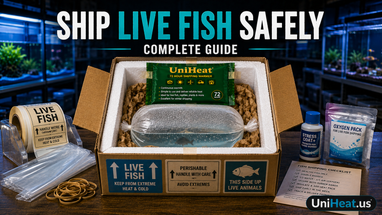
Live aquarium fish shipping is a specialty within live-animal logistics that combines the temperature-control challenges of reptile shipping with unique water-chemistry, oxygen-management, and bag-integrity considerations that no other category faces. Every year millions of live fish move through the US parcel network — from $5 guppies to $500 rare cichlids to $5,000 show koi — and each shipment depends on getting the fundamentals right: proper bagging technique, adequate oxygen, temperature stability, and disciplined ship-day timing. This guide walks through the complete framework for aquarium fish shipping, extending our foundational piece on shipping tropical fish safely in winter into a comprehensive vertical resource within our cold-weather shipping resource center.
The Short Answer: Bag Correctly, Insulate Well, Ship Monday
Fish shipping success has three pillars that must all be executed correctly: (1) bagging technique that provides adequate oxygen and prevents leaks, (2) insulation and temperature control matched to species requirements, and (3) ship-day discipline with overnight service to minimize transit time.
The critical difference from other live-animal categories is water. Water provides significant thermal mass that buffers temperature changes — a 1-quart fish bag cools much more slowly than a reptile in an empty container. This gives fish shipping some resilience that other categories don't have, but it also means water quality matters. Ammonia buildup, oxygen depletion, and pH drift all become concerns during 24-48 hour transit windows.
The framework parallels the operational architecture in our capstone piece on cold chain solutions for small businesses, adapted for the unique demands of aquatic shipping.
Understanding Fish Shipping Physiology
Water as Thermal Buffer
Water has extraordinarily high specific heat — it takes significant energy to change water temperature. A 1-quart bag of water at 78°F, well-insulated, will lose only a few degrees over 24 hours of shipping. This is dramatically different from reptiles, which cool to ambient within hours. Water is the fish shipper's biggest ally.
Oxygen as the Limiting Factor
The main constraint on fish shipping isn't temperature — it's oxygen. Fish continuously consume oxygen from the water. Over 24-48 hours in a sealed bag, oxygen depletes even in a properly bagged shipment. Pure oxygen bagging (vs air) can extend transit tolerance from 24 hours to 48-72 hours by starting with 5x higher oxygen concentration.
Ammonia Buildup
Fish excrete ammonia through gills and waste. In a small bag with limited water volume, ammonia can build to toxic levels over extended transit. This is why fish are fasted 24-48 hours before shipping — empty digestive tracts produce less ammonia. And why bag-to-fish ratio matters — more water dilutes ammonia accumulation.
Stress and Physiological Response
Handling stress (netting, bagging, packing) triggers physiological responses that compound during transit. Elevated cortisol suppresses immune function, and stressed fish are more susceptible to disease outbreaks upon arrival. Minimizing handling time and providing dark, quiet transit conditions matters.
Species-Specific Requirements
Different species have very different tolerances. Bettas breathe atmospheric air and don't require oxygenation. Discus need pristine water chemistry and warmth. Reef fish need saltwater and premium conditions. Understanding species-specific needs drives packaging and handling decisions.
The Fundamentals of Fish Bagging
The Standard Bagging Ratio
The industry standard is approximately 1/3 water and 2/3 air (or pure oxygen) by volume. This ratio provides:
- Enough water for the fish to swim and dilute waste
- Enough air/oxygen headspace for sustained respiration
- Buffer space for temperature-driven volume changes
Water Amount by Fish Size
| Fish Size | Water Volume | Bag Size | Notes |
|---|---|---|---|
| Small (under 1″) | 1-2 cups | 4″×8″ or 4″×10″ | Multiple fish per bag possible |
| Medium (1-3″) | 2-4 cups | 6″×12″ | Individual or pairs |
| Large (3-6″) | 1-2 quarts | 8″×15″ | Individual bagging |
| Extra large (6-10″) | 2-4 quarts | 12″×20″ | Double-bagged for security |
| Show koi (10″+) | Multiple gallons | Custom | Specialty freight often used |
Air vs Pure Oxygen
Standard air bagging uses 2/3 atmospheric air, which contains about 21% oxygen. Pure oxygen bagging uses medical/industrial-grade O2, which is close to 100%. The oxygen advantage:
- Air bagging: 24-30 hours safe transit for most species
- Pure oxygen: 48-72 hours safe transit for most species
Pure oxygen is standard for wholesale fish shipping and premium retail. Home shippers typically use air, which is adequate for overnight service on shorter routes but marginal for cross-country transit.
Bag Sealing Technique
- Fill bag with 1/3 water containing the fish
- Squeeze out excess air, keeping the fish comfortable
- Inflate remaining 2/3 with air (or oxygen)
- Twist the top of the bag tightly
- Fold twisted section over
- Secure with rubber band, wrapped multiple times
- Double-bag for security (second bag over first)
- Test by gently pressing — no leaks
Double-Bagging
Double-bagging is standard practice for all fish shipping. The inner bag can develop micro-punctures from spines, teeth, or handling. The outer bag catches any leaks. This is non-negotiable for reliable fish shipping.
Species-by-Species Shipping Guide
Bettas (Betta splendens)
Unique among aquarium fish because they breathe atmospheric air through a labyrinth organ. This makes them the most forgiving shipping fish.
- Water requirement: Minimal (1-2 cups adequate)
- Oxygen: Air is sufficient (they breathe atmosphere)
- Temperature: 76-82°F ideal, tolerates 65-85°F briefly
- Bag ratio: Can use 1/2 water, 1/2 air (they'll surface breathe)
- Standard packaging: Insulated container + 72-hour heat pack in winter
- Bagging note: Bettas can be shipped in small individual bags with less water than other species
Guppies, Platies, Swordtails, Mollies (Livebearers)
Small, hardy freshwater fish. Standard aquarium hobby favorites.
- Water requirement: Standard bagging ratio
- Oxygen: Air adequate for overnight; oxygen better for extended transit
- Temperature: 72-80°F ideal, tolerates 65-85°F
- Multiple per bag: Yes, 3-6 individuals in a 4″×10″ bag
- Standard packaging: 1.5-2″ EPS foam + 72-hour heat pack
Tetras, Rasboras, Danios (Small Community Fish)
Very small schooling fish. Typically shipped in groups.
- Water requirement: Standard ratio, minimal per fish
- Oxygen: Oxygen preferred for grouped shipments
- Temperature: 72-80°F ideal
- Multiple per bag: Yes, 6-12 small individuals typical
- Sensitive species: Cardinal tetras and rummy-nose tetras stress more than others
Goldfish and Koi
Cold-water fish with different temperature tolerance than tropical species.
- Water requirement: More water per fish (higher waste output)
- Oxygen: Oxygen strongly preferred (goldfish have high oxygen needs)
- Temperature: 60-75°F (they tolerate cooler conditions)
- Winter shipping: Less heat protection needed than tropical species
- Show koi: Often shipped via specialty aquatic freight due to size
Cichlids (African, American, Central American)
Diverse group with species-specific requirements. Generally hardy but often aggressive, requiring individual bagging.
- Water requirement: Larger volume (larger fish, aggressive metabolism)
- Oxygen: Oxygen recommended
- Temperature: 76-82°F for most species
- Individual bagging: Required for most; aggression causes injury in shared bags
- African cichlids: Need harder, alkaline water (pH stability during transit)
Discus (Symphysodon)
Premium fish with strict water quality requirements. Considered demanding to ship.
- Water requirement: Larger volume, pristine water quality
- Oxygen: Pure oxygen strongly recommended
- Temperature: 82-86°F (higher than most tropical fish)
- Winter shipping: 96-hour heat pack, 2″ EPS foam
- Special consideration: Sensitive to ammonia and pH swings; fast 48 hours before shipping
Marine/Reef Fish (Saltwater)
Saltwater fish shipping has additional considerations beyond freshwater. Saltwater carries dissolved oxygen less efficiently than freshwater, making oxygen management more critical.
- Water requirement: Larger volume, appropriate salinity
- Oxygen: Pure oxygen essential
- Temperature: 76-82°F for most reef species
- Individual bagging: Typical for aggressive or venomous species
- Water preparation: Pre-mixed saltwater at correct salinity (typically 1.025 SG)
- Sensitive species: Butterflies, angelfish, and some tangs are notoriously difficult to ship
Invertebrates (Shrimp, Snails, Coral)
Related but distinct from fish. Many aquatic invertebrates ship alongside fish shipments.
- Shrimp: Very sensitive to ammonia and temperature; often shipped in individual bags with plants for oxygen
- Snails: Hardy shippers, can go with minimal water
- Coral: Specific requirements including light exclusion (avoid heat gain in transit)
Plants and Aquascape Materials
Live aquatic plants often ship alongside fish. Standard packaging: wet paper towels around plants in sealed bags, no fish, standard cold-weather protection.
Standard Fish Shipping Configuration
Layer 1: Fish in Bag
Fish is bagged individually or in appropriate groups following the ratio guidelines above. Double-bagged for security. Bag positioned upright in the box (fish can't survive upside-down).
Layer 2: Padding Around Bag
Newspaper, kraft paper, or bubble wrap around the bag prevents movement and provides secondary thermal buffering. This is where structural stability comes from.
Layer 3: Insulation
1.5-2″ EPS foam liner surrounds the padded bag. Cold-tolerant species (goldfish, koi) can use 1.5″; tropical/reef species should use 2″ for winter reliability.
Layer 4: Heat Pack Placement
Heat pack placed on top of insulation, not in direct contact with the bag. Direct contact can overheat the water. Standard placement: top layer above the bag, with foam or paper barrier between pack and bag.
Layer 5: Outer Box
Double-walled corrugated for structural rigidity. Adequately sized to fit insulation and bag with 1-inch clearance on all sides. Sealed but with subtle vent holes near the top for CO2 escape (fish do respire).
Layer 6: Labels
"Live Animals" declaration, "Fragile" or "Handle With Care," "This Side Up" indicators (critical for fish), signature required, "Perishable" if applicable.
For container sizing framework, see our recent piece on insulated shipping containers: types, sizes & selection guide. For box selection details, see choosing the right box size and insulation for heat packs.
Carrier Options for Live Fish Shipping
FedEx
The industry standard carrier for aquarium fish shipping. FedEx Priority Overnight is the standard service tier.
- Live animal declaration required
- Priority Overnight strongly preferred (no ground service for live fish)
- Signature required, adult signature preferred
- FedEx accepts most freshwater and saltwater fish shipments
- FedEx has best reputation for careful live-fish handling
UPS
Regional variability in UPS acceptance of live fish. Some UPS accounts accept live fish shipments, others do not. Verify with your local UPS account rep before establishing regular shipping.
USPS
USPS does not accept live fish shipments. Attempting to ship live fish via USPS results in package interception and animal mortality. This is different from feeder insects (which USPS accepts) and highlights the specific carrier rules for vertebrate shipping.
Regional Freight for Large Fish
Show koi, large marine fish, and very large freshwater species (arowanas, larger cichlids) often ship via specialty aquatic freight rather than parcel service. This is more expensive but provides individual attention to high-value animals.
Route strategy in our piece on route package protection.
Ship-Day Discipline for Fish
Monday Only for Tropical/Reef
For tropical freshwater and reef fish, ship Monday only. This guarantees Tuesday delivery for overnight service. Weekend delays are catastrophic for oxygen-limited shipments.
Monday-Tuesday for Hardy Species
For hardier species (goldfish, some cichlids, bettas), Tuesday shipping may be acceptable for shorter routes. But Monday remains the standard.
Never Wednesday-Friday
Wednesday, Thursday, or Friday shipping creates weekend delay risk. A delayed fish shipment that sits at a hub 4-5 days will not survive. This ship-day discipline is one of the most important operational disciplines in fish shipping.
The ship-day framework connects to the broader loss prevention framework in our piece on how to reduce winter shipping losses.
Cost Analysis for Fish Shipping
| Component | Cost per Shipment |
|---|---|
| Fish bags (double-bagged) | $0.50-2 |
| Rubber bands and sealing | $0.25 |
| Pure oxygen (if used) | $0.50-1 |
| Heat pack (72-96 hour) | $3-8 |
| EPS foam liner (1.5-2″) | $4-15 |
| Double-walled corrugated box | $3-6 |
| Buffer materials | $1-2 |
| Labels and declaration | $1-2 |
| FedEx Priority Overnight | $30-70 |
| Total per shipment | $43-107 |
Fish shipping economics vary widely by species value. A $10 guppy order can't absorb $70 shipping cost, so bettas and small community fish typically ship in groups or through bundled orders. Premium species ($100-500+ discus, cichlids, reef fish) easily absorb premium shipping. Framework for shipping economics in our piece on cost vs protection in heat pack usage.
Real Fish Shipping Scenarios
Scenario 1: Betta Breeder DTC (50 shipments/week)
Origin: Thailand-import distributor in Los Angeles. Product: single premium bettas ($40-200). Route: nationwide. Configuration: 4″×8″ individual bag with 1-2 cups water and air, single-bag or double-bag, 6″×6″×6″ box, 1.5″ EPS foam liner, 72-hour heat pack (winter), FedEx Priority Overnight. Ship Monday only. Per-shipment cost: $40-55. Loss rate under 2%. Bettas are ideal shipping species due to labyrinth breathing.
Scenario 2: Tropical Fish Retailer (200 shipments/week)
Origin: Florida wholesale hub. Product: mixed community fish orders ($30-80). Route: nationwide. Configuration: multiple bags per order (species grouped), 2″ EPS foam, 72-hour heat pack, FedEx Priority Overnight. Ship Monday-Tuesday. Per-shipment cost: $50-75. Loss rate under 3%.
Scenario 3: African Cichlid Breeder (40 shipments/week)
Origin: Michigan. Product: African cichlids ($15-75 individual, $100-500 for groups). Route: nationwide. Configuration: individually bagged fish (aggression prevention), pure oxygen bagging, 2″ EPS foam, 96-hour heat pack (winter), FedEx Priority Overnight. Ship Monday only. Per-shipment cost: $70-95. Loss rate under 2%.
Scenario 4: Discus Specialty Store (25 shipments/week)
Origin: Illinois. Product: discus fish ($75-300). Route: nationwide. Configuration: individual bagging with pure oxygen and larger water volume, 2″ EPS foam, 96-hour heat pack, FedEx Priority Overnight, ship Monday only. Per-shipment cost: $85-110. Fish fasted 48 hours before shipping. Loss rate under 3% (higher than average due to species sensitivity).
Scenario 5: Reef Fish Wholesaler (100 shipments/week)
Origin: Hawaii-import distributor in California. Product: marine reef fish ($30-500). Route: nationwide. Configuration: individual bagging with pre-mixed saltwater and pure oxygen, 2″ EPS foam, 96-hour heat pack, FedEx Priority Overnight, ship Monday only. Per-shipment cost: $75-105. Loss rate under 4% (saltwater shipping is generally higher-risk than freshwater).
Scenario 6: Goldfish/Koi Specialty (30 shipments/week)
Origin: Louisiana. Product: fancy goldfish and small koi ($40-200). Route: nationwide. Configuration: larger water volume per fish (goldfish waste), pure oxygen, 1.5-2″ EPS foam, 72-hour heat pack (winter, less needed than tropical), FedEx Priority Overnight. Ship Monday-Tuesday. Per-shipment cost: $55-80. Cold-tolerant species allows slightly relaxed winter protection.
Common Fish Shipping Mistakes
Mistake 1: Under-bagging with water. Insufficient water volume means faster ammonia buildup and less thermal buffer. Follow ratio guidelines strictly.
Mistake 2: Skipping double-bagging. Micro-punctures in single bags cause leaks that ruin entire shipments. Double-bagging is non-negotiable.
Mistake 3: Not fasting fish. Feeding fish before shipping means digestive activity produces ammonia during transit. Fast 24-48 hours before ship day.
Mistake 4: Wrong ship day. Thursday or Friday shipping creates weekend risk that kills fish reliably. Monday-Tuesday only. Similar principle to our piece on 5 common mistakes when using heat packs.
Mistake 5: Air bagging for long transit. Using air bagging (vs oxygen) for cross-country shipments pushes toward oxygen depletion. Pure oxygen for long routes.
Mistake 6: Overheating with heat pack contact. Direct contact between heat pack and fish bag can cook the water. Always insulate between pack and bag.
Mistake 7: Ignoring species differences. One-size-fits-all bagging kills sensitive species. Discus need different treatment than guppies.
Customer Communication for Fish Shipping
Fish shipping requires extensive customer communication:
Pre-Shipment
- Confirmation of aquarium readiness and appropriate parameters
- Delivery date and time window
- Adult signature requirement
- Acclimation protocol (drip method or floating method depending on fish)
- Live-arrival guarantee terms
Delivery Day
- Tracking updates
- Reminder about signature requirement
- Instructions to open immediately upon delivery (not later)
- Instructions to check bag integrity before opening
Post-Delivery Acclimation
- Detailed acclimation protocol (drip acclimation for reef, floating for freshwater)
- Water quality parameters for the receiving aquarium
- Photo documentation for any DOAs (Dead on Arrival)
- Reporting window (usually 1-2 hours for DOA reports)
The customer education component is more extensive than most product categories, similar in scale to our piece on managing expectations around heat pack performance extended to aquatic requirements.
Live Arrival Guarantees for Fish
Every fish seller offering shipping should have a live-arrival guarantee. Standard terms:
- Replace or refund fish that arrive DOA (Dead on Arrival)
- Customer must open package immediately at delivery
- Photo documentation within 1-2 hours of delivery
- Photos should include dead fish in bag with visible label and packing materials
- Package must have been signed for by adult
- Package must not have been left outside in cold conditions
Common Guarantee Terms
- Full replacement or refund for DOA fish
- Store credit vs cash refund varies by seller
- Shipping cost typically not refunded on DOAs
- Fish that die after acclimation are usually not covered
Insurance and Risk
Carrier insurance does not cover live fish. Third-party live-animal shipping insurance is available but expensive. The live-arrival guarantee is essentially self-insurance by the seller. The economics work when overall shipping mortality stays under 3-5% for the operation.
Building a Fish Shipping SOP
Pre-Ship SOP (48 hours before)
- Fast fish 24-48 hours before shipping (reduces ammonia during transit)
- Verify ship day is Monday (or Tuesday for hardy species)
- Weather check origin, hub, destination
- Confirm customer readiness
- Prepare bagging supplies
Pack-Out SOP (Ship Day)
- Catch fish carefully with appropriate net
- Place in prepared bag with correct water volume
- Add pure oxygen (if using) or squeeze to displace air
- Fill remainder with oxygen/air to correct ratio
- Seal bag tightly with rubber bands
- Double-bag by placing sealed bag inside second bag
- Verify no leaks
- Place bag in insulated box cavity
- Add buffer materials around bag
- Activate heat pack 20-30 minutes before pickup
- Place heat pack on top of insulation, not touching bag
- Seal outer box
- Affix all labels: Live Animals, Fragile, This Side Up
- Photograph packed box for records
Post-Ship SOP
- Log tracking number and route metadata
- Send customer shipment confirmation with tracking
- Send acclimation instructions and reporting requirements
- Handle any DOA claims within reporting window
For the daily discipline framework, our winter shipping checklist for small businesses applies with fish-specific additions.
Water Chemistry Considerations
Ammonia Neutralizers
Some shippers add ammonia-neutralizing products to bag water. These bind ammonia into non-toxic forms and can extend safe transit time. Products like Prime, Ammo-Lock, or similar are common in commercial fish shipping.
pH Buffering
Bag water pH can drift during transit due to CO2 accumulation. For sensitive species, adding pH buffers can help. But most standard shipping uses source water without additives beyond ammonia neutralizers.
Beneficial Bacteria
Some shippers include beneficial bacteria (nitrifying bacteria) in bag water to establish biological filtration. This is more relevant for extended transit times.
Temperature Preconditioning
Fish shipped in water at the temperature they'll experience (rather than cooler or warmer) tolerate transit better. Pre-warming winter shipments to ideal ranges before bagging helps establish thermal reserves.
Regulatory Considerations for Fish Shipping
Interstate Restrictions
- Some states restrict certain fish species (piranhas, snakeheads, some cichlids)
- Hawaii has strict prohibitions on many freshwater species (invasive concerns)
- Australia and other international destinations have complex import rules
- Verify destination state regulations before shipping
Aquaculture Certifications
Commercial fish operations may need aquaculture certifications depending on species and volume. Home hobbyists typically don't need certifications for occasional shipping.
Marine Fish Regulations
Marine fish shipping has additional regulations. Wild-caught reef fish may be restricted (Hawaii aquarium fish collection has faced legal challenges). Coral shipping is subject to CITES restrictions for many species.
How Fish Shipping Connects to Broader Cold Chain
Fish shipping shares infrastructure with other SMB cold chain operations — same heat packs, insulated containers, and shipping supplies serve fish, reptiles, plants, and food shipping. The unique element for fish is the water content and bagging technique that no other category requires.
For the broader system view:
- Shipping tropical fish safely in winter — foundational fish framework
- Reptile winter shipping guide — related live-animal category
- Shipping live feeder insects — insect shipping framework
- Heat mat vs heat pack for plant shipping — plant framework
- How to select the perfect heat pack duration — pack tier framework
- Understanding heat pack activation and performance — chemistry basics
- How long heat packs last in transit — realistic duration
- How many heat packs you really need per box — multi-pack framework
- Heat pack vs insulation in cold shipping — foundation science
- How to choose the right heat pack for your shipment — selection framework
- Dry ice vs heat packs vs gel packs — technology comparison
For the temperature science that drives fish shipping decisions, see our recent piece on complete freezing points reference for shipped products, which includes tropical fish physiological freeze data. For product-specific configurations, see the cold-weather shipping protection reference table. Bulk pack purchasing available through our UniHeat shop across 40-hour, 72-hour, and 96-hour options. For scaling operational patterns, see how to scale heat pack usage for higher volumes.
Highlights — Fish Shipping Reference Card
Frequently Asked Questions
How do you ship live aquarium fish?
Ship live aquarium fish in double-bagged plastic bags filled 1/3 with water and 2/3 with air (or pure oxygen). Fast the fish 24-48 hours before shipping to reduce ammonia during transit. Place the sealed bag in a double-walled corrugated box lined with 1.5-2 inch EPS foam insulation. Add a 72-96 hour heat pack in winter, placed on top of the foam (not touching the bag). Ship Monday only via FedEx Priority Overnight with adult signature required. Total per-shipment cost typically runs $40-90. Loss rate targets: under 3% for most species with proper protocol.
Can you ship fish through USPS?
No. USPS does not accept live fish shipments under any circumstances. Only FedEx accepts live fish reliably, and UPS acceptance varies by region and account. All live fish shipping must use overnight service (FedEx Priority Overnight or UPS Next Day Air where accepted). Attempting to ship live fish via USPS results in package interception and animal mortality. This is different from feeder insects, which USPS does accept — the distinction between invertebrates (accepted) and vertebrates (not accepted) is important.
What's the right water-to-air ratio for shipping fish?
The industry standard is approximately 1/3 water and 2/3 air (or pure oxygen) by volume. This provides enough water for the fish to swim and dilute waste, enough air/oxygen headspace for sustained respiration, and buffer space for temperature-driven volume changes. Using pure oxygen instead of air roughly doubles the safe transit time from 24-30 hours to 48-72 hours by starting with 5x higher oxygen concentration. Bettas are an exception — they breathe atmospheric air and can be shipped with more water and less headspace.
How long can fish survive in a shipping bag?
Standard air-bagged fish safely survive 24-30 hours in a properly bagged shipment. Pure oxygen-bagged fish survive 48-72 hours. Actual survival depends on species (bettas easiest, discus most challenging), bag size and water volume, temperature stability during transit, fasting status before shipping, and stress level during handling. This is why overnight shipping is essential — a 2-day or ground shipment exceeds safe transit windows for most species.
What temperature do fish need for shipping?
Temperature requirements vary by species group. Tropical freshwater fish (tetras, livebearers, most community fish) need 72-80 degrees Fahrenheit. Discus and demanding tropical species need 82-86 degrees Fahrenheit. Reef fish need 76-82 degrees Fahrenheit with pre-mixed saltwater. Cool-water fish (goldfish, koi) tolerate 60-75 degrees Fahrenheit. Winter shipping requires heat pack protection: 72-96 hour packs depending on species and route. Below 55 degrees Fahrenheit for extended periods causes mortality in most tropical species.
Should I use pure oxygen or air when bagging fish?
Air is adequate for overnight shipping of most species on shorter routes. Pure oxygen is strongly preferred for cross-country shipping, multiple fish per bag, sensitive species (discus, reef fish), and any shipment where transit might extend beyond 24 hours. Pure oxygen is standard for commercial wholesale shipping and premium retail. Home hobbyists shipping occasional fish can use air on short overnight routes but should consider oxygen for anything more demanding.
How much does it cost to ship a fish?
Fish shipping costs typically run $40-90 per shipment. Standard breakdown: fish bags ($0.50-2), sealing supplies ($0.25), pure oxygen ($0.50-1 if used), heat pack ($3-8), EPS foam liner ($4-15), double-walled corrugated box ($3-6), buffer materials ($1-2), labels ($1-2), FedEx Priority Overnight service ($30-70). Small orders can bundle multiple fish per bag to spread shipping cost. Premium species easily absorb premium shipping; commodity species (guppies, mollies) rely on bundled orders.
Why do fish need to be fasted before shipping?
Fasting fish 24-48 hours before shipping empties their digestive tracts, which reduces waste production during transit. This has multiple benefits: less ammonia builds up in the bag water (ammonia is highly toxic to fish), less oxygen is consumed metabolizing food, less waste creates less water quality degradation, and cleaner bag water reduces stress. For sensitive species like discus, some shippers fast 48-72 hours. For hardy species like guppies, 24 hours is adequate. Do NOT feed fish on the day of shipping.
Summary
Live aquarium fish shipping combines temperature-control challenges with unique water-chemistry, oxygen-management, and bagging considerations that no other shipping category faces. Standard framework: double-bag with 1/3 water and 2/3 air or pure oxygen, place in EPS foam-lined double-walled corrugated box with 72-96 hour heat pack (winter), ship Monday only via FedEx Priority Overnight, live-arrival guarantee as industry standard.
Species selection significantly affects difficulty and cost. Bettas are the easiest shipping fish (labyrinth breathing), followed by hardy freshwater species (livebearers, tetras, goldfish). Discus and marine reef fish are the most demanding. Cichlids require individual bagging due to aggression. Per-shipment costs typically run $40-90 including overnight service.
Water provides significant thermal buffer that gives fish shipping some resilience compared to reptile shipping. But oxygen depletion, ammonia buildup, and pH drift during extended transit are unique constraints that determine safe transit windows. Fasting fish before shipping and using pure oxygen dramatically extend safe transit tolerance.
For the broader system view that connects fish shipping to other live-animal categories and SMB cold chain operations, see our shipping solutions resource center, our capstone piece on cold chain solutions for small businesses, and comprehensive coverage across live animal shipping, heat pack topics, and temperature control shipping. For adjacent categories, our vertical guides on reptile shipping and live feeder insect shipping cover complementary principles across the full live-organism shipping spectrum.