
Posted by UniHeatPacks on 22nd Jul 2026
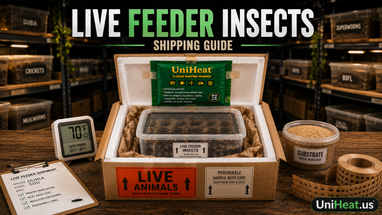
Shipping Live Feeder Insects Safely (Crickets, Roaches, BSFL)
Shipping live feeder insects is the trickiest live-animal category in cold-weather logistics. Crickets, roaches, mealworms, and other feeders serve the reptile hobby, aquarium fish keepers, chicken owners, and biological control markets. They ship in staggering volumes — millions of boxes per year across the US. But they're also small, easily temperature-shocked, and vulnerable to both cold and heat during transit. Species-specific requirements, humidity control, ventilation, and shipping-day discipline all matter more than they do for larger animals. This guide walks through the framework: species-by-species tolerances, packaging protocols, seasonal considerations, and how live feeder shipping fits into the broader SMB cold chain framework we've built across our cold-weather shipping resource center.
The Short Answer: Species-Specific Care and Monday-Only Shipping
Live feeder insects survive shipping when three things go right: appropriate temperature control (heat pack in winter, gel pack in extreme summer heat), appropriate ventilation (never sealed airtight), and ship-day discipline (Monday only for most species so the package doesn't get stuck in a hub over the weekend).
The species differences matter more than in other live-animal categories. Crickets die at 45°F. Dubia roaches slow down but survive down to 50°F. Mealworms tolerate cold better than any other feeder. BSFL (black soldier fly larvae) have specific humidity requirements. One-size-fits-all protocols don't work for feeder shipping.
The framework parallels other live-animal shipping we've covered — live reptiles, live fish — but with feeder-specific adjustments. Our foundational live-animal work in ball python winter shipping covers reptile principles that apply here at smaller scale. For fish, our piece on shipping tropical fish safely in winter covers the aquatic side. Feeder shipping is the third pillar of live-organism shipping.
Why Feeder Insect Shipping Is Uniquely Demanding
Several factors make feeder insect shipping harder than other live-animal categories:
Small Size Means Small Thermal Mass
A ball python has significant body mass that resists rapid temperature change. A cricket weighs 0.5 grams. Feeder insects reach ambient temperature within minutes of environmental exposure. There's no thermal buffer from the animals themselves — the packaging is doing 100% of the temperature control work.
High Volume, Low Value Economics
A shipment of 500 crickets might retail at $15-25. The shipping cost floor (FedEx Priority Overnight, heat pack, insulation, outer box) is $22-30. This inverted economics means feeder shippers can't afford premium packaging — they must nail the fundamentals with basic materials.
Suffocation Risk
Feeder insects consume oxygen and produce CO2. Sealed containers with 500+ insects can create anoxic conditions within hours. Every feeder shipment requires ventilation. This is different from most other product categories where sealed boxes are standard.
Cannibalism Under Stress
Under thermal or humidity stress, some feeder species become cannibalistic. Crickets in particular will eat each other when stressed. Packaging design affects behavioral stress, not just physical temperature control.
Escape Risk
Feeder insects are experts at finding gaps. Improperly sealed lids, poorly designed ventilation, or damaged containers result in loose insects at destination — a customer experience disaster for retail shippers.
Species-by-Species Temperature and Care Guide
Different feeder species have different requirements. Understanding these differences drives packaging decisions.
Crickets (Acheta domesticus, Gryllodes sigillatus)
The most temperature-sensitive common feeder. Crickets require warm shipping conditions and are the most vulnerable to cold damage.
- Safe temperature range: 60-90°F during shipping
- Damage threshold: Below 55°F causes stress; below 45°F causes death
- Humidity needs: Moderate; typically ships with piece of orange or damp paper
- Container: Ventilated cardboard box with egg-crate structure inside
- Loss rate: Winter feeder shippers typically report 3-8% cricket mortality even with heat packs
Crickets ship in maximum quantities of 500-1,000 per standard container. Larger orders use multiple containers within one outer box.
Dubia Roaches (Blaptica dubia)
The gold standard of modern feeder shipping. Roaches are hardier than crickets, tolerate cold better, don't chirp (making them house-legal in more areas), and have longer shelf life at the destination.
- Safe temperature range: 65-95°F during shipping
- Damage threshold: Below 50°F causes slowdown; below 40°F causes death
- Humidity needs: Low; ships in dry containers with egg-crate
- Container: Ventilated plastic container with egg-crate structure
- Loss rate: Winter dubia shippers typically report 1-3% mortality with proper packaging
Dubia's cold tolerance is why they've become the professional breeder's choice. A dubia shipment that would have killed crickets can arrive with 98%+ survival if packaged correctly.
Mealworms (Tenebrio molitor)
The easiest feeder to ship. Mealworms are extraordinarily cold-tolerant compared to other feeders and can survive shipping conditions that would kill crickets and roaches.
- Safe temperature range: 40-85°F during shipping (very wide)
- Damage threshold: Below 32°F risks freezing; sustained above 90°F causes stress
- Humidity needs: Low; ships in bran or wheat middlings substrate
- Container: Sealed plastic tub with pinhole ventilation is often sufficient
- Loss rate: Winter mealworm shippers typically report under 1% mortality
Mealworms are the safest feeder for cold-weather transit. Some mealworm operations skip heat packs entirely for shipments through mild-cold destinations, though heat packs remain the winter standard for extreme cold.
Superworms (Zophobas morio)
Larger mealworm relatives. Similar shipping profile but with a few important differences:
- Safe temperature range: 55-85°F during shipping
- Damage threshold: Below 45°F causes stress
- Cannibalism risk: Higher than mealworms; ship with adequate substrate
- Container: Ventilated plastic tub with wheat middlings substrate
Waxworms (Galleria mellonella)
Small waxy larvae, popular with certain reptile keepers.
- Safe temperature range: 55-70°F during shipping (prefer cool)
- Damage threshold: Above 80°F causes rapid pupation, below 45°F causes stress
- Humidity needs: Moderate; ships in sawdust substrate
- Special consideration: Cooler shipping is preferred; sometimes ships without heat pack in winter destinations
Hornworms (Manduca sexta)
Large caterpillars raised on artificial diet. Very fast-growing.
- Safe temperature range: 65-85°F during shipping
- Damage threshold: Below 55°F causes stress
- Humidity needs: Moderate; ships with artificial diet in cup
- Special consideration: Ship in individual cups to prevent size disparity issues
Black Soldier Fly Larvae (BSFL) (Hermetia illucens)
Increasingly popular as a nutritionally dense feeder. Slightly different shipping profile.
- Safe temperature range: 50-90°F during shipping (broad tolerance)
- Damage threshold: Below 45°F causes stress
- Humidity needs: Moderate; ships with light substrate
- Container: Ventilated plastic container
- Loss rate: Similar to dubia roaches with proper packaging
Species Comparison Table
| Species | Cold Tolerance | Heat Tolerance | Shipping Difficulty |
|---|---|---|---|
| Crickets | Poor (dies below 45°F) | Moderate (stress above 90°F) | Hardest |
| Dubia Roaches | Good (survives to 40°F) | Good (tolerates 95°F) | Easy |
| Mealworms | Excellent (down to 32°F) | Good (up to 90°F) | Easiest |
| Superworms | Moderate (stress below 45°F) | Good (up to 85°F) | Moderate |
| Waxworms | Moderate (prefer cool) | Poor (pupate above 80°F) | Moderate (heat-sensitive) |
| Hornworms | Moderate (stress below 55°F) | Good (up to 85°F) | Moderate |
| BSFL | Good (down to 45°F) | Good (up to 90°F) | Easy |
The pattern: hardier species (mealworms, dubia, BSFL) tolerate shipping conditions that would kill more sensitive species (crickets, waxworms). Breeders often shift toward hardier species partly because of shipping economics.
Packaging Configuration for Feeder Insects
The core packaging challenge for feeder insects is balancing temperature control with ventilation. Sealed insulated boxes provide great thermal protection but kill insects through suffocation. The solution is layered:
Standard Feeder Shipping Configuration
- Inner container — ventilated plastic tub or cardboard container with species-appropriate substrate and internal structure (egg crate, sawdust, wheat middlings)
- Ventilation on inner container — small perforations or mesh window; insect-escape-proof but air-permeable
- Absorbent layer — paper towels or shredded paper around the inner container to catch any moisture
- Insulation layer — 1.5″ EPS foam or similar insulated packaging around the inner container
- Heat pack (winter) or gel pack (extreme summer) — placed on top of insulation, not in direct contact with inner container
- Outer box — corrugated cardboard box, ventilated at the top
The critical insight: the outer box needs vents to prevent CO2 buildup, even though this reduces thermal efficiency. The trade-off is unavoidable for live-insect shipping. Full container framework in our recent piece on insulated shipping containers: types, sizes & selection guide. The relationship between insulation and heat pack performance is covered in our foundational piece on heat pack vs insulation in cold shipping. Complementary buffer materials that work well for feeder shipping are covered in our piece on the top 3 packing materials to pair with heat packs.
Ventilation Details
- Inner container needs ~10% of surface area vented for adequate airflow
- Outer box needs 4-6 small vent holes near the top
- Fine mesh or perforated cardboard works better than open holes for escape prevention
Substrate Selection
- Crickets: Egg-crate cardboard for climbing surface
- Dubia roaches: Egg-crate cardboard
- Mealworms: Wheat middlings or bran (also provides food)
- Superworms: Wheat middlings with additional separation
- Waxworms: Sawdust with wax paper strips
- Hornworms: Individual cups with artificial diet
- BSFL: Light substrate similar to wheat middlings
Winter Feeder Shipping Configuration
For cold-weather routes, heat pack protection is essential for most species. The specific approach:
Cold-Sensitive Species (Crickets, Superworms, Hornworms, Waxworms)
- Use 72-hour heat pack standard
- Upgrade to 96-hour pack for extreme cold zones or weekend risk
- 1.5″ EPS foam insulation minimum
- Ship Monday only, never later in the week
- Consider Hold for Pickup at destination for cold-zone destinations
Cold-Tolerant Species (Mealworms, Dubia, BSFL)
- 72-hour heat pack for standard cold weather
- Mealworms may ship without heat pack in mild cold destinations (below 40°F but above 32°F)
- 1.5″ EPS foam insulation
- Ship Monday or Tuesday (dubia and mealworms tolerate slightly more delay risk)
Weight and Space Calculations
Feeder shipments are typically small (5-15 lbs total) but the box needs adequate cavity space for both the inner container and insulation:
- Small orders (100-500 crickets/roaches): 8″×8″×8″ interior
- Medium orders (500-1,000): 10″×10″×10″ interior
- Large orders (1,000-5,000): 12″×10″×10″ interior with multiple inner containers
For box size framework, see our resource on choosing the right box size and insulation. For multi-container shipments, the framework in how many heat packs you really need per box covers heat distribution across larger boxes. Selecting the appropriate pack tier is covered in how to choose the right heat pack for your shipment.
Summer Feeder Shipping Configuration
Summer feeder shipping has different challenges than winter. Heat during transit can kill some species faster than cold in winter.
Heat-Sensitive Species (Waxworms, Hornworms)
- Gel pack cooling required for shipments through hot hubs (above 85°F)
- 1.5″ EPS foam insulation
- Ship Monday or Tuesday
- Waxworms specifically: consider avoiding shipping in extreme heat entirely
Heat-Tolerant Species (Dubia, Mealworms, BSFL)
- Insulation without cooling media adequate for most summer conditions
- Consider gel pack in extreme heat destinations (above 100°F ambient)
- 1.5″ EPS foam sufficient
Summer vs Winter Trade-Off
Some feeder categories have opposite seasonal challenges. Waxworms are heat-sensitive in summer and stress-sensitive in winter, making them the hardest species to ship year-round. Crickets face winter freeze risk and summer heat stress. Dubia roaches and mealworms are the easiest to ship in both seasons because of their broad tolerance ranges. Framework connects to our piece on gel packs vs heat packs where the seasonal transition logic is fully covered.
Carrier Options for Live Feeder Insects
Carrier rules for live insects vary significantly:
USPS
USPS Priority Mail accepts most live insects when properly packaged and labeled as containing live animals. Feeder insects specifically are a common USPS shipment category. USPS Priority Mail Express (overnight) is often the operational choice for cold-weather routes.
USPS rules:
- Package must be marked with "Live Animals" designation
- Container must be escape-proof
- Adequate ventilation required
- Overnight/expedited service strongly recommended
- Package damage during transit is a real risk (rougher handling than premium carriers)
FedEx
FedEx accepts live insects with restrictions. Live crickets, roaches, and mealworms typically ship without issue. Requirements:
- Priority Overnight or 2-Day Air service
- Container declared as live animals on shipping label
- Escape-proof, ventilated packaging
- Some FedEx regions restrict certain species; verify with account rep
UPS
UPS has more restrictive rules for live insects than FedEx. Some UPS regions do not accept live insect shipments. Verify acceptance with your local UPS account rep before establishing regular shipping through them.
Regional Considerations
Some states have restrictions on shipping certain insect species. Dubia roaches are prohibited in some US states (notably Florida) due to invasive-species concerns. Verify destination state regulations before shipping. Our piece on route package protection covers the route strategy framework, which applies to feeder shipping with the added regulatory layer.
Ship-Day Discipline for Feeder Insects
Ship-day discipline is one of the most critical factors in feeder shipping success. The rule is stricter than for other categories:
Monday Only Standard
For most feeder species, Monday shipping is the standard. This gives the package the maximum window (Tuesday delivery for overnight, Wednesday for 2-day) before any weekend risk. A Monday shipment that faces a 1-day delay still delivers Wednesday.
Tuesday Sometimes Acceptable
For hardier species (dubia, mealworms, BSFL), Tuesday shipping may be acceptable for shorter routes. A Tuesday shipment delivers Wednesday (overnight) or Thursday (2-day) with some buffer.
Never Wednesday+
Wednesday, Thursday, or Friday shipping creates weekend delay risk. A Thursday-shipped package that experiences delays could sit at a hub through Sunday, arriving Tuesday of the following week. For most feeder species, this is catastrophic.
Weekend Shipping
Saturday delivery is available through both USPS Priority Mail Express and FedEx Overnight, but adds cost and doesn't help the delay-risk problem meaningfully. Most feeder operations ship Monday only regardless of Saturday delivery options.
The ship-day framework is one of the most important operational disciplines across live-animal shipping, covered in our piece on how to reduce winter shipping losses. Historical patterns from prior peak seasons are documented in our resource on lessons learned from peak season shipping, which applies to feeder shipping with the added mortality-timeline urgency.
Cost Analysis for Feeder Shipping
| Component | Cost per Shipment |
|---|---|
| Heat pack (72hr, winter) | $3-6 |
| Insulation liner (1.5″ EPS) | $4-8 |
| Inner container + substrate | $1-3 |
| Outer corrugated box | $2-4 |
| Live animal declaration labels | $0.50-1 |
| Carrier service (Priority Overnight) | $18-35 |
| Total per shipment | $28-57 |
The economics of feeder shipping are tighter than most SMB categories. A $25 cricket order plus $30 shipping means the customer pays $55 total for a product worth $25. This drives feeder retailers toward:
- Bundling multiple species per shipment (spread shipping cost across more products)
- Volume-based pricing tiers (larger orders get proportionally lower per-cricket shipping cost)
- Subscription models (regular customers absorb shipping cost through recurring value)
- Regional shipping strategies (some feeder operations focus on specific US regions to reduce transit distance)
The cost-vs-protection trade-off is covered in our piece on cost vs protection in heat pack usage, which applies with particular urgency to feeder shipping where margins are tight.
Common Feeder Shipping Mistakes
Six patterns that account for most feeder shipping failures:
Mistake 1: Sealing containers airtight. Suffocation is the fastest mortality cause in feeder shipping. Every container needs adequate ventilation. Framework in our piece on 5 common mistakes when using heat packs, extended here for the ventilation-specific case.
Mistake 2: Overpacking containers. Too many insects per container causes stress cannibalism (crickets, superworms) or heat buildup from insect metabolism. Follow species-specific density guidelines.
Mistake 3: Wrong ship day. Feeder shipments delayed over a weekend arrive with high mortality regardless of packaging. Monday-only discipline matters more here than in most categories.
Mistake 4: Ignoring species differences. One-size-fits-all packaging kills crickets while dubia and mealworms survive. Match packaging to species requirements.
Mistake 5: Under-insulating for cold routes. Feeder shipments through cold hubs need proper insulation. Cutting corners saves cents and kills insects.
Mistake 6: Not testing packaging in the field. Prototype configurations that seem thermally sound may fail under real-world FedEx handling. Real shipment testing before scaling matters. Framework in our piece on managing expectations around heat pack performance.
Real Feeder Shipping Scenarios
Scenario 1: Cricket Retailer to Pet Store Chain
Origin: Georgia. Product: 5,000 mixed-size crickets ($75). Route: GA to national pet store chains. Configuration: 12″×10″×10″ box, 1.5″ EPS foam liner, ventilated inner container with egg-crate structure, 72-hour heat pack (winter), FedEx Priority Overnight. Ship Monday only. Per-shipment cost: $35-45. Winter mortality target: under 5% (industry standard for crickets).
Scenario 2: Dubia Roach Breeder DTC
Origin: Florida (yes, breeders can be based in FL, they just can't ship there). Product: 500 medium dubia roaches ($30). Route: FL to nationwide (except FL, TX, LA which have restrictions). Configuration: 8″×8″×8″ box, 1.5″ EPS foam, ventilated plastic tub with egg-crate, 72-hour heat pack in winter, FedEx Priority Overnight. Ship Monday or Tuesday. Per-shipment cost: $25-32. Mortality typically under 2%.
Scenario 3: Mealworm Bulk Retailer
Origin: California. Product: 5,000 mealworms with bulk substrate ($40). Route: nationwide. Configuration: 10″×10″×10″ box, 1.5″ EPS foam liner (skip in mild weather), plastic tub with wheat middlings, 72-hour heat pack for extreme cold destinations only, USPS Priority Mail or FedEx Priority Overnight. Ship Monday-Tuesday. Per-shipment cost: $18-30. Mealworm mortality typically under 1%.
Scenario 4: BSFL Direct Sales
Origin: Texas. Product: 1,000 BSFL for chicken flocks ($25). Route: nationwide. Configuration: 10″×8″×8″ box, 1.5″ EPS foam, ventilated plastic container with substrate, 72-hour heat pack in winter, FedEx Priority Overnight. Ship Monday. Per-shipment cost: $30-40. BSFL are increasingly popular with backyard chicken keepers.
Scenario 5: Waxworm Specialty Reptile Shop
Origin: Michigan. Product: 250 waxworms ($15). Route: US Midwest/Northeast. Configuration: 6″×6″×6″ small box, 1.5″ EPS foam, small ventilated container with sawdust, gel pack in summer to keep them cool (waxworms pupate above 80°F), FedEx Priority Overnight. Ship Monday only. Per-shipment cost: $22-28. Waxworms need cooling rather than warming for most of the year — a good example of when the framework in our piece on dry ice vs heat packs vs gel packs matters for species selection. For pharmaceutical-adjacent supplement shippers considering feeder-like small-parcel workflows, our piece on pharmaceutical cold chain packaging for small businesses covers analogous operational patterns.
Building an SOP for Feeder Insect Shipping
Live feeder shipping requires disciplined operational procedures. Key SOP components:
Pre-Ship SOP
- Verify ship day is Monday (or Tuesday for hardier species)
- Weather check origin, hub, destination
- Confirm sufficient stock of each species ordered
- Prepare species-specific containers with appropriate substrate
- Count insects and verify quantity
- Print live animal declaration labels
Pack-Out SOP
- Assemble inner container with substrate and structure
- Load insects into container (avoid overcrowding)
- Add moisture source if species requires (crickets, waxworms, hornworms)
- Verify inner container ventilation
- Assemble outer box with EPS foam liner
- Place inner container in EPS cavity
- Add buffer materials (kraft paper) around inner container
- Activate heat pack (winter) 20-30 min before pickup
- Place heat pack on top of EPS foam, not touching inner container
- Seal outer box, ensuring vent holes are unobstructed
- Affix shipping label with live animal declaration
- Document with photo of packed box
Post-Ship SOP
- Log tracking number and route metadata
- Send customer notification of shipment
- Include expected delivery window and unboxing instructions
- Track any customer-reported mortality within 24 hours
- Route-level mortality tracking for continuous improvement
For the daily operational discipline framework, our resource on the winter shipping checklist for small businesses applies with feeder-specific additions.
Customer Communication for Live Feeder Shipping
Feeder shipping has a customer education component that other product categories don't. Customers need to know:
- Expected delivery day and time window
- Live animal declaration means they must be present at delivery
- Unboxing steps (open in cool room, gradual temperature acclimation)
- Feeding and short-term care of received insects
- Reporting procedure for mortality (many feeder retailers have live-arrival guarantees)
Clear customer communication reduces post-delivery mortality claims and improves customer retention. This connects to the customer experience side covered in our capstone piece on cold chain solutions for small businesses.
Regulatory Considerations for Feeder Shipping
Live insect shipping has some regulatory considerations beyond standard cold chain:
State-Level Restrictions
- Dubia roaches: Prohibited in Florida, Hawaii, some jurisdictions
- Discoid roaches (Blaberus discoidalis): Legal alternative to dubia in restricted states
- Some non-native beneficial insects: Various state permit requirements
USDA Regulations
The USDA regulates the movement of certain insects across state lines. Most feeder species used for reptile husbandry are not restricted, but some categories (agricultural pest species, endangered insect species) have USDA permit requirements.
Local Retail Regulations
Some jurisdictions have local regulations on the sale of live insects. Retailers should verify local rules before shipping into restricted areas.
Live-Arrival Guarantees and Insurance
Most feeder retailers offer live-arrival guarantees to build customer trust. Standard terms:
- Replace or refund if mortality exceeds 10-20% (threshold varies by species)
- Customer must report within 24 hours of delivery
- Photo documentation required
- Package must not have been left outside in extreme conditions
This guarantee is essentially self-insurance. Retailers price shipping accordingly, knowing that a small percentage of shipments will require replacement. The economics work when overall mortality stays under 3-5% for the shipping operation.
Shipping insurance from carriers doesn't typically cover live-animal shipments. FedEx and UPS both exclude live animals from standard declared value coverage. Framework for shipping loss management in our piece on how to reduce winter shipping losses.
How Feeder Shipping Connects to Broader Cold Chain
Live feeder insect shipping shares infrastructure with other SMB cold chain operations. The same heat packs, insulated containers, and shipping supplies serve reptile shipping, plant shipping, and feeder shipping. Operations often serve multiple live-animal categories from the same fulfillment infrastructure.
For the broader system view:
- Shipping container insulation guide — materials and R-values
- How to select the perfect heat pack duration — pack tier framework
- Understanding heat pack activation and performance — chemistry basics
- How long heat packs last in transit — realistic duration
- How to scale heat pack usage for higher volumes — scaling framework
For adjacent live-animal categories, our vertical guides on live reptile shipping and live fish shipping cover complementary principles. For the seasonal transition framework that affects feeder shipping through the calendar year, see our piece on the complete fall-to-winter shipping transition guide. Bulk pack purchasing is available through our UniHeat shop, and 40-hour packs may be appropriate for very short routes.
Highlights — The Live Feeder Shipping Reference Card
Frequently Asked Questions
How do you ship live feeder insects safely?
Ship live feeder insects in a ventilated inner container (with species-appropriate substrate and structure) inside an insulated outer box with 1.5-inch EPS foam liner. Include a 72-hour heat pack in winter shipping (placed on top of the EPS foam, not touching the inner container). Ensure the outer box has vent holes for CO2 escape. Ship Monday only for most species. Use FedEx Priority Overnight or USPS Priority Mail Express. Total per-shipment cost typically runs $25-45. Mortality target: under 5% for crickets, under 2% for hardier species like dubia roaches and mealworms.
Can you ship live insects through USPS?
Yes. USPS Priority Mail and Priority Mail Express both accept live insects when properly packaged with escape-proof containers, adequate ventilation, and "Live Animals" declaration on the package. Most feeder insect suppliers use USPS Priority Mail Express (overnight) for cold-weather routes. USPS handling is rougher than FedEx or UPS, so extra attention to package durability matters. FedEx and UPS also accept live insects with varying restrictions; verify with your carrier for specific species and destinations.
What temperature do crickets need for shipping?
Crickets survive best at 60-90 degrees Fahrenheit during shipping. Below 55 degrees causes stress, below 45 degrees causes rapid mortality. Winter cricket shipments require heat pack protection (72-hour standard, 96-hour for cold-zone destinations). Above 90 degrees causes heat stress and cannibalism. Summer shipments may need gel pack cooling through extreme-heat destinations. Crickets are the most temperature-sensitive common feeder species, which is why breeders increasingly favor hardier alternatives like dubia roaches and mealworms.
How do you ship dubia roaches?
Ship dubia roaches in a ventilated plastic tub with egg-crate structure inside a 1.5-inch EPS foam insulated outer box. Winter shipments include a 72-hour heat pack placed on top of the foam. Dubia are more cold-tolerant than crickets (survive down to 40 degrees Fahrenheit) and heat-tolerant (up to 95 degrees), making them the easiest feeder to ship reliably. Ship Monday or Tuesday. USPS Priority Mail Express or FedEx Priority Overnight both work. Total per-shipment cost typically $25-35. Note: dubia roaches are prohibited in Florida, Hawaii, and some other states.
What day should I ship live feeder insects?
Ship Monday only for most feeder species. This gives the package the maximum window before weekend delay risk. A Monday shipment delivers Tuesday (overnight) or Wednesday (2-day), with buffer time built in. For hardier species (dubia roaches, mealworms, BSFL), Tuesday shipping may be acceptable for shorter routes. Never ship Wednesday, Thursday, or Friday during active winter or summer heat, as weekend delays can cause mass mortality. Some carriers offer Saturday delivery, but this rarely improves the delay-risk profile enough to justify the cost.
How much does live feeder insect shipping cost?
For most SMB feeder shipping operations, all-in cost runs $25-45 per shipment. This includes the 72-hour heat pack ($3-6), 1.5-inch EPS foam liner ($4-8), inner container with substrate ($1-3), outer corrugated box ($2-4), live animal declaration ($0.50-1), and carrier service ($18-35 for FedEx Priority Overnight or USPS Priority Mail Express). The tight margin economics of feeder shipping drive many retailers toward volume bundling, subscription models, and regional shipping strategies to spread shipping cost across more products.
What feeder insects are easiest to ship?
Mealworms are the easiest to ship due to their exceptional temperature tolerance (32 to 90 degrees Fahrenheit range). Dubia roaches are second easiest due to broad tolerance and low cannibalism risk. Black soldier fly larvae (BSFL) are similarly easy. Crickets are the hardest common feeder to ship due to narrow temperature tolerance and stress cannibalism. Waxworms and hornworms are moderate difficulty due to specific temperature preferences (waxworms pupate above 80 degrees). Species selection can significantly affect shipping success rates and overall economics.
Do I need a live animal declaration for feeder insect shipping?
Yes. Both USPS and FedEx require "Live Animals" declaration on packages containing live insects. This label alerts handlers to treat the package appropriately and helps prevent adverse handling. It also serves as documentation if a customer files a mortality claim. The label is inexpensive (typically $0.50-1 per shipment) and required by carrier policy. Most feeder shippers use standard "Live Animals" labels affixed prominently on the outer box, along with any species-specific compliance markings for state-restricted species.
Summary
Live feeder insect shipping is a specialized SMB cold chain category with unique operational challenges. Small thermal mass, tight margin economics, species-specific temperature requirements, suffocation risk from sealed containers, and the need for absolute ship-day discipline all differentiate feeder shipping from other live-animal categories.
The standard framework: ventilated inner containers with species-appropriate substrate, 1.5″ EPS foam insulation, 72-hour heat pack in winter, ship Monday only, FedEx Priority Overnight or USPS Priority Mail Express. Total per-shipment cost typically $25-45. Mortality targets vary by species: under 2% for hardy species (dubia, mealworms, BSFL), under 5% for temperature-sensitive species (crickets, waxworms).
Species selection matters as much as packaging. Mealworms, dubia roaches, and BSFL are the easiest feeders to ship due to broad tolerance ranges. Crickets and waxworms are the hardest due to narrower temperature requirements. Breeders often shift toward hardier species partly for shipping economics.
For the broader system view that connects feeder shipping to the rest of the SMB cold chain, see our shipping solutions resource center and comprehensive coverage across live animal shipping, heat pack topics, and temperature control shipping. For adjacent live-animal shipping frameworks, our piece on heat mat vs heat pack for plant shipping covers plant applications, and our piece on route package protection covers the routing framework that applies across all live shipping.