
Posted by UniHeatPacks on 8th May 2026
Common Packaging Mistakes That Lead to Frozen Shipments
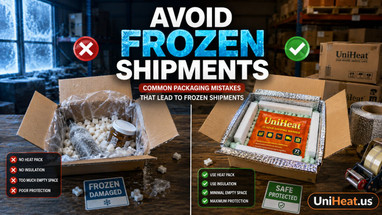
Frozen shipments are one of the most frustrating and costly problems in cold weather logistics. What makes it worse is that in most cases, the issue is not extreme weather—it’s packaging mistakes.
In this guide, we break down the most common packaging mistakes that lead to frozen shipments and how to avoid them using better planning, proper insulation, and reliable UniHeat heat packs.
Mistake #1: Assuming the Box Provides Enough Protection
One of the most overlooked mistakes is believing that a standard cardboard box offers any real protection against cold temperatures.
In reality, cardboard provides almost no insulation. It simply holds the product—it does not regulate temperature.
This assumption often leads businesses to skip additional protective layers, leaving shipments fully exposed to freezing conditions.
A cardboard box slows down nothing. Cold air moves through it quickly.
Without insulation or a heat source, the internal temperature of a package quickly matches the external environment.
Mistake #2: Using No Heat Pack at All
This sounds obvious… but it still happens more often than expected.
Some businesses rely entirely on insulation, assuming it will “hold in warmth.” But insulation cannot create heat—it only slows heat loss.
Without an active heat source, shipments in freezing conditions will eventually reach freezing temperatures.
Using the right heat pack makes a significant difference:
- 40 Hour Heat Pack Uniheat for short deliveries
- 72 Hour Heat Pack Uniheat for standard shipments
- 96 Hour Heat Pack Uniheat for long or uncertain routes
Skipping heat packs entirely is one of the fastest ways to guarantee failure.
Mistake #3: Choosing the Wrong Heat Pack Duration
Even when heat packs are used, choosing the wrong duration creates problems.
A common mistake is selecting heat packs based on expected transit time instead of worst-case scenarios.
For example, a 2-day shipment may seem safe with a 40-hour pack. But if a delay occurs, protection runs out.
That gap—sometimes just a few hours—is enough for freezing damage to occur.
It’s usually safer to slightly overestimate rather than underestimate.
Mistake #4: Ignoring Insulation Inside the Box
Heat packs alone are not enough.
Without insulation, heat dissipates quickly, especially in freezing conditions or during long transit times.
Insulation helps retain heat and creates a stable internal environment.
- Thermal liners
- Foam inserts
- Insulated bubble wrap
- Double-walled boxes
Skipping insulation reduces the effectiveness of even the best heat packs.
Mistake #5: Poor Heat Pack Placement
Placement matters more than most people realize.
Heat rises, so placing heat packs at the bottom of the box limits their ability to warm the contents.
Another mistake is placing heat packs directly against products, which can cause uneven heating.
Place heat packs near the top and separate them from products using padding.
Small adjustments in placement can significantly improve results.
Mistake #6: Leaving Too Much Empty Space
Empty space inside a package allows cold air to circulate freely.
This reduces the effectiveness of both heat packs and insulation.
A tightly packed box helps maintain a more stable temperature.
Using fillers or inserts to reduce air gaps can improve thermal performance.
Mistake #7: Shipping Late in the Week
This mistake isn’t about packaging directly… but it has a huge impact.
Shipments sent late in the week may sit in unheated warehouses over the weekend.
This extended exposure increases the risk of freezing.
Shipping earlier in the week reduces this risk significantly.
Mistake #8: Underestimating Cold Exposure Time
Many shipments spend more time outside controlled environments than expected.
Sorting facilities, delivery trucks, and loading docks are rarely temperature-controlled.
This means packages may be exposed to cold for hours—or even days.
Planning only for transit time ignores these hidden risks.
Mistake #9: Not Testing Packaging Methods
Some businesses assume their packaging works without testing it.
But real-world conditions can be unpredictable.
Testing different packaging combinations helps identify weaknesses before they cause damage.
Even simple tests can reveal major improvements.
Mistake #10: Treating All Shipments the Same
Not all products require the same level of protection.
Highly sensitive items need more heat and insulation than less sensitive ones.
Using a one-size-fits-all approach often leads to unnecessary losses.
Tailoring packaging to the product improves results significantly.
How to Prevent Frozen Shipments
Avoiding these mistakes comes down to preparation and consistency.
- Use the correct heat pack duration
- Always include insulation
- Pack tightly with minimal air gaps
- Position heat packs correctly
- Plan for delays and exposure
These steps may seem simple… but together, they create a much more reliable shipping system.
Frequently Asked Questions
What is the main cause of frozen shipments?
Poor packaging choices, especially lack of heat packs or insulation.
Are heat packs enough on their own?
No, they must be combined with insulation for best results.
How can I reduce shipping failures?
Use proper packaging methods, correct heat pack duration, and plan for delays.
Does box size affect temperature control?
Yes, larger empty spaces reduce heat retention.
Summary: Most frozen shipments are caused by avoidable packaging mistakes. By choosing the right heat packs, using proper insulation, and improving packing methods, businesses can significantly reduce risk and protect their products.